

This week's edition is a short one as I am taking some time off. But there is still something to celebrate, plenty to read, and a good investor letter to unpack.
🎉 Guru Gems is closing in on 500 subscribers: I’m giving away prizes!
📚 Summer reading: the most popular posts from the Guru Gems archive
📬 A quick review of Giverny Capital Asset Management's Q2 letter
🎉 Almost 500 of You

When I published the first Guru Gems issue back in April 2025, I would have been delighted with 100 readers. We’re now closing in on 500 subscribers (1150 followers on Substack!), and I’d like to celebrate that properly.
3 winners will each get their pick of a one-month paid subscription to Michael Burry, DeepValue Capital, or Jimmy Investor — three high-quality Substacks that share the most readers with Guru Gems.
How to win (between now and subscriber #503, or 15 August at the latest):
🏆 Existing subscribers: the 2 readers with the most referrals win. Get your personal referral link here: gurugems.org/leaderboard
🎲 New subscribers: everyone who subscribes before we hit #503 is entered into a random draw for the third prize.
Winners choose which of the three publications they’d like.
New here? Guru Gems studies the world’s best investors and applies their lessons to two real-money portfolios.
Why 503? It’s a nice prime number. The physics nerd in me occasionally leaks out :)
📚 Summer Reading

August is usually a good time of the year to catch up on some reading. Here are the posts I’d point you to, especially if you’ve joined recently and are wondering where to start.
My 3 most popular Guru deep-dives
Norbert Lou — The Punch Card Mindset: why less is more, and how focus drives extraordinary returns. Also where the idea for the PayPal position started.
Dev Kantesaria & The Valley Forge Way: extreme concentration, a medical doctor’s temperament, and FICO as the ultimate toll booth.
Sir Chris Hohn & The TCI Way: fortress businesses, and why S&P Global sits in two of the world’s most disciplined portfolios.
My 3 favorite Gurus
Bryan Lawrence & The Lawrence Method and, one year later, The Lawrence Method Revisited: six questions, being wrong 30% of the time, and a beaten-down software name.
Timeless Lessons from François Rochon: the Rule of 3, the Podium of Errors and The Giverny Way: 32 years of compounding with patience, humility and rationality
A Hidden Master: Marc Werres & The Hinde Way: seven positions, two years without a new idea, and one of the best letters almost nobody reads.
The quarterly Guru portfolio updates
Every quarter I go through the 13F filings of the most interesting Gurus and try to separate signal from noise. Here’s the most recent one: What Gurus are buying and selling — Q1 2026.
The Q2 update will land in two weeks.
And if you still want more to read…
…check out the full Guru Gems Archive:

→ If you enjoy this newsletter, please subscribe and like this post 🤍
→ If you find value here, consider buying me a virtual coffee ☕
📬 A Good Letter: Giverny Capital Asset Management, Q2 2026
Regular readers know I always enjoy a good investor letter. I wrote about my three favourites a while ago:

David Poppe’s quarterly letter is certainly also one I always look forward to.
Quick context: Giverny Capital Asset Management (GCAM) is David Poppe’s New York firm, run in partnership with François Rochon’s Giverny Capital. Poppe previously ran Ruane, Cunniff & Goldfarb, the firm behind the Sequoia Fund.
So his letters are written from deep inside the quality-compounding tradition.

Three takeaways from the Q2 letter:
1. 🗳 The market is voting, not weighing
Poppe reminds us of Graham’s famous line: in the short run the market is a voting machine, in the long run a weighing machine. Right now, he argues, the voter has some fairly extreme views.
The S&P 500 returned about 10.2% in the first half, and yet 210 stocks in the index were down, while roughly 200 beat the index return. A 40/60 split isn’t unusual. What is unusual is that two-thirds of the laggards trailed by more than 10 percentage points.
That dispersion would make sense if the earnings were concentrated in the winners, except they aren’t.
We own Index constituents such as Charles Schwab, JP Morgan, Mastercard and Progressive Corp. that continue to grow their earnings per share at healthy rates and in some cases at higher rates than usual, but whose stock prices are lagging.
Poppe also highlights Constellation Software, which kept compounding adjusted EPS and free cash flow per share at roughly 20%, while the stock dropped 21%.
The market speculates that CSU’s earnings may grow in the near term, but over time Artificial Intelligence (AI) applications are going to enable lower-cost competitors to enter the business.
All of this is to say, we’re out of sync with the Index and we’re not inclined to change course. I believe we own high quality earnings compounders that will benefit from implementing AI capabilities and are likely to maintain their dominant competitive positions. We’re generating a good return, but I think our companies overall are performing better than their stock prices would indicate.
2. ⚡ Momentum has taken over
Poppe highlights a very interesting chart in his letter which counts the number of days per year the US Momentum Index moves up or down by at least 1.5%.
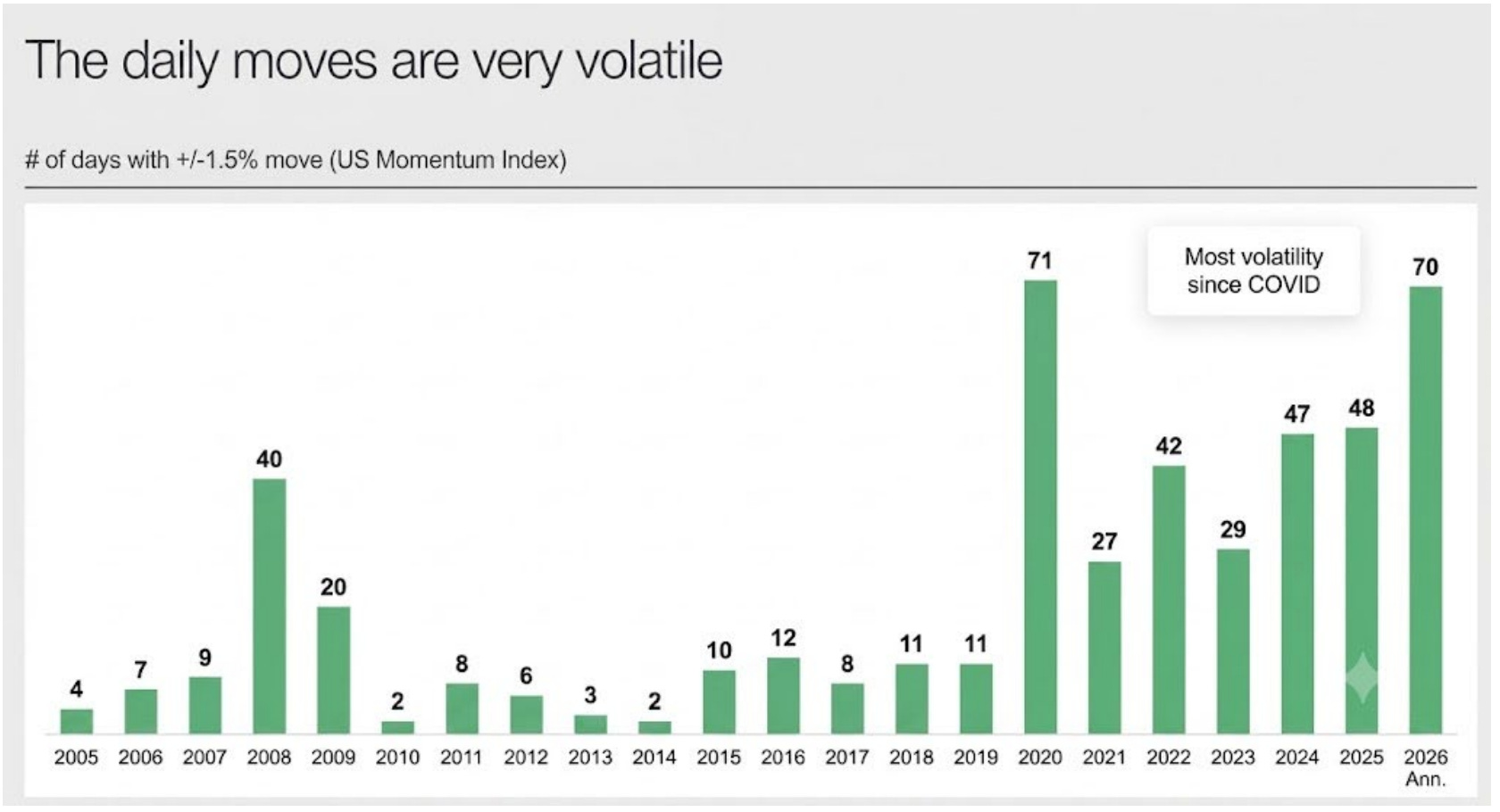
A decade ago: roughly 10 days a year. In 2020: 71. Annualised for 2026: 70, the most volatile since COVID.
Poppe writes that the market over the past few years increasingly has become skewed to chasing momentum and believes this is driven by “a push and pull between fear of missing out on a revolutionary technological advance and of being wiped out if the advance ends up delivering disappointing financial returns.”
He illustrates what that feels like from inside his portfolio: on a single day in May, one GCAM holding (AAON) reported strong earnings and rose 31%, while another (Installed Building Products) reported mildly disappointing earnings and fell 28%.
3. 🚀 Betting on moonshots
On the bubble question, Poppe sees some red flags, but also acknowledges that “Corporate America is remarkably efficient, with profit margins and returns on capital far higher than they were a generation ago”
The market is strong for good reasons, yet this feels like a moment where people are betting on moonshots.
The moonshots may well happen. But what if they don’t happen soon? In the meantime, some very good companies are being left on the floor.
He flags a risk we’ve also heard from Paul Tudor Jones, Seth Klarman, and David Rolfe at Wedgewood: the equity supply/demand balance is about to change drastically:
Massive IPOs either completed or on tap from AI darlings like Space Exploration Technologies, Open AI and Anthropic, plus chunky secondary stock and/or debt offerings from Alphabet, Amazon, Nvidia, Oracle and others may eventually drain what has been a very deep pool of investor liquidity.
📊 GCAM Portfolio Activity
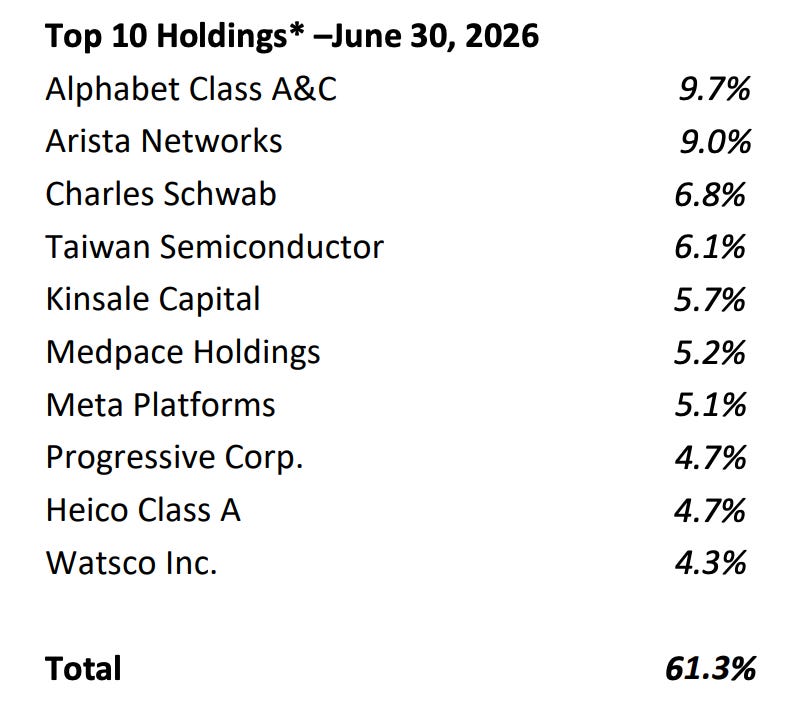
Alphabet (the ultimate Guru Gem) and Arista Networks are GCAM’s largest positions, even after trimming both 20% and 17% respectively. Both positions were in the top 5 contributors to performance over the first half of the year:
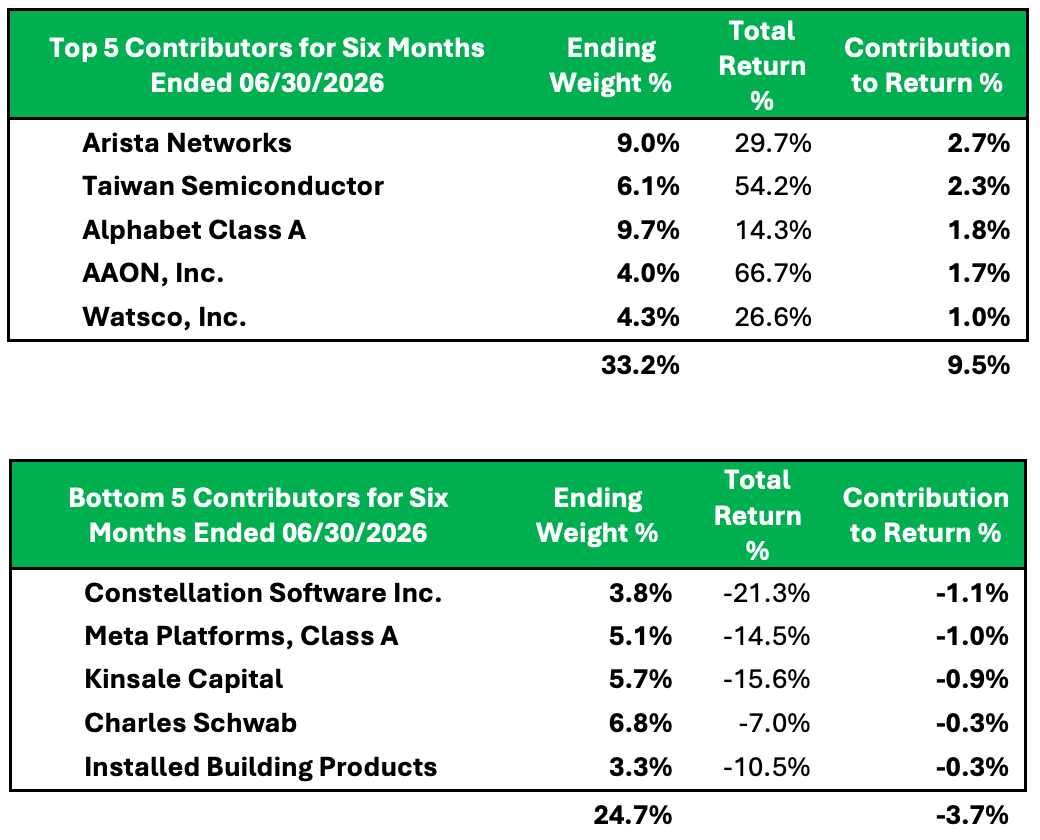
My two cents on the best and worst contributors is that our top five are terrific, have run up a lot this year and now are expensive. Our bottom five are terrific, unpopular with Mr. Market and, as a result, are attractively priced.
They used the proceeds of the Arista and Alphabet sales to add to their financial stocks:
Charles Schwab ($92 and $85), Kinsale Capital (mid-$330s), TWFG (~$19) and Progressive ($205)
🔮 Next week
I’m doing a lot of reading during my break, partly for pleasure, and partly to finish a Guru deep-dive I’ve been working on for a while: Seth Klarman.
I finally managed to get my hands on a copy of Klarman’s iconic ‘Margin of Safety’, so this will hopefully be a nice add to the research I’ve already conducted.
Stay tuned!