

In today’s update:
💎 Guru Gems Portfolio — a mid-year look in the mirror
🔍 Alphabet’s phenomenal, historic, confusing quarter
📝 A quick word on⚕️ Baxter and 💸 PayPal
📜 Wedgewood Partners: Are Hyperscalers still Magnificent?
Start here if you are new to Guru Gems.
2-minute AI summary of today’s post:
💎 The Guru Gems Portfolio at Mid-Year
As I have written before, I’m all about transparency with Guru Gems, even when the numbers aren’t pretty.
The Guru Gems portfolio is up just 2.2% since inception (Apr 2025). Not exactly a wonderful result, and it stings even more considering my biggest position, Alphabet, is up 102% since purchase.
Three names carry most of the blame:
CCC Intelligent Solutions (CCC, −33%) and Constellation Software (CSU, −32%) remain caught in the SaaSpocalypse, the market’s conviction that AI will let anyone rebuild established software.
Copart (CPRT, −25%) is deeply out of favor, mostly driven by slowing revenue growth over the last several quarters. The shares are now down more than 50% from their peak, the largest drawdown in over 20 years. But as I argued in my recent Warning Signs post, the fundamentals seem to tell a different story. I still believe Copart is a wide-moat compounder working through cyclical challenges.
The Guru Gems portfolio performance stands in sharp contrast to the more ‘mechanical’ approach of my Magic Formula portfolio, which is up 16% since inception and 12% YTD, four percentage points ahead of the S&P 500’s 8%.
With high quality stocks underperformance currently at 1999 extremes (there is an interesting chart on this in Wedgewood’s latest letter; more on that further down this post), it’s too early to throw in the towel and give up on my Guru Gems portfolio.
So keeping François Rochon and Bryan Lawrence’s ‘rule of 3’ in mind, I’m giving myself another 2-3 years to see if I can do better.
👉 Full Guru Gems portfolio and all transactions are available in my Guru Master Google Doc.
🔍 Alphabet: A Phenomenal, Historic, Confusing Quarter
Alphabet released Q2 earnings this week, and since it is still my largest position, it deserves a closer look.
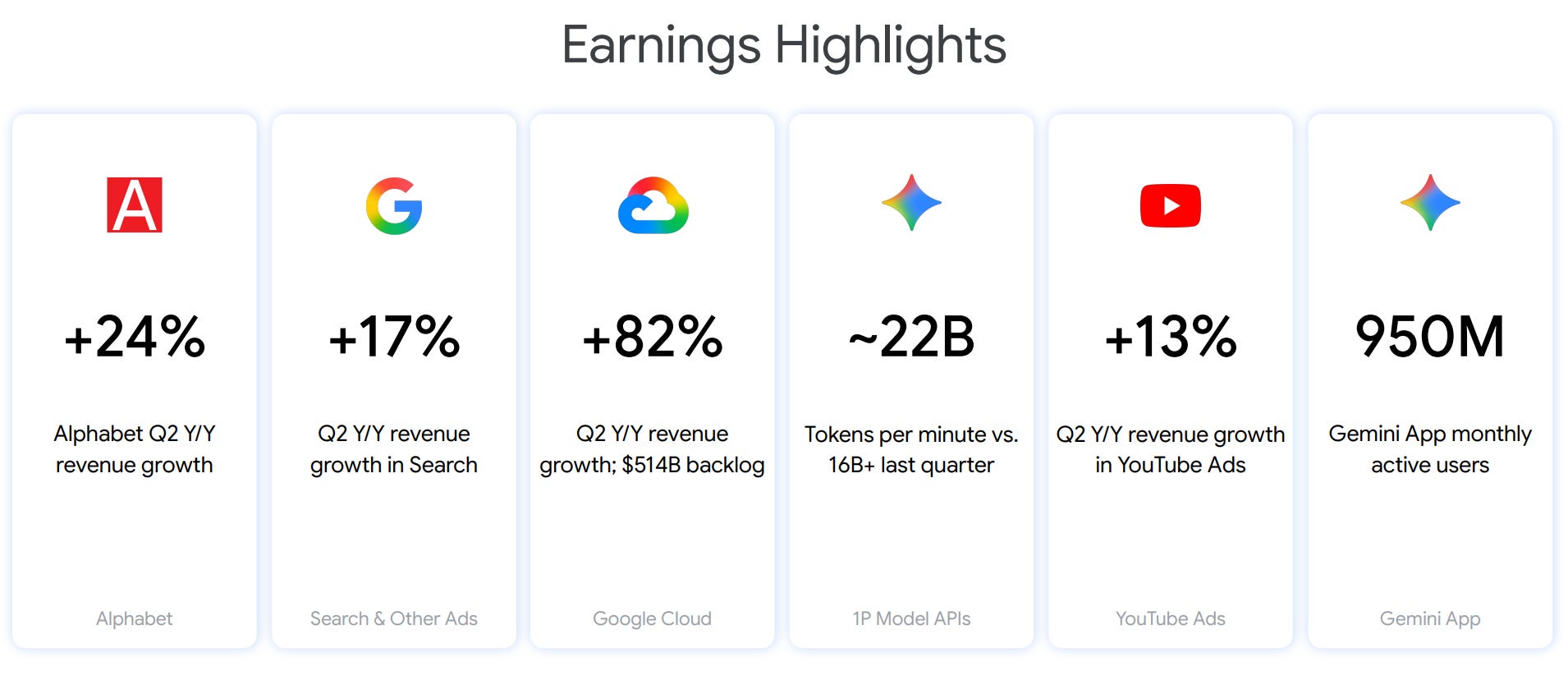
On the surface, the numbers look phenomenal:
The good:
Revenue grew 24% to $119.8B: remarkable acceleration for a company this size. Search & other grew 17%, YouTube ads 13%.
Google Cloud grew 82% (!!) to $24.8B, with operating margin jumping from 20.7% to 35.6% and backlog reaching $514 billion.
Operating income grew 30%, faster than revenue; Alphabet keeps getting more profitable while investing heavily.
The AI flywheel is spinning: the Gemini app reached 950 million monthly active users, and Alphabet’s model APIs now process ~22 billion tokens per minute, up from 16 billion just last quarter.
The bad (or at least, the expensive):
Capital expenditures hit $44.9 billion in a single quarter, double of last year’s Q2, and management raised full-year capex guidance to $195–205 billion, with 2027 expected to be significantly higher again.
As a consequence, for the first time in its history as a public company, Alphabet reported negative free cash flow: −$5.9 billion for the quarter.
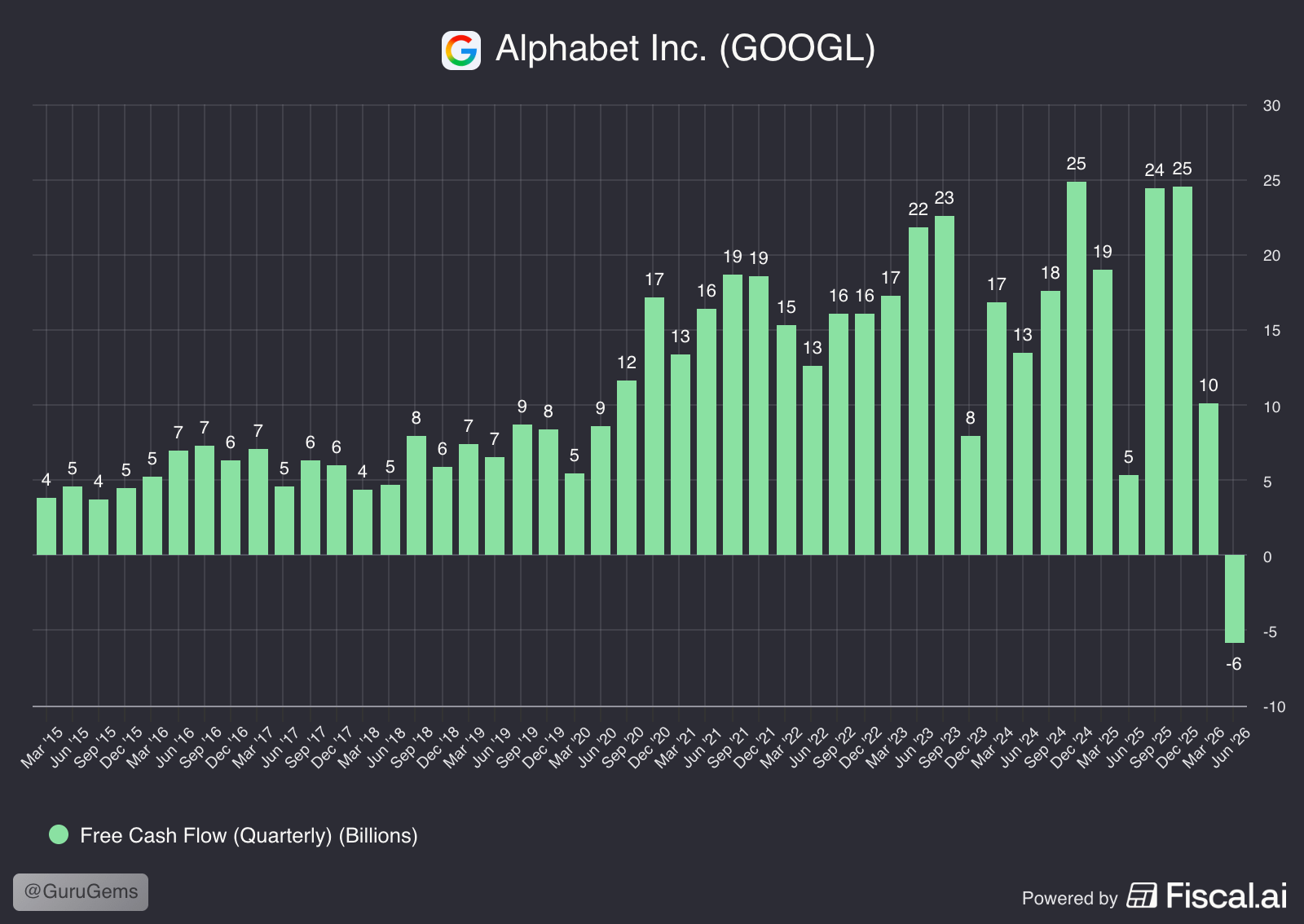
To fund its massive AI infrastructure push, Alphabet raised $49.6 billion of equity in June: a $20.5B public offering of common stock, a $10B private placement to Berkshire Hathaway, and $19.1B of 6.25% mandatory convertible preferred stock. This is on top of ~$56B of new debt in the first half. It also put a $40B at-the-market program in place (unused so far, and earmarked primarily to cover taxes on employee stock grants). Meanwhile, share buybacks have stopped entirely: zero in H1 2026, versus $28 billion in H1 2025.
One more thing to keep in mind when seeing headlines about net income tripling: reported EPS of $9.11 (+294%) was inflated by a $99 billion mark-up of Alphabet’s equity investments, mostly its SpaceX stake. Strip that out, and the operating story is (only!) a 30% profit grower.
Alphabet is probably one of the most covered stocks on the planet, so rather than pretending I can add much new analysis, let me share some of the more interesting perspectives I came across this week:
A good summary of the Q2 results by SixSigmaCapital: Alphabet Inc. Earnings Update
A very comprehensive deep dive on Alphabet by Ozeco and how Alphabet is the only company paid at every layer of the token economy
A much more bearish view by Tae Kim who expects Alphabet shares to fall much further than they already have this week
One element that seems underreported: Alphabet’s equity issuance, and how it may be contributing to the current negative sentiment. Here is an interesting chart from Jeff Weniger

Finally, an interesting take arguing Google’s search revenue growth is partly artificial and damaging for Google long term: Max Anderson on X
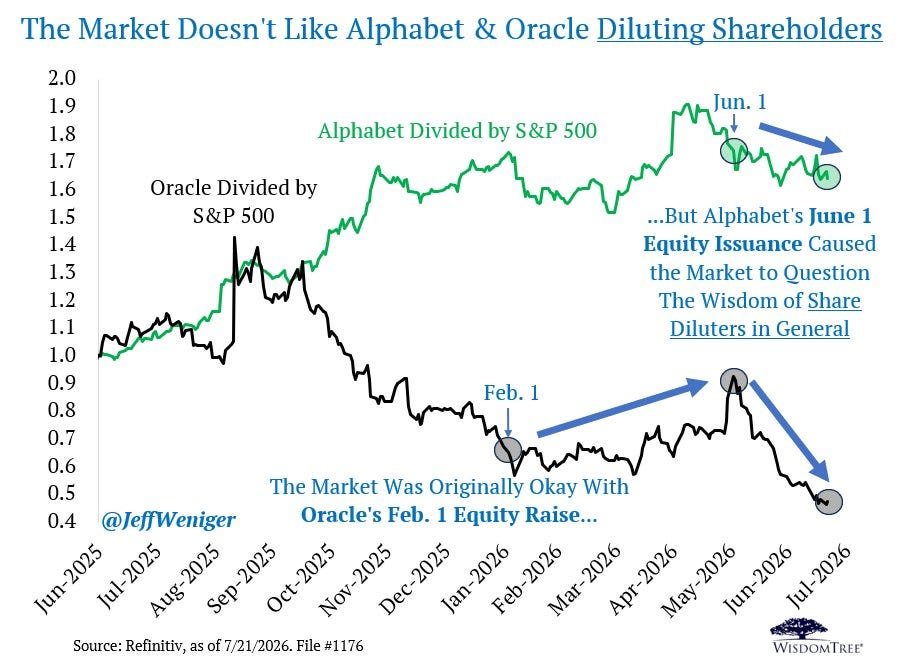
The market’s verdict, for what it’s worth: the stock fell about 7% the day after earnings and nearly erased all of its YTD returns. Over the past year the stock is still up 64% though…
As I shared in my Q1 13F update post, I trimmed my Alphabet position a bit in May at $395. Other than this small trim, I am keeping the position unchanged for now.
→ If you enjoy this newsletter, please subscribe and like this post 🤍
→ If you find value here, consider buying me a virtual coffee ☕
⚕️ A Quick Word on Baxter (BAX)
Last week I re-examined the Baxter thesis and landed on "holding, not adding".
The next test comes quickly: Baxter reports Q2 earnings this Thursday, July 30. I'll be watching the three indicators I laid out last week: operating-margin progress toward the 13–14% guide, any timeline on lifting the Novum pump hold, and progress toward the 3.0x leverage target.

I’ll share a Note with my thoughts on Thursday or Friday, so make sure to subscribe/follow on Substack if you haven’t already (for all email-only subscribers, consider downloading the Substack app as this is where I share additional notes or interesting articles).
💸 A Quick Word on PayPal (PYPL)
Until last week, PayPal was also among the worst performers in the portfolio. That changed on July 15 when PayPal received a joint $53 billion takeover proposal ($60.50 per share) from Stripe and Advent International. The shares jumped ~17% on the news and have come back closer to my average purchase price of $59.9.
PayPal’s board of directors rejected the offer, signalling that the offer significantly undervalues the company.
I am not selling (yet) and will be watching closely how this further develops. PayPal is also releasing Q2 earnings this coming week, so it will be interesting to hear management’s outlook and any new comments on the takeover interest.
📜 Wedgewood Partners: Are Hyperscalers Still Magnificent?
The final piece this week: Wedgewood Partners’ Q2 letter, which connects nicely to the Alphabet story above.

I always enjoy reading Wedgewood’s Client Letters and I highlighted them as one of the picks in my 3 Favorite Investor Letters back in January.

Magnificent
Their latest letter contains a section titled “Are Hyperscalers Still Magnificent?”
Their answer: “We certainly think so, and have increased our weightings accordingly.”
A few interesting takeaways from the letter:
1/ The market is funding the AI trade by selling the hyperscalers
Wedgewood identifies three headwinds: negative sentiment around capex crushing profitability, billions rotating out of hyperscalers into semiconductor and memory stocks (semis are now ~25% of the S&P 500, up from ~5% a few years ago), and IPO funding for SpaceX (and prospectively Anthropic and OpenAI) coming at the expense of hyperscaler shares.
2/ Reframing the capex debate
Rather than staring only at collapsing free cash flow (see Alphabet above), Wedgewood looks at returns on the growing asset base:
“We think Alphabet is an exceedingly rare, if not entirely unique, business, growing a nearly $450 billion gross asset base by 40% while maintaining a 30% return on that massive asset base.”
They also make a point I haven’t seen anywhere else: the hyperscalers’ investment portfolios act as a hedge on their own capex inflation. Alphabet’s ~$150 billion of (unrealized) gains on SpaceX and its 14% Anthropic stake could effectively cover years of incremental memory-driven capex costs. Meta’s AMD warrants (~$90B by Wedgewood’s estimate) play the same role. The market ignores these “one-time” gains; Wedgewood argues they are an overlooked shock absorber.
3/ It's the second derivative that matters
Wedgewood has owned semiconductor stocks for decades (”we have the scars to prove it”), and their explanation of how cyclical top traps are set is worth reading:
“Memory company earnings will surely grow over the next few years, at least until demand cools and/or supply shortages wane. However, and this is key, it only takes a modest cooling in current red-hot demand or a modest easing of the significant supply shortage for these stocks to drop as suddenly as they have risen because expectations reverse; earnings expectations will always be too high once growth-rate deceleration kicks in. It is the second derivative change in the rate of growth that matters. This is how cyclical top traps are set. The market always sniffs out a peak in earnings growth acceleration well before the cycle turns. Again, it matters little if earnings continue to grow; the stocks lead fundamental results, often by years.”
If that sounds familiar, it’s essentially the same message Rich Pzena delivered in last week’s issue: today’s memory earnings are a cyclical peak, not a plateau.
4/ And finally: Zoetis, not so magnificent anymore
Wedgewood sold their entire Zoetis position this quarter. There is no explanation why and this seems like a strange move, as not long ago, they highlighted Zoetis as a high-quality business finally on discount:
“We believe that, over the long term, reality tends to win; high-quality businesses earn the valuations they deserve at some point and will outperform the broad market. We believe we have been given the opportunity to do this with Zoetis now.”
That makes two disciplined quality investors (Terry Smith at Fundsmith and David Rolfe at Wedgewood) who built Zoetis positions in early 2025 and have now walked away. (Smith did offer an explanation in his half-year letter: he pointed to management’s failure to respond to new generic competition, or to communicate clearly about it.)
Not everyone is heading for the exit, though. Michael Burry started buying in May, after the stock dropped further on a guidance cut. He believes the company is very well run, with strong capital allocation and conservative financing, in his words, a “fat pitch” that requires patience.
I made similar points in my May update when I added Zoetis to the portfolio, in addition to the exposure it gives to a powerful secular tailwind: the growing global animal health market.

That thesis hasn’t changed since May, so I’m happy to keep holding.
That’s it for this week…thanks for reading and I’ll be back next week.