

Welcome back!
Last month I launched a new series within Guru Gems: Physics for Investors.
In the first issue, I covered the second law of thermodynamics and the idea that businesses, like cups of hot coffee, naturally cool toward equilibrium unless work is done to hold them apart from it.

Today’s issue builds on that first one.
If the natural tendency of every business is to decay toward the cost of capital, then how do we explain the few businesses that seem to do the opposite? The ones that do not resist decay, but actually get stronger the bigger they get? Amazon, Visa, Alphabet…
These businesses are governed by a different principle which I will cover in more detail below.
2 minute AI audio version of today’s update:
New to Guru Gems? Start here
🎤 Why Microphones Scream
Picture a microphone held too close to a loudspeaker. A faint sound is picked up by the microphone, amplified, and pushed out through the speaker, now louder. That louder sound is picked up again, amplified, pushed out and so on… Within a second or two, the whole room is filled with a sharp, uncomfortable noise (a ‘screech’).
What you have heard is the result of a positive feedback loop.
Feedback is a fundamental concept in control theory and comes in two flavours:
Negative feedback is self-correcting. A classic example is a thermostat: the room gets too warm, the thermostat switches the heating off, the room cools back to the set point. Any deviation triggers a force that pushes the system back toward equilibrium.
As I explained in last month’s post, negative feedback is the reason most businesses drift back toward average returns. Competition is a negative feedback loop. It punishes success and erodes excess profit, always nudging the system back toward equilibrium.
Positive feedback is the opposite. Instead of counteracting a change, it amplifies it. A produces more of B, which produces more of A, which produces more of B again. The microphone screech is positive feedback. Or a snowball rolling downhill, gathering mass and speed as it goes. Each turn of the loop strengthens the next.
I will show later that the same concept applies to businesses: A negative feedback business fights just to stand still. A positive feedback business compounds.
One important thing to note is that positive feedback loops are almost always self-limiting. The microphone screech stops when the amplifier maxes out. The snowball stops at the bottom of the hill. Nothing compounds forever, because every loop eventually runs into a constraint: a saturated market, a physical limit, a competitor, a regulator…
⚙️ The First Feedback Machine
Last month’s Physics guru was James Clerk Maxwell. In 1868 Maxwell wrote a short paper titled “On Governors.”
A “governor” was the spinning-ball device that James Watt had attached to steam engines decades earlier to stop them running away with themselves: as the engine sped up, two weighted balls swung outward, closing a steam valve and slowing the engine back down. It’s the textbook example of negative feedback: a machine using its own deviation from a target to correct itself.
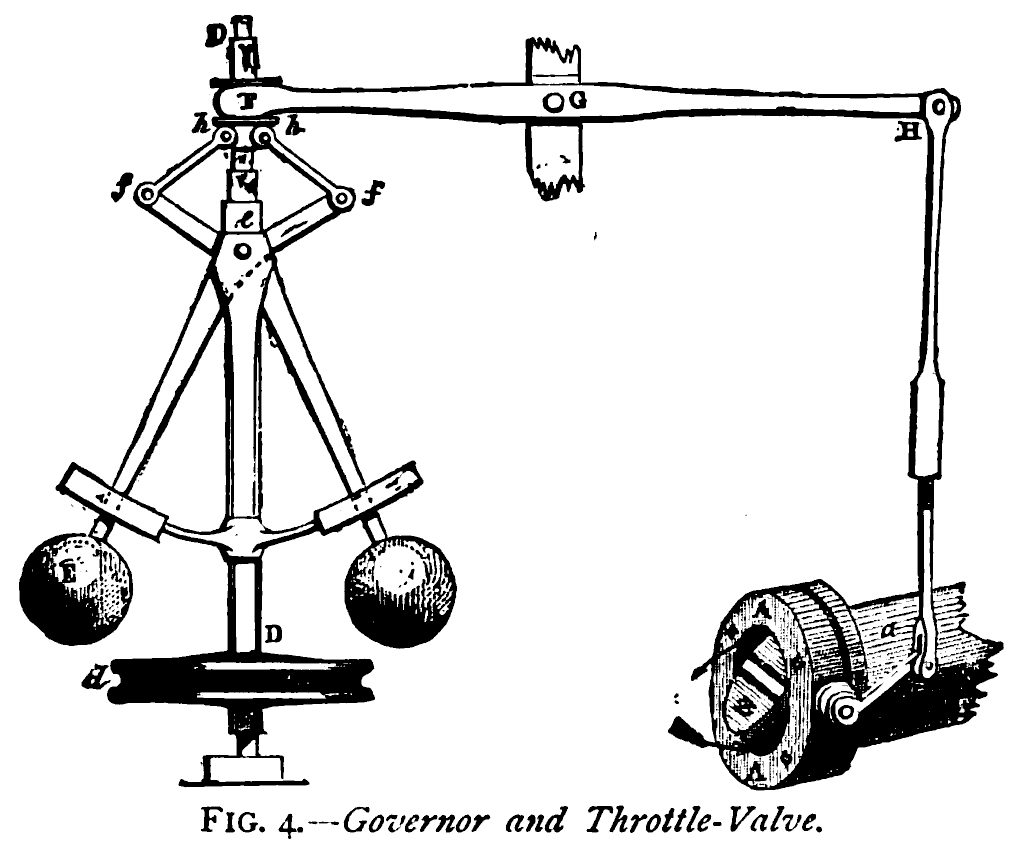
Maxwell was the first to analyze the mathematics of why such a device stays stable rather than oscillating wildly, and his paper is now regarded as the first significant paper on control theory. It was so dense and barely illustrated however, that it was almost entirely overlooked for eighty years.
The person who rediscovered it, and recognised its importance, was the guru of this month’s issue: Norbert Wiener. When Wiener built the science of feedback in 1948, he reached back to Maxwell’s forgotten paper as a foundation, and even borrowed his new field’s name from it. “Governor” comes, via Latin, from the Greek word kybernetes (χυβερνήτης), meaning “steersman.” Wiener took the same Greek root and coined the word cybernetics.
So the man who taught us about entropy also planted the seed of the science of feedback, which the man we are about to meet grew into a field.
If you enjoy this newsletter, please help others discover it by clicking 🤍
🧔🏼♂️ The Guru: Norbert Wiener (1894-1964) - The Father of Feedback
Norbert Wiener was a child prodigy. He graduated from Tufts with a degree in mathematics at 14, briefly tried graduate study in zoology at Harvard (he gave it up after discovering he was hopeless at lab work), and completed a PhD at Harvard at 19, on mathematical logic.
He then studied in England under Bertrand Russell and in Germany under David Hilbert, two of the greatest mathematical minds of that time. In 1919 he joined MIT, where he would remain for the rest of his career.
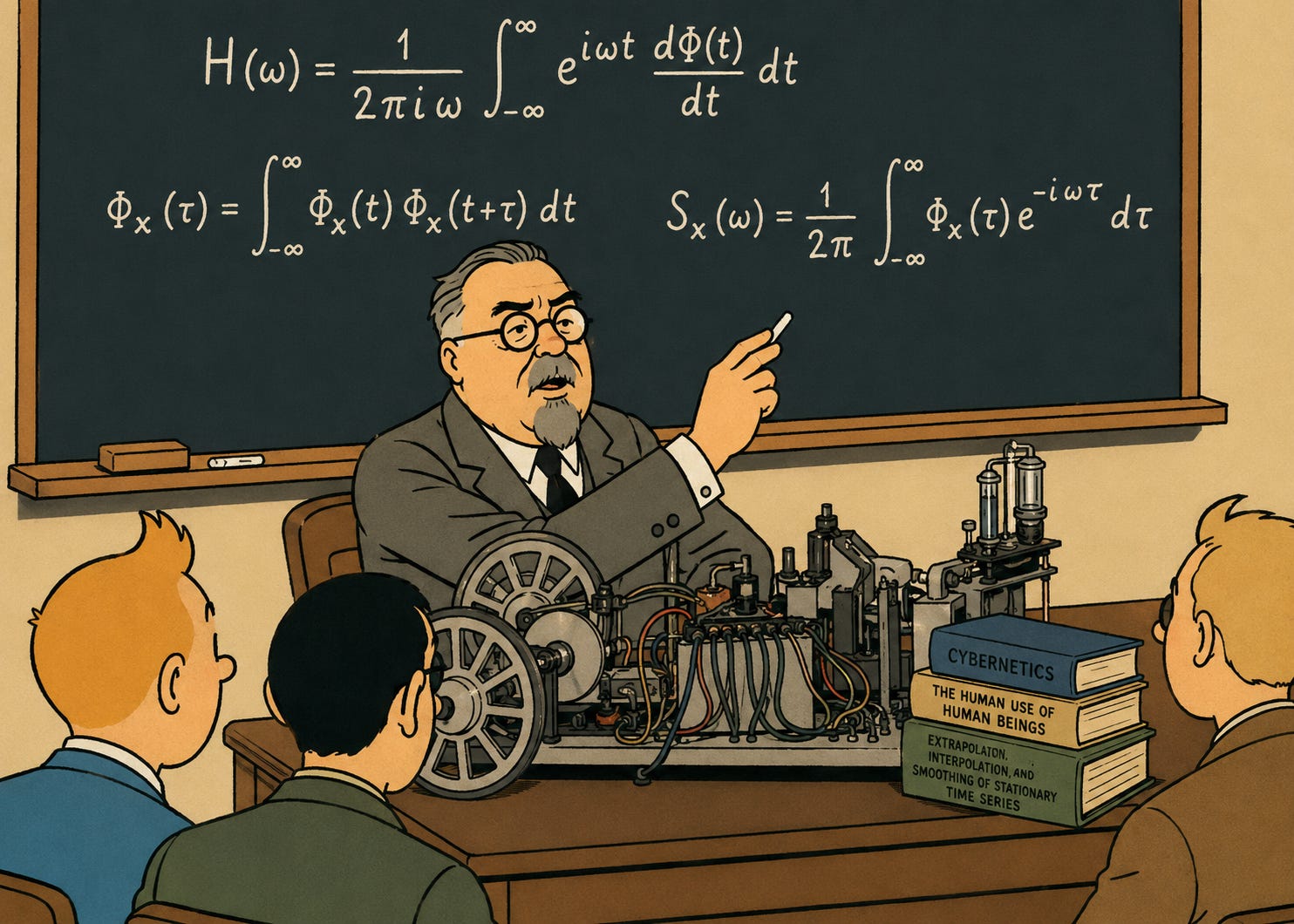
Although Wiener is usually described as a mathematician, his most important early work sat on the border of mathematics and physics: Brownian motion, the random movement of tiny particles suspended in a fluid.
Brownian motion (sometimes referred to as a ‘Random Walk’ process) was first explained by Einstein in 1905, in one of the four ‘Annus Mirabilis’ papers he published that year). Einstein provided the first hard evidence that atoms and molecules actually exist.

15 years later, Wiener built on Einstein’s work and developed the mathematics that define the process. To this day, the process is called the Wiener process in his honour, and is denoted as Wt.
In 1948, Wiener wrote his most popular and influential book ‘Cybernetics: Or Control and Communication in the Animal and the Machine’ and coined the term cybernetics to describe the study of control and communication in machines and living beings. Wiener realized that “almost all complex systems are driven by feedback loops of information”.
For Wiener, a system becomes “intelligent” if it uses past outputs (feedback) to improve future behavior. His work showed that whether in a thermostat or the human brain, feedback loops allow a system to adjust its actions based on results.
Wiener’s book formally established how feedback stabilizes or destabilizes systems. As he noted, no one before had fully recognized how feedback and information processing keep systems stable. In doing so, Wiener bridged engineering and biology, influencing later fields like systems theory and AI.
📖 For more on Wiener's life and his line from cybernetics to modern AI, Max Planck Neuroscience has a short, accessible piece: From Cybernetics to AI: the pioneering work of Norbert Wiener. Britannica's biography is also excellent.
🌀 The Engines of Compounding
Wiener’s great insight was that you can understand a complex system by asking a simple question: what are its feedback loops, and which way do they run?
Applying that same question to a business can help us to identify compounders.
Most businesses are dominated by negative feedback. Grow too fast and you attract competitors. Get too big in one market and you saturate it. Raise prices too far and customers leave. These are all corrective forces (the competitive equivalent of Maxwell’s steam-engine ‘governor’), and they are why, as we saw last month, the typical business regresses toward the cost of capital over time.
Few businesses are dominated by positive feedback. For these companies, each unit of success makes the next one easier, not harder. Size becomes an advantage rather than a burden. These are the great compounders, and almost all of them run on one of four engines:
1/ Network effects
Each new user makes the product more valuable to every other user.
Visa is a textbook case: The more consumers carry Visa cards, the more merchants must accept them; the more merchants accept them, the more consumers want them. The network feeds itself.
Uber, which I wrote about through Bill Ackman’s lens, is based on the same idea: more drivers mean shorter wait times, which attract more riders, which in turn attract more drivers.
Mastercard and MercadoLibre, both on my watchlist, run on versions of the same loop.
2/ Scale economies
As a business grows, its cost per unit falls, letting it lower prices, which wins more volume, which lowers costs further.
This is the engine of Amazon and Costco for example. Wise, a cross-border payments company and a newer name I have started studying in more detail, also has this engine (more on Wise below).
The investors Nick Sleep and Qais Zakaria gave this model the memorable name “scale economies shared”. Jeff Bezos famously popularised the same idea as the “flywheel”, which is simply positive feedback drawn as a circle.
3/ Data and learning loops
More usage generates more data, which improves the product, which attracts more usage.
This is Google’s search advantage, and increasingly the engine of every serious AI business. The system gets smarter the more it is used.
4/ Brand and reputation flywheels
Success builds trust, trust builds more success.
Think of the credit-rating duopoly of S&P Global and Moody’s, or the slow-compounding prestige of a luxury house. Reputation, once earned at scale, becomes very hard for a newcomer to replicate.
These four engines nicely connect back to last month’s post. A positive feedback business is one whose compressor gets cheaper to run as the business grows. The network, the scale, the data, the brand: each does work of holding back competition with every passing year. That is why these businesses are so extraordinarily valuable, and so rare.
💳 WISE: A Scale Economies Case Study
Wise (formerly TransferWise) illustrates a powerful scale-driven feedback loop.
Wise built a global payments network enabling low-cost cross-border transfers.
The more money customers move through Wise, the lower its cost per transaction becomes, and rather than pocketing the savings, Wise passes them back as lower fees, which attracts still more volume.
This is a textbook positive feedback loop.
By FY2025 Wise was processing over $185 billion in annual transactions for about 15.6 million people and businesses.
I have a personal connection with Wise. I have been an expat for more than a decade and have used Wise for most of that time either to transfer money between international accounts, or to pay for things while travelling.
For years I was a happy customer without ever thinking of it as an investment. Only recently, when Wise came in the news quite a bit after shifting its primary listing from London to New York, did I start looking at Wise through an investor's eyes.
Here are some excellent deep-dives on Wise worth reading:
The Pursuit of Compounding - Wise: The Real-Time Dismantling of Cross-Border Banking
Compound with René - Deep Dive: Wise Plc. – Betting on the Unexpected?!
✔️ Three questions to ask before owning a compounder
In the spirit of last month's issue, here are three feedback questions worth asking before owning a business:
1. Which way does the feedback run? Does growth in this business invite correction (negative feedback) or does it reinforce itself (positive feedback)? Does getting bigger make the company stronger, or does it simply invite competitors and diseconomies of scale?
2. What is the engine, and is it still turning? If there is a positive feedback loop, name it precisely: network, scale, data, or brand. Then ask whether it is still strengthening or beginning to mature. Remember that every loop is self-limiting. A network effect in a saturated market is a spent force, however powerful it once was.
3. What could break the loop? A positive feedback loop can turn negative if external conditions change. Could new regulations, competitors, or technology shifts weaken the loop? For example, a company’s social network might flourish until a tough privacy law emerges, or a market leader might lose its edge if the industry “heats up” with insurmountable competition. Investors should check whether the business’s feedback mechanism still holds in tomorrow’s environment or if it’s at risk of reversal.
Closing Thought: The Investor’s Job
Negative feedback is everywhere. It is the governor of the whole economy, always pulling the exceptional back toward the average. Every so often, however, a business builds a loop that compounds instead of corrects, and those loops are where the big winners are made.
But finding the loop is only half the work. Every loop is self-limiting; the snowball always reaches the bottom of the hill.
The investor’s real job is not just to spot a positive feedback loop, but to judge how much room it has left to run.
That’s it for this week!
I hope you enjoy these ‘Physics for Investors’ issues. Please give me feedback (pun intended) on how to make these even more interesting or what topics you would like to see covered.
If you enjoyed this post, I would really appreciate it if you could like or share it or leave a comment!
You can follow me on X @guru_gems and Substack @gurugems for more insights.
Until next week!
Thanks! Very good writing!
First class post, and thank you for mentioning my deep-dive analysis on Wise Group