

Welcome back!
This is the third issue of Physics for Investors, a Guru Gems series where I revive my old passion for physics and apply a single idea from that world to how we think about businesses and markets.
In Issue 1, I used the second law of thermodynamics to explain why most businesses decay toward the cost of capital. In Issue 2, feedback loops explained why a rare few businesses escape that decay and compound instead.


Today’s issue is about a third state every value investor knows well: the stock that is neither decaying nor compounding. A stock that is simply stuck.
I will try to answer two questions about these stocks.
First, what does it mean for a stock to be stuck, and how does a stock that is truly stuck (holding real value the market refuses to recognize) differ from one that only looks stuck?
Second, if nobody can predict when any single stock comes unstuck, how should we invest in them at all?
And of course there will be a Guru. Today I introduce you to none other than Ludwig Boltzmann, the man who bridged the gap between the invisible world of atoms and observable macroscopic properties like temperature and pressure.
“I adhered scrupulously to the precept of that brilliant theoretical physicist L. Boltzmann, according to whom matters of elegance ought to be left to the tailor and to the cobbler.”
— Albert Einstein in the preface of his book ‘Relativity: The Special and the General Theory’
2 minute AI audio version of today’s post:
New to Guru Gems? Start here
🧊 The water that refuses to freeze
Everyone knows water freezes at 0°C (32°F). Except that in reality, it often doesn’t.
High up in the atmosphere, clouds are full of liquid water droplets at minus 10, minus 20 degrees Celsius. Very pure water can stay liquid down to about minus 40°C (which, coincidentally, is the one temperature where Celsius and Fahrenheit agree).
You can try a version of this at home: leave a smooth bottle of purified water undisturbed in the freezer for a couple of hours, take it out gently, and it may still be liquid several degrees below its freezing point. Then give the bottle a sharp knock, and ice crystals will shoot through it in seconds.
Physicists call this state supercooled, and it is the classic example of a metastable state.
Here is a ‘cool’ video explaining the physics of supercooling:
So what is going on? Below 0°C, ice is the more stable arrangement, so the water “wants” to freeze. But the freezing has to start somewhere; a first tiny cluster of molecules must lock into a crystal seed before the rest can follow.
Forming that first seed briefly costs energy before it releases energy. There is a ‘barrier’ to get over, and physicists call the height of that barrier the activation energy.
So the supercooled water is not in its most stable state, and it is not going anywhere either. It can stay like that for hours, sometimes indefinitely, until something kicks it over the edge: a knock, a speck of dust, an ice crystal dropped in. That something is called a nucleation event.
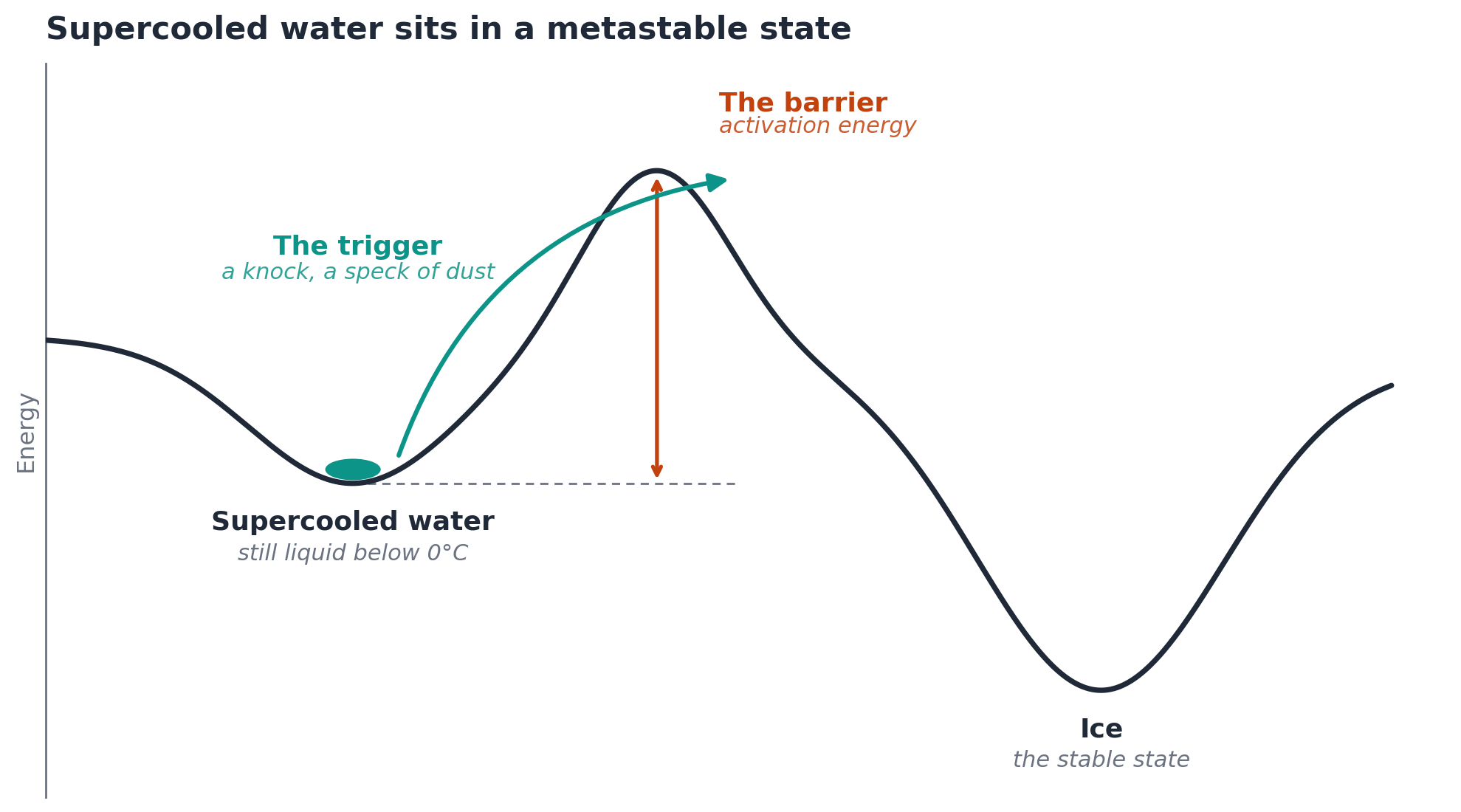
And when the transition finally comes, it can go fast. The bottle sits there doing nothing for hours, and then turns to slush in a few seconds..
Are you still following? :)
Let’s take a break from physics, and just keep these two ideas in mind: a barrier, and a trigger.
Now let’s talk about cheap stocks.
🪤 Supercooled stocks and value traps
Imagine a stock trading at $20 that you are convinced is worth $40.
If the stock is really worth $40, why is it still trading at $20? Why hasn’t the market corrected it already?
Metastability may suggest an answer: because there is a barrier. The pessimism is priced in, the sellers have already sold, everyone has accepted the narrative (“secular decline”, “uninvestable”, …), and nobody wants to be first. The market will not change its mind spontaneously. Something has to happen first.
Every value investor knows what this ‘something’ can look like: an earnings report that proves the pessimism wrong, or a new CEO, a product launch, a divestiture, an activist arriving, a cycle turning, a takeover bid. These are the market’s nucleation events.
Interestingly, the word used in finance for these events is the same word used in science: catalyst. In chemistry, a catalyst is defined as something that lowers the activation barrier without being consumed.
Is the stock stuck, or is it broken?
Before going further, I should point out where I think the physics analogy stops working.
When supercooled water gets its knock, it always freezes: thermodynamics defines which state is stable, so the destination is guaranteed.
A cheap stock doesn’t have such guarantee. While you sit there waiting for something to happen, the business itself can deteriorate. The share price stays at $20, but the $40 you thought it was worth erodes to $30, and then to $20.
So for every statistically cheap stock, there is really one question to answer: is it stuck, or is it broken?
A metastable bargain is stuck. The business is temporarily impaired, but its long-term economics remain intact. The normalized earnings power is still there. Something specific stands between today’s depressed state and a healthier future state, and that something can happen.
A value trap is broken. The business is deteriorating structurally. The ‘normalized’ earnings you are anchoring to no longer exist and there is no barrier to cross. It is just a business heading toward a permanently lower equilibrium. This is the decay I covered in Issue 1, now disguised as a stock that is stuck, and the disguise is why value traps fool so many investors: the price stands still while the value beneath it erodes, until one day the “cheapness” is gone without the price ever having moved.
Now let’s introduce our Guru.
If you enjoy this newsletter, please help others discover it by clicking 🤍
🧔🏼♂️ The Guru: Ludwig Boltzmann (1844–1906)
Boltzmann was born in Vienna in 1844 and spent his career on one big idea: that the visible properties of matter (temperature, pressure, entropy) are statistics over countless invisible molecules.
There is a nice connection with the 2 previous Gurus.
Issue 1's guru, James Clerk Maxwell, laid the foundations of the kinetic theory of gases, and Boltzmann picked up that work and carried it much further.
Issue 2 featured Einstein's 1905 Brownian motion paper, which Norbert Wiener later turned into mathematics. That same 1905 paper would settle a thirty-year debate about whether atoms exist at all, and Boltzmann stood at the center of that debate.
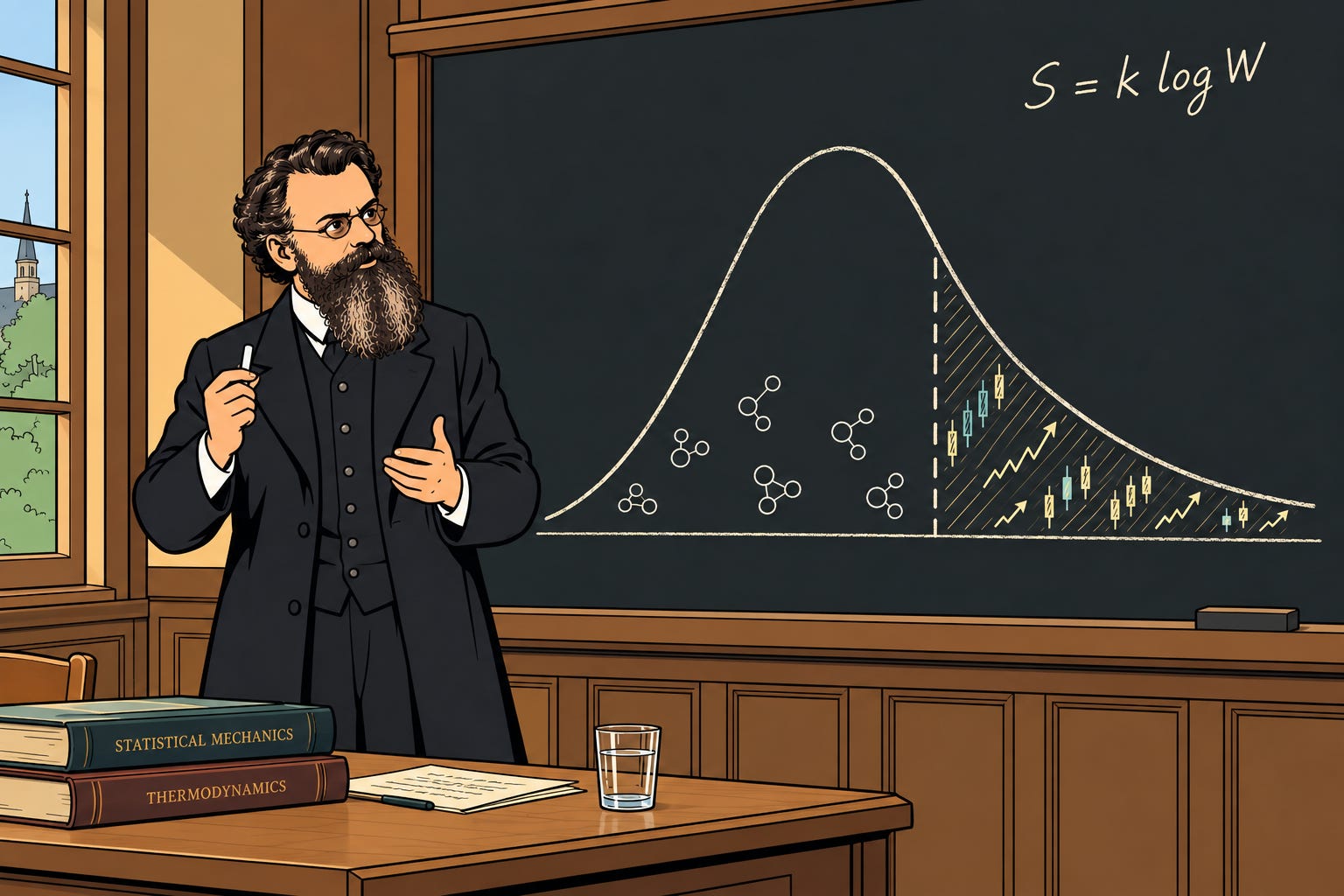
Building on Maxwell’s work, Boltzmann derived what we now call the Maxwell-Boltzmann distribution: at any given temperature, the energies of molecules follow a predictable curve. Most molecules are ordinary. A few, out in the tail of the distribution, are energetic enough to do something rare: escape a liquid, trigger a reaction, or clear a barrier.
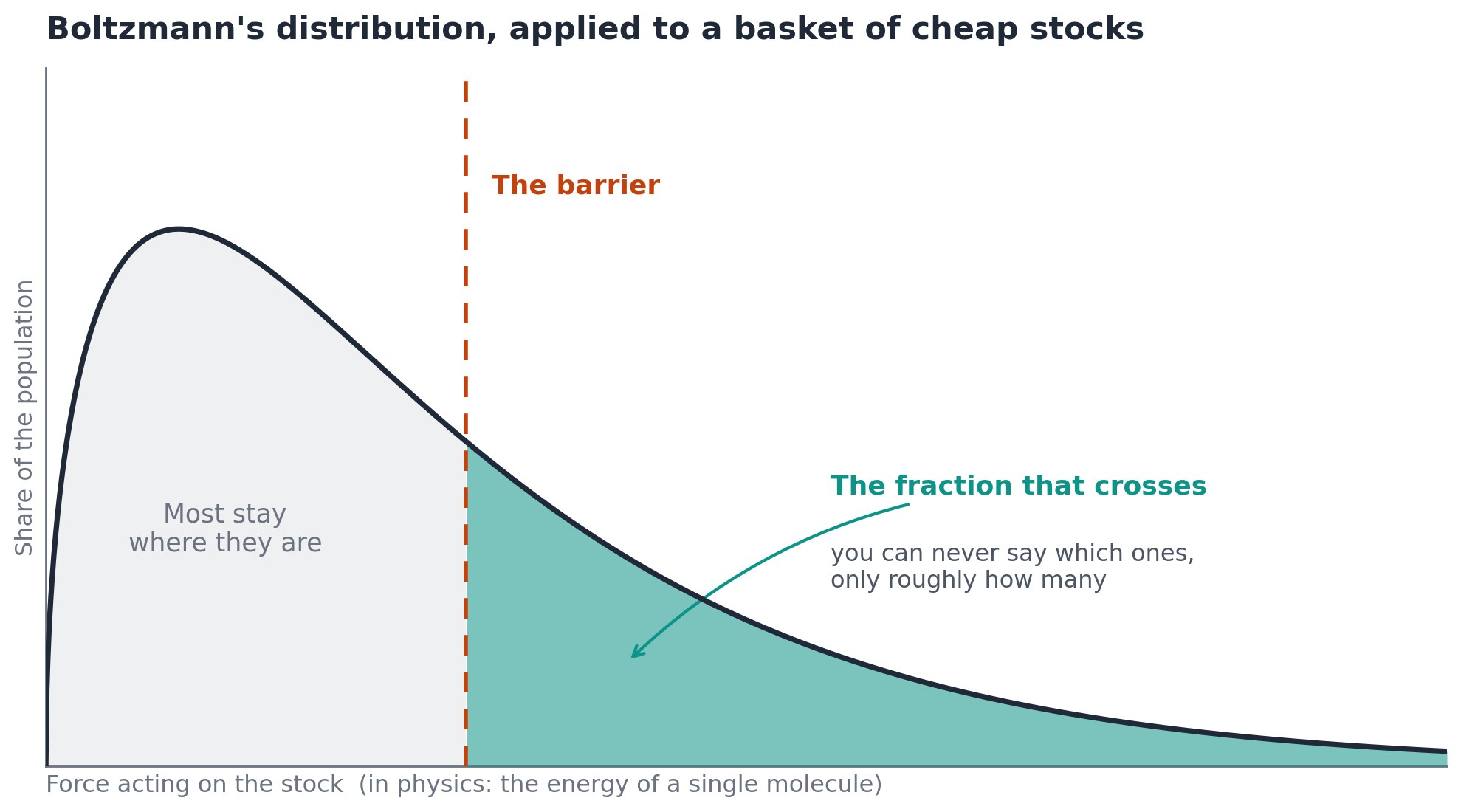
The interesting part about the distribution is that you can never say which molecule will clear the barrier, but you can always say, with great precision, what fraction will.
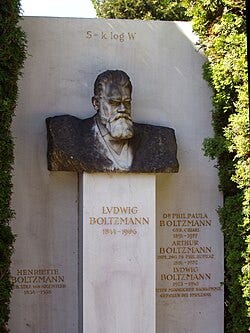
In 1877, Boltzmann also gave a statistical meaning to entropy, a concept I touched on in Issue 1: disorder is simply the number of ways a state can be arranged. The formula, S = k log W, is carved on his gravestone in Vienna.
For decades, Boltzmann defended the reality of atoms against the scientific establishment of his day, led by Ernst Mach and Wilhelm Ostwald, who considered atoms an unscientific fiction since nobody had ever seen one.
This lifelong scientific struggle deeply impacted his career and personal life. Boltzmann, increasingly isolated and in declining health, passed away on 5 September 1906, almost exactly 120 years ago this week.
Within three years, Jean Perrin’s experiments confirmed Einstein’s Brownian-motion predictions, and even Ostwald conceded that atoms were real.
Boltzmann held his unpopular position for thirty years and never got to see the proof arrive. A feeling that may be familiar to value investors :)

🎲 Betting on the distribution, not the molecule
Back to our cheap stock.
Owning a stock that you believe is cheap means you are making two bets:
You have to be right about the value: the stock is stuck, not broken.
You have to be right, or at least lucky, about the timing: the push has to arrive within your investment horizon.
Owning twenty-five of them changes the problem.
You are no longer asking “when will this stock re-rate?”, which nobody can answer. You are asking “how many of these 25 will cross their barriers this year?”
That second question does have an answer, and it is the exact question Boltzmann answered for molecules.
This is where Joel Greenblatt’s Magic Formula comes into the picture.
A basket of 20 to 30 good-and-cheap stocks, each held for exactly one year, with no exceptions. Some fraction will get their earnings surprise, their takeover bid, or their cycle turn within any given year.
Fun fact: Greenblatt’s formula is inspired by Benjamin Graham’s approach of buying 20-30 companies whose stock prices were so low that “the purchase price was lower than the proceeds that would be received from simply shutting down the business and selling off the company’s assets in a fire sale”.
Then you basically collect whatever fraction of the basket has ‘nucleated’, recycle the rest, and restock with freshly supercooled names.
There is even some academic evidence that fits this picture.
In a well-known 1997 study, Good News for Value Stocks, La Porta, Lakonishok, Shleifer and Vishny found that a significant portion of value stocks' outperformance is delivered in the short windows around earnings announcements, as value stocks keep delivering positive surprises for years after they were identified as cheap.
In other words: most nucleation events are boring quarterly reports, impossible to time for any single stock, but still happening enough across the population to have a meaningful impact.
Watching the barriers break
A bit over one year into my own Magic Formula Portfolio, I have been able to watch this process live:
EverQuote (EVER) jumped 64% in May on a strong first quarter.
Abercrombie & Fitch (ANF) did the same thing three months later, reporting earnings in August that beat expectations by a wide margin and raising its full-year guidance. The stock rose more than 30% in a matter of days.
Catalyst Pharmaceuticals (CPRX) was acquired by Angelini Pharma at $31.50, a 58% return in my portfolio, delivered by a trigger that probably only a few saw coming.
Rimini Street (RMNI) jumped about 30% on a legal settlement, but then gave most of it back. Clearly, not every knock is hard enough, and some pushes fail to clear the barrier.
I could not have picked these winners in advance, but I also did not need to. 21 of 25 positions are currently in the green, and the basket is up 22% YTD, despite individual disasters like YELP and LULU.
Speaking of Lululemon (LULU), they just reported a very poor quarter, cut the guidance once again, and the stock fell around 17%. It now trades roughly 80% (!) below its Dec 2023 high. Plenty of commentators call it the definitive value trap.
Others point out that a new CEO takes over this month, and that a quarter like this is what you would expect a company to report right before a new boss walks in.
Stuck or broken? I don’t have the answer. On the Magic Formula criteria, it still looks attractive (ROCE 32%; EV/EBIT 7.1). But it does start showing signs of a value trap (declining revenue and falling comparable sales).
The good thing is that with 25 equally-weighted names, the impact on my portfolio is limited. Lululemon still has 8 months in the portfolio, and when its year is up it gets sold regardless of what I conclude.
“If you are able to stick with the magic formula strategy through good periods and bad, you will handily beat the market averages over time” — Joel Greenblatt
Patience is still key
Greenblatt made it clear in his book that the formula goes through long stretches of not working, which is exactly when many investors give up, and so miss the payoff that comes later.
Some years simply produce fewer crossings than others. The stored energy does not go anywhere when that happens. It waits, and it accumulates.
That is worth holding in mind when you look at where value sits today. As I wrote in my Pzena Halftime post, the valuation gap between the cheapest and the most expensive parts of the market is about as wide as it has ever been.
To stick with the physics analogy: there are a lot of supercooled bottles in the freezer right now, and each one is holding more stored energy than usual.
💎 Deep value: curating the distribution
Since nobody can win the timing bet, the value bet is the one worth working on. And there is a spectrum of how much work you can put in.
On one end of the spectrum are simple filters, applied to the whole population.
Since the two failure modes of a cheap stock are the broken business and the unclearable barrier, I try to keep the most likely value traps out of my Magic Formula basket: companies whose revenues or earnings decline year after year (the classic broken profile, hence the Revenue 3yr CAGR and EPS 3yr CAGR checks I’ve added), and companies carrying heavy debt (hence the Net Debt/EBITDA filter).
At the other end sit the Deep Value investors, like Rich Pzena.
They build the entire investment process around one question: is there a barrier at all?
In a recent interview, Pzena explained how his firm screens on what they call price-to-normal earnings:
“Normal earnings we can define as what should the company earn over a full economic cycle... What’s at the top of the list are companies that are selling for a low price relative to what their history suggests they should be earning, and they’re generally not earning that. So you have a very rich universe to go in and analyze it and say, is this business any good? Are the problems temporary and not permanent? And does the management have a rational plan to restore the earnings?”
Temporary and not permanent: that is the stuck-versus-broken question I discussed earlier.
The research shifts the odds on the value bet:
“We try to find things where even if you’re 50-50 in your guess, you would win. And if you can be 60-40 because of an intense research process, then you can have a great record.”
Pzena does not claim any edge on the timing bet though. His average holding period is around three and a half years, and he is explicit that the waiting is structural:
“What makes something cheap is that you really don’t know what’s going to happen in the future... So we buy before we know.”
You cannot wait to see the ice forming and then buy the bottle; by the time the improvement is obvious, most of the stored energy has already been released.
What’s interesting looking at Pzena’s portfolios is that even with all that research, he still owns the population. Across all strategies, his firm holds 159 names, with the largest position at 6.5% of the combined portfolios. The US Small Cap Value Fund holds around 50 stocks, most sized at 2 to 3%. Even US Best Ideas, his most concentrated portfolio, holds 15 to 25 names, which is close to the 20 to 30 Greenblatt recommends for the Magic Formula.
Deep value in the Guru Gems portfolio
My own designated deep-value turnaround, Baxter (BAX), which I covered most recently in July, has been an interesting case study. On 30 July, Baxter reported organic revenue growth of 5% and adjusted EPS well above consensus, and raised both its top- and bottom-line outlook for the year. The stock rose over 15% that day, extending a climb of nearly 60% from its March low.
Baxter is the type of stock I have been describing here: statistically cheap, with problems that may or may not turn out to be fixable, and a timing question nobody can answer. It sits in my Guru Gems portfolio, and writing this issue did make me wonder whether it would be better placed in the Magic Formula basket. I have kept it where it is, because unlike a screen pick it is a name I researched in depth before buying, and one I have real conviction in.
Rich Pzena clearly has real conviction in it too. Baxter is the second-largest holding at 7.2% in his US Best Ideas strategy, his most concentrated portfolio. Even as one of his very best ideas, though, a stock like this gets a single-digit weight in a portfolio of 15 to 25 names.
Mine is at 5–6%, which feels about right for a stock where I am confident about the value and have no idea about the timing.
Closing: two lessons from metastability
Congrats, you made it to the end of this post :)
Or maybe you just scrolled to the closing part, in which case this one is for you. Two things to remember about supercooled stocks:
1. Being right about value is not the same as being right about timing.
A statistically cheap stock is a metastable state: real stored energy behind a real barrier. Your research can tell you whether the stock is stuck or broken, whether the normalized earnings still exist, whether the barrier is finite, etc.
It cannot tell you when the push arrives. You can be completely right about a stock and still look wrong for years while you wait for something to happen.
2. When timing is unknowable, own the population.
Boltzmann could never say which molecule would clear the barrier, but he could say precisely what fraction would, and that was enough to build a science on.
Greenblatt’s 20-30 stock Magic Formula basket and Pzena’s 50-name funds are the same move: convert an unanswerable question about one cheap stock into an answerable question about a group of cheap stocks.
Curate the population as carefully as possible. Just don’t bet the outcome on a single name!
Final thought
Both lessons above apply to stocks that look cheap.
This is not an argument against concentration in general. If you own a handful of businesses you understand deeply and that are compounding away, you are playing the game from Issue 2, where barriers and triggers are not really the point.
As you know, I run two portfolios: the Guru Gems portfolio holds a more concentrated set of names I have researched one by one, while the Magic Formula portfolio holds 25 ‘cheap-and-good’ ones on a one-year rotation.
But if you find yourself drawn to a stock mainly because it looks cheap, that is the moment to think about the distribution rather than the single name.
That’s it for this week!
I hope you enjoy these ‘Physics for Investors’ issues. Please give me feedback on how to make these even more interesting or what topics you would like to see covered.
If you enjoyed this post, I would really appreciate it if you could like or share it or leave a comment!
You can follow me on Substack @gurugems and X @guru_gems for more insights.
Until next week!
Greenblatt
Nice work marrying physics and investing. Curious about the 1-year holding period rule. What if the culling proves premature? Is the 1 year window based on say, statistical analysis that showed this period to be optimal or convenience or something else? I’ve read many of Mr. Goldblatt’s works but that was a while ago. Thanks and keep up the good work.