
Welcome back, and welcome to all new subscribers who joined recently!
When I launched Guru Gems in April 2025, I had a fairly simple idea: study the world’s best long-term investors, understand how they think, and see whether I could apply some of their wisdom to build a portfolio of my own.
For those who have been here from the start, you will know that there is one book that had a significant influence on that idea: William Green’s Richer, Wiser, Happier: How the World’s Greatest Investors Win in Markets and Life.
There is a passage in the introduction that particularly resonated with me. Green writes that understanding how the best investors think and why they win "can help us immeasurably in so many ways—financially, professionally, and personally."
I have now studied more than 20 Gurus myself. When I reread the book recently, it struck me how often the Gurus I’ve covered say the same things as the investors in the book, sometimes almost word for word.
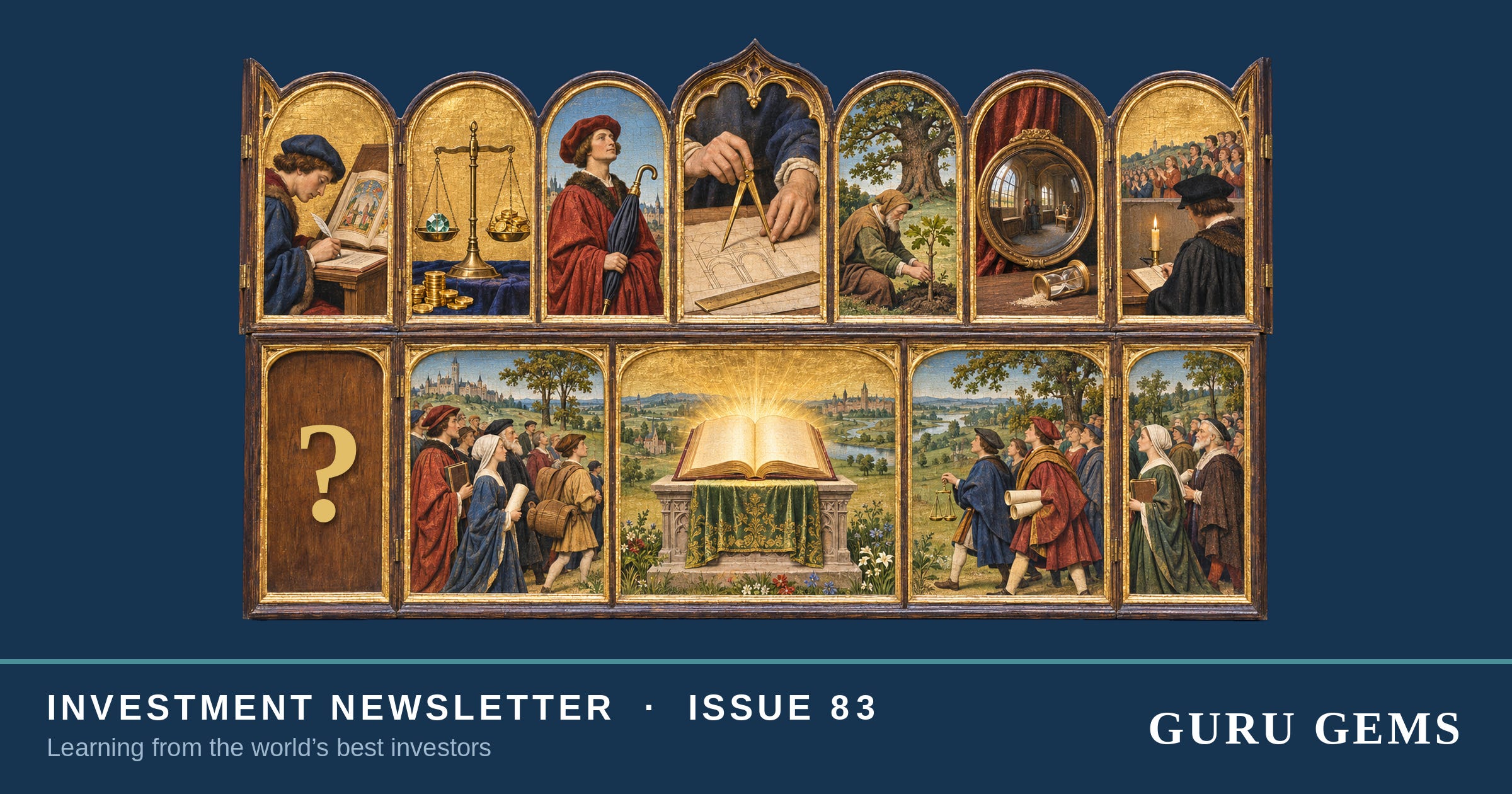
In this post, I share the seven lessons from the book that stuck with me most, and check them against what the Gurus I’ve studied actually do.
Each lesson ends with three things:
Ask yourself: one question to use before your next investment
Recent update: what these investors have done lately, mostly from their latest filings
Go deeper: where I’ve written about it before, and articles by other writers that I recommend
All seven lessons and questions are summarized at the end.
Let’s go!
📌 A quick note on the Q3 13F update
The 13F deadline for this quarter was on Saturday 14 November, so most filings will only be in by Monday 16 November.
The full update follows next week. In the meantime, you can check my live dashboard here and I’ll also share the most interesting moves via Substack Notes as they come in.
New to Guru Gems? Start here.
1. Learn from people who have already done the work
Green opens the book with Mohnish Pabrai, who is very open about where his ideas come from:
“I’m a shameless copycat. Everything in my life is cloned... I have no original ideas.”
Pabrai copied Buffett’s 1950s partnership almost in full, and he finds many of his stock ideas by studying the top holdings in other investors’ 13F filings.
That is close to what I do here every quarter. And many of the Gurus I’ve covered borrowed openly too.
Warren Buffett and Charlie Munger explained why this works:
“You can learn a lot from other people. In fact I think if you learn reasonably well from other people, you don’t have to get too many ideas on your own. You can just apply the best of what you see.” —Warren Buffett
“I believe in the discipline of mastering the best that other people have figured out. I don’t believe in just sitting down and trying to dream it all up yourself. Nobody’s that smart.” —Charlie Munger
Ryan O’Connor, a ‘Hidden Master’ I recently studied, modeled Crossroads Capital on Buffett’s partnerships of 1956 to 1969, down to the two buckets Buffett used: ‘generals’, undervalued compounders, and ‘workouts’, special situations where an event unlocks the value.
Fun fact: O’Connor’s grandfather was an old poker buddy of Buffett’s.

The risk with ‘cloning’ other investors is ‘borrowed conviction’: owning a stock because a Guru owns it, without understanding why.
While copying a portfolio is relatively easy, understanding the thinking behind it is much harder.
Ask yourself
“Why is this one of their top holdings, and would I still own it if they sold?”
Recent update
Pabrai’s 13F shows only his US stocks: $362 million at the end of September. Most of his money is now in Turkey, where he says short-term traders leave good businesses badly mispriced (CNBC TV18 interview, 22 October).
He sums up his approach with a Munger line Green also quotes in the book: “take a simple idea and take it seriously”.
Go deeper
From Guru Gems:
Cloning the World's Best Investors (My very first Guru Gems post)
From other writers:
Mohnish Pabrai: The Dhandho Investor by MOI Global Equity Research
The Power of Implicit Conviction by The Pursuit of Compounding
2. The price you pay still matters
Howard Marks, whose book I reviewed in Guru Gems #15, gets a chapter of his own in Richer, Wiser, Happier. Green writes that, for Marks, buying cheap is the most reliable route to good returns and overpaying is the greatest risk.
So the first question about any investment should be: “Is it cheap?”

Marks also explains why bargains appear at all. Most investors assume the latest trend will continue, so they overpay when things are going well and sell too cheaply when they’re not.
In his words:
“Skepticism calls for pessimism when optimism is excessive. But it also calls for optimism when pessimism is excessive.”
Marc Werres (Hinde Group), one of my ‘Hidden Masters’, looks for great businesses that are out-of-favor and have become cheap. He follows what he calls Warren Buffett's model for a great investment: "a marvelous business that encounters a one-time huge, but solvable problem."

His best example is Netflix in 2022, which he saw as a great business going through a “temporary slowdown in its growth”.
Hinde kept buying as the stock fell nearly 75% from its high and most investors wrote it off.
Over the next 41 months the position returned more than 4 times his money.
He then trimmed it to about 2% of the portfolio once the stock passed $1,000, because “its stock clearly offers a notably lower prospective return above $1,000 than it did below $300”. (this was before the stock’s 10-for-1 split)
(Interesting side note: it looks like he may be repeating his playbook with Netflix. The stock is down more than 45% from its 52-week high and Werres wrote in his Q3 letter that he added to his position again.)
This lesson on price is particularly relevant today. When an investment theme becomes very popular, it is tempting to believe the companies benefiting from it will keep growing indefinitely.
However exciting a business might be, the price we pay still matters.
Ask yourself
“Is it cheap? And is the problem behind the low price temporary or permanent?”
Recent update
Marks keeps publishing fantastic memos and a new one just came out on 11 November: A Layman Thinks About AI. He works through 11 questions about investing in AI, from who will profit to what it means for credit markets.
As always, it’s an excellent piece, and mandatory reading for every investor.
Go deeper
From Guru Gems:
Supercooled Stocks: The Physics of the Value Trap
From other writers:
The Lessons of Howard Marks' Memos ('90-'95) by The Intellectual Edge
3. Protect your ability to stay in the game
The book has several versions of this:
Bill Ruane’s first rule is: “Do not borrow money to buy stocks.”
Irving Kahn, Benjamin Graham’s teaching assistant in the 1920s, asked one question before any investment: “How much can I lose?”
And Matthew McLennan of First Eagle holds cash and gold as ballast because “you need to buy the umbrella before it rains.”
Seth Klarman has built Baupost around the same idea. On leverage for example, he says: “If we can’t make money unleveraged, we’d rather go out of business.”

He has changed how he applies it, though. Baupost used to hold 30% cash or more at times, which he says was “almost certainly” a mistake, so they now own larger, more liquid companies instead.
Protecting your ability to stay in the game is particularly relevant for anyone running a concentrated portfolio, where a few bad investments can have a disproportionate impact on the overall result.
Ask yourself
Kahn’s question: “How much can I lose?”
Recent update
Baupost's Q3 13F, filed on 13 November, shows Amazon still as their largest US holding: 18.5% of the portfolio at the end of September. Amazon is one of my Gems.
Go deeper
From Guru Gems:
Warning Signs and Downside Protection
From other writers:
→ If you enjoy this newsletter, please subscribe and help others discover it by clicking 🤍
→ If you find value here, consider buying me a virtual coffee ☕
4. Find a process you can actually follow
Joel Greenblatt sums up stock picking in one line: