

“The only way to invest well long-term is to be differentiated from the crowd”
— Seth Klarman
In today’s edition:
👤 Guru in the spotlight: Seth Klarman
🛡 The six things Baupost does to protect capital
🫧 What Klarman says about today's AI market
💎 Gems in focus: Klarman's three largest positions
Today’s post is a bit longer, so grab a coffee and make yourself comfortable! If you’re in a rush, here is a 2-minute AI audio version of today’s post:
New to Guru Gems? Start here
👤 Guru in the spotlight: Seth Klarman

Seth Klarman has been running the Baupost Group in Boston since 1982. In those 44 years he has had five down years, and the worst of them was ‑12%.
This is probably not a coincidence when your whole investment philosophy is built around ‘downside protection’.
Regular readers will remember I shared some thoughts from Klarman’s June interviews in issue #63, and promised a full deep-dive.
Baupost’s origin story is an interesting one. In 1982 four Boston families were sitting on the proceeds of some business sales: a stake in Channel 5, the ABC affiliate, and a computer consulting and publishing business among them. Jordan Baruch, Isaac Auerbach, William Poorvu, and Howard Stevenson pooled $27 million and formed an expanded family office to protect and compound that wealth across generations. The firm’s name is an amalgam of their surnames (BA-AU-PO-ST).
They needed someone to do the actual investing. Poorvu had taught real estate at Harvard Business School, and he recruited a former student: a 25-year-old whose entire track record was a stint as an analyst at Max Heine and Michael Price’s Mutual Shares, the legendary value shop, between Cornell and his MBA.
So even though Klarman was not the founder, he was there from day 1, and hired to run it. The families were very clear about what they expected from him:
“Our mandate wasn’t really to grow an investment business. It was to deliver good returns with limited downside to those clients.”
Baupost today runs roughly $22 billion across public equities, credit, private investments and commercial real estate, and it still behaves like a family office that would prefer to miss an opportunity than lose the money.
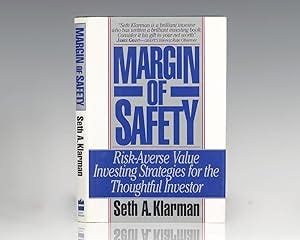
Klarman wrote Margin of Safety in 1991, when he was 34. It sold badly, went out of print, and then became one of the most sought-after investment books ever written.
Over the past four decades, Klarman gave few interviews or talks in public. His explanation was that if you are accumulating a stock, you get a better price when nobody knows.
Over the past few years, it seems Klarman has been doing more interviews and I have gone through all of them to build this post.
If you enjoy this newsletter, please help others discover it by clicking 🤍
And if you would like to support my work, consider buying me a virtual coffee ☕
🛡 The Baupost Way
When Klarman was asked in a recent interview what makes Baupost unique, his answer was all about how the firm avoids losing money:
“The way we protect capital is we focus on downside as much as upside. We do meticulous fundamental research on every company. We will hold cash in the absence of immediate opportunity. We don’t leverage the portfolio at all. We’ll buy senior securities… so that we’re structurally senior in a lot of what we do, which protects on the downside. And finally, we do macro hedges.”
Klarman mentions six distinct practices to protect capital in a single breath, so let’s unpack this a bit more and go through them one by one.
1. On downside
You can see this in the way Baupost approaches new ideas for the portfolio. When an analyst pitches him, Klarman wants to run the post-mortem before the investment has been made:
“If we’re wrong and three years from now we’re sitting here… going over what went wrong, what are we going to be talking about?”
Readers of my Chris Hohn deep-dive will recognise this mindset. Hohn also applies a risk-first framing to every investment: “The vast majority of investors focus on return. But in my career I focused on risk.”

The key lesson from these two brilliant investors is that you should decide what you can lose before you get excited about what you can make.
2. On doing the work
Klarman describes Baupost’s research process as “a mile wide and then a mile deep”: a team of generalists scanning everything, then drilling into a single name until they know it unbelievably well. The point of all that depth is what the work buys you on the day the market turns against you:
“The challenge is the discipline to wait patiently until those bargains emerge, and then the temerity to stand there when it’s going down in your face. The market’s telling you you’re wrong, but you’re holding on because you’ve done the work.”
Months of that kind of work create their own problem, though. The analyst who went a mile deep does not arrive at the meeting neutral:
“The analyst needs to fall in love with the positions. As portfolio manager, I just date their ideas.”
To counter this bias, Klarman keeps asking his analysts questions. If we didn’t own this already, would we still buy it today? And before buying a single share, he wants to know where they would sell:
“If they say, ‘Well, I like it at 70, but I’d sell it if it got to 80’… it’s like, you’re that sure that it’s going to move 15 percent? Because what if it goes to 50 before it goes to 80? Maybe it’s not the right entry point.”
3. On cash
Baupost holds cash, sometimes a great deal of it, and Klarman has spent decades defending the practice against clients who reasonably ask what they are paying him for. Here is what he said on this during a lecture to a Columbia MBA class in 2010:
“To say you have to look only at today’s opportunity set, and therefore be fully invested all the time, is sort of like saying you have to marry someone from your high school graduating class as that’s the whole opportunity set.”
Although this is also the one guardrail he has since walked back. Baupost ran 30% cash and higher at times, and he told in an interview that he “almost certainly made a mistake”, because the optionality never paid for itself across a decade of suppressed rates and no serious drawdown.
So he changed the mechanism rather than the principle. In his words:
"We made our liquid books more liquid, especially our public equity book, where we used to own companies with 500 million or billion dollar market cap. Now we have much bigger market cap holdings on average… we can pivot on a dime with a large percentage of our book. So we don't need as much cash."
More on his portfolio later in this post.
4. On leverage
Klarman is very clear on what he thinks about leverage:
“If we can’t make money unleveraged, we’d rather go out of business.”
And one of my favourite lines, which should be an important reminder for anyone using leverage:
“The risk of leverage is that it’s like drowning in a pond that, on average, is one foot deep.”
Leverage is what turns investors into forced sellers, and Klarman is explicit that "you never want to be a forced seller, and you especially want to be able to buy from forced sellers in any asset class."
5. On seniority
A large part of Baupost’s book sits above the equity in the capital structure: senior debt, structured private deals, instruments with contractual claims. Credit is, according to Klarman, the firm’s best discipline.
“Bonds are a wonderful safe instrument in the following context: you get senior securities, you’re first in line, contractual terms, you get interest, you get your principal back, you know when you’re getting those things back… The problem is everyone knows that, so they don’t return very much, most of the time.”
Most of the time, safety is priced in and returns are dull. But in distress, when downgrades and defaults force other holders to dump, Klarman gets to buy equity-like returns wrapped in bond-like protections.
6. On hedging
Finally, an overlay of macro protection bought at the least intuitive moment:
“We’re buying macro protection when vols are low and people think nothing bad is going to happen. So we can sell that at a gain… during a storm.”
The logic is the same as with any insurance: it is cheapest when nobody thinks they will need it. And these hedges do more than soften the blow. When the storm arrives, Baupost can sell them at a profit, which frees up cash at exactly the moment the best bargains start to appear.
All six guardrails end up serving the same purpose, which is to make sure Baupost is still buying on the worst day of the cycle.
The guardrails at work: 2008
When Bear Stearns and then Lehman came apart in 2008, Baupost, closed to new money for much of its history, called up its waiting list and raised several billion dollars inside a single quarter. The team deployed it at a reported pace of roughly $100 million a day, buying residential mortgage securities, the debt of the auto finance arms, and "very interesting" pieces in the collapsed Lehman capital structure.
While much of the industry sat paralysed, Klarman described his team as “kids in a candy store.”
But when Klarman was asked about this period, he pushed back on the heroic version, and clarified that it was all very calculated:
“The way you’re conveying it probably comes across as we come in with giant satchels of money and hand over fist deploy it. It wasn’t like that at all. It was the same cerebral, methodical, painstaking environment that we do every day… I can buy this bond at 70 that I think is covered at par.”
🫧 What Klarman says about today’s AI market
When asked about today’s market in a podcast with Morgan Stanley’s Michael Mauboussin, Klarman called the current environment (Aug 2025) “a 4 out of 10 opportunity set.” Markets at all-time highs, very little despair, very little panic.
When asked in another interview more recently (Jun 2026) whether this is a bubble, he would not go all the way:
“I think it has characteristics of a bubble… you certainly see it in places like when Allbirds, the shoe company, added AI to their name and the stock did well. And that’s crazy. That’s reminiscent of the dotcom.”
(Note how the thumbnail below says “THIS IS A BUBBLE”….not really what he said)
His real concern is about which way the multiple is moving:
“If you threw this much uncertainty into a market, I think you’d say maybe the market should actually be at a lower multiple to accommodate all this uncertainty. And instead the multiple keeps going up.”
But a low score is not zero, so it means there are still opportunities. Klarman splits the market into three buckets:
There are AI winners, which everybody wants. There are AI losers, which everybody is dumping. And then there is a third group he calls AI agnostic: businesses the technology simply will not affect much, which nobody finds exciting.
Baupost is spending its time in that third bucket, and picking through the perceived losers for anything that has been miscategorised.
As for the AI model companies themselves, Klarman is uninvolved. He argues that they have to spend enormous sums continuously just to stay in front, and if they ever fall behind they are in real trouble. For Klarman, that is not the description of a great business.
Which brings us, finally, to what he actually owns.
💎 Baupost portfolio
Below is an overview of Baupost’s top 10 US equity holdings at the end of Q2 2026.
This $5.4 billion, 23-stock portfolio is not all of Baupost. It reflects the 13F, which captures US-listed equities only, roughly a quarter of the firm. As highlighted in the introduction, Baupost’s total assets is roughly $22 billion across public equities, credit, private investments and commercial real estate.
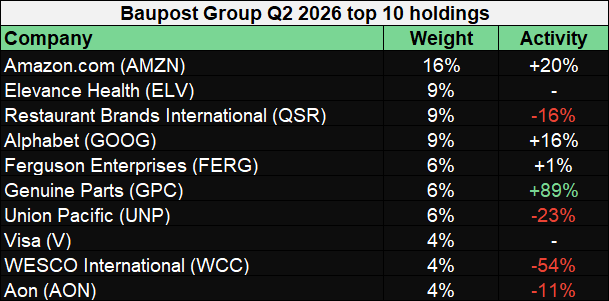
Here is a closer look at the top 3 positions from end of Q1 [Note: my original post was written before Q2 holdings were released. I have now added some Q2 commentary]
1. Amazon (AMZN) — Q1: 12.7%; Q2: 16.5%
Amazon is Klarman's largest disclosed equity position, and he built it over just 2 quarters.
He opened it in Q4 2025 at 9.3% of the portfolio, then added another 47% in Q1. Going from zero to a 12.7% position in two quarters is quite a statement of conviction.
Amazon was trading in the $200-250 range during those quarters, so with a current share price of $274, he is probably up somewhere between 15%-30% on this position.
A position this size in a mega cap is also exactly what Klarman described when he talked about the cash decision. This is one of the “much bigger market cap holdings” (together with Alphabet) that lets Baupost “pivot on a dime with a large percentage of our book”.
As for the business itself, what Klarman likes is that Amazon is an enormous cash flow machine, versatile enough to play several roles in AI, with a data centre business growing much faster than anyone expected a year ago.
Klarman saw an opportunity to buy this wonderful businesses at an attractive valuation:
“You don’t have to buy them this second… there are blips in almost every company where you get windows of opportunity.”
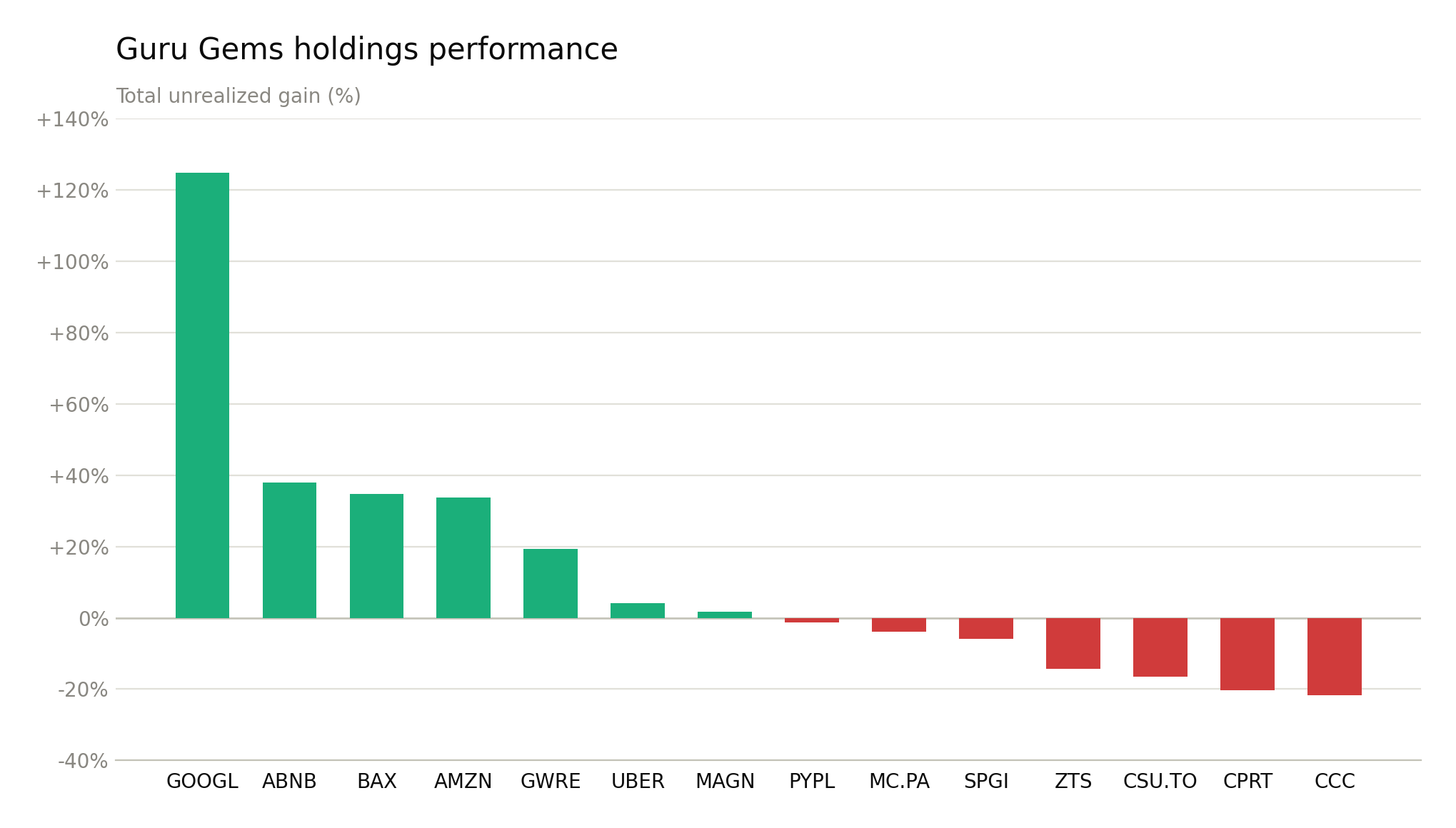
It’s always pleasing to see when a Guru confirms one of my earlier picks. I bought Amazon in February at $204.50 and added in March at $207.40, for an average of $205.20. My Amazon position is up 33%, putting it in the top 5 best Guru Gems performers. (Alphabet, the ultimate Guru Gem, remains by far my best performer)
Klarman and the Guru Gems portfolio are in good company: Josh Tarasoff, Bill Ackman, Dennis Hong, and John Armitage, all have significant positions in Amazon, with the last three all adding during Q1.
2. Restaurant Brands International (QSR) — Q1: 11.7%; Q2: 9.0%
QSR is the franchisor behind Burger King, Tim Hortons, Popeyes and Firehouse Subs; it’s a capital-light royalty stream on other people’s restaurants.
Compared to Amazon, Klarman’s second-largest position is the opposite story: he has been slowly adding to this position almost every quarter since end of 2024.
The stock has been trading in the $65-$75 range for most of that time so depending on his entry prices, this position is probably a modest gain until now, with an additional ~3.5% dividend yield on top.
“A lot of value investing is like watching paint dry.”
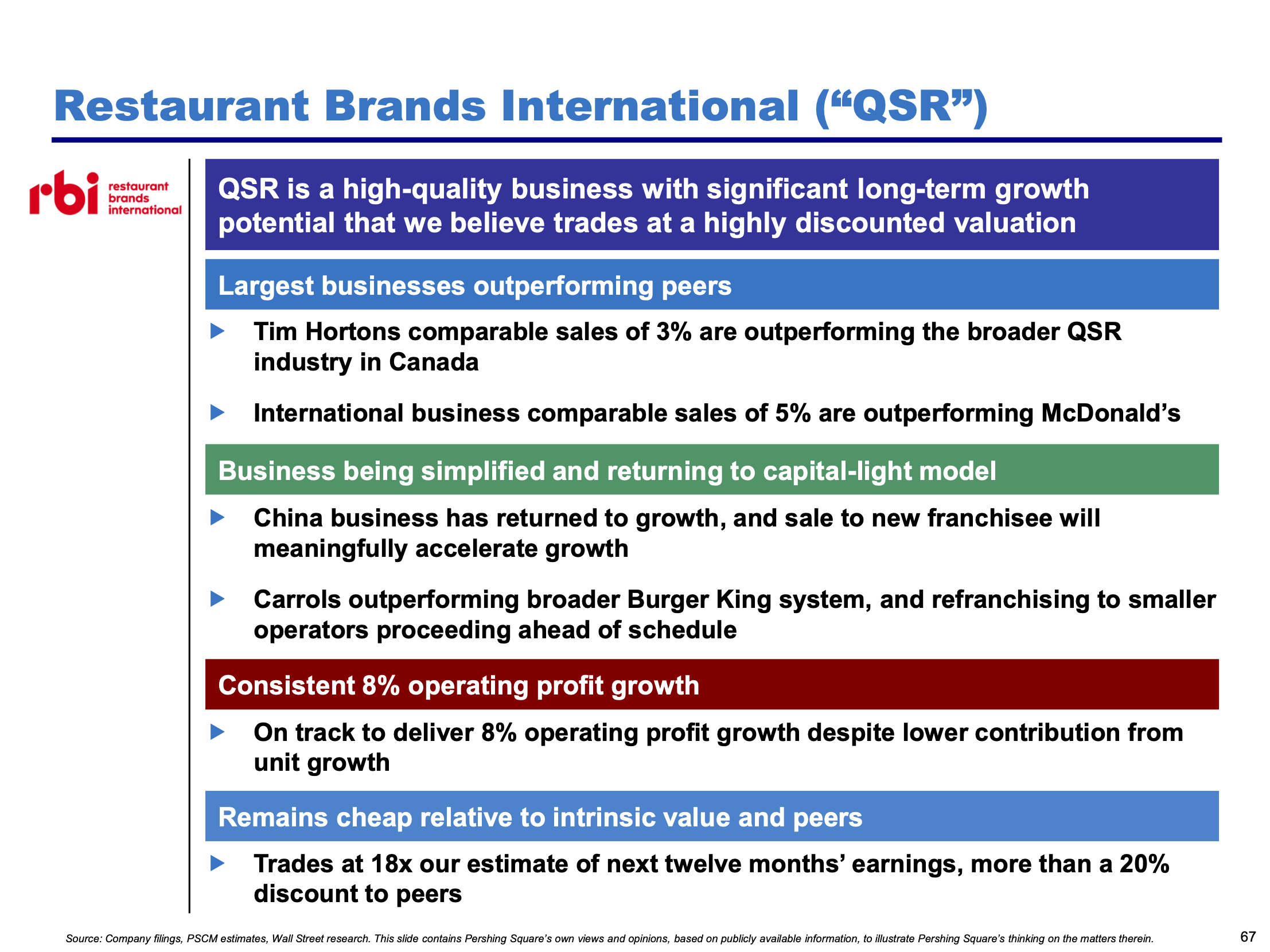
Just like Amazon, QSR is also a large position in Bill Ackman’s portfolio. Below is an extract from Ackman’s February 2026 presentation detailing why he holds QSR.
If you want to learn more about Bill Ackman and his Pershing Square approach, check out my post from February:

Long-time readers know I also have my own history with this stock.
QSR has been on the Guru Gems watchlist since my Chris Davis deep-dive back in issue #7, and it earned a Silver medal on my Podium of Errors in March as an error of omission. The stock came very close to $60 in September, I waited for it to go a bit lower, and it never did.

With Davis, Klarman and Ackman all holding meaningful positions, this remains a highly Guru-endorsed name on my watchlist, and if it ever revisits those levels I won’t make the same mistake twice.
3. WESCO International (WCC) — Q1: 7.7%; Q2: 4.2%
A company I had never looked at before, and the hardest of the three to write about.
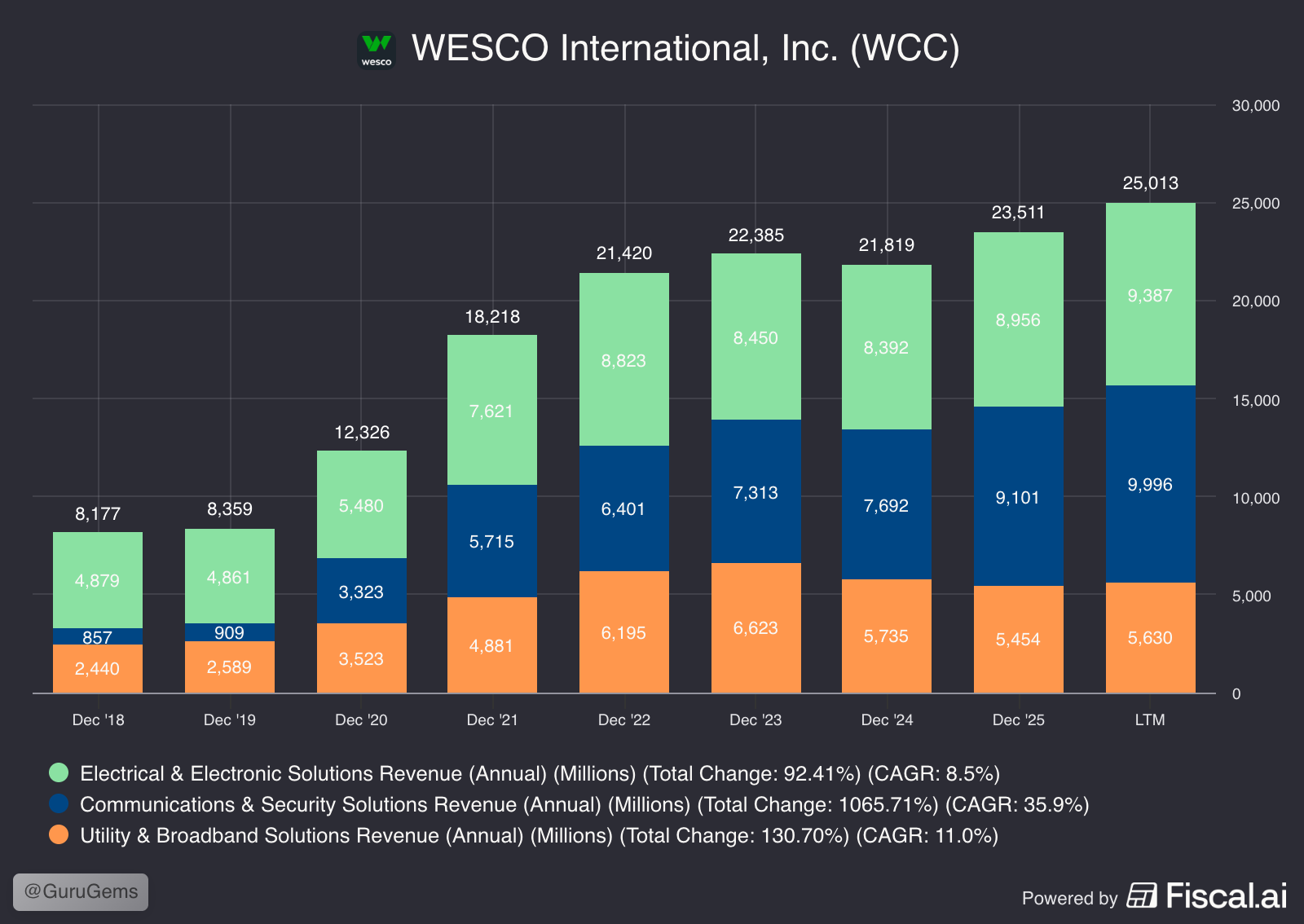
WESCO distributes electrical, networking, security and utility equipment, the unglamorous plumbing of construction sites, industrial plants, power lines and, increasingly, data centres.
It doubled in size by acquiring Anixter in 2020, and the data centre business (part of Communications & Security Solutions in blue below) has been growing at roughly 50% a year to more than 20% of revenue. Second quarter organic sales grew 13% and the backlog grew 60%.
Klarman opened the position in Q1 2024 and then built it aggressively: he almost quadrupled it in Q2, added another 57% in Q3, and kept buying through 2024 and into the first half of 2025.
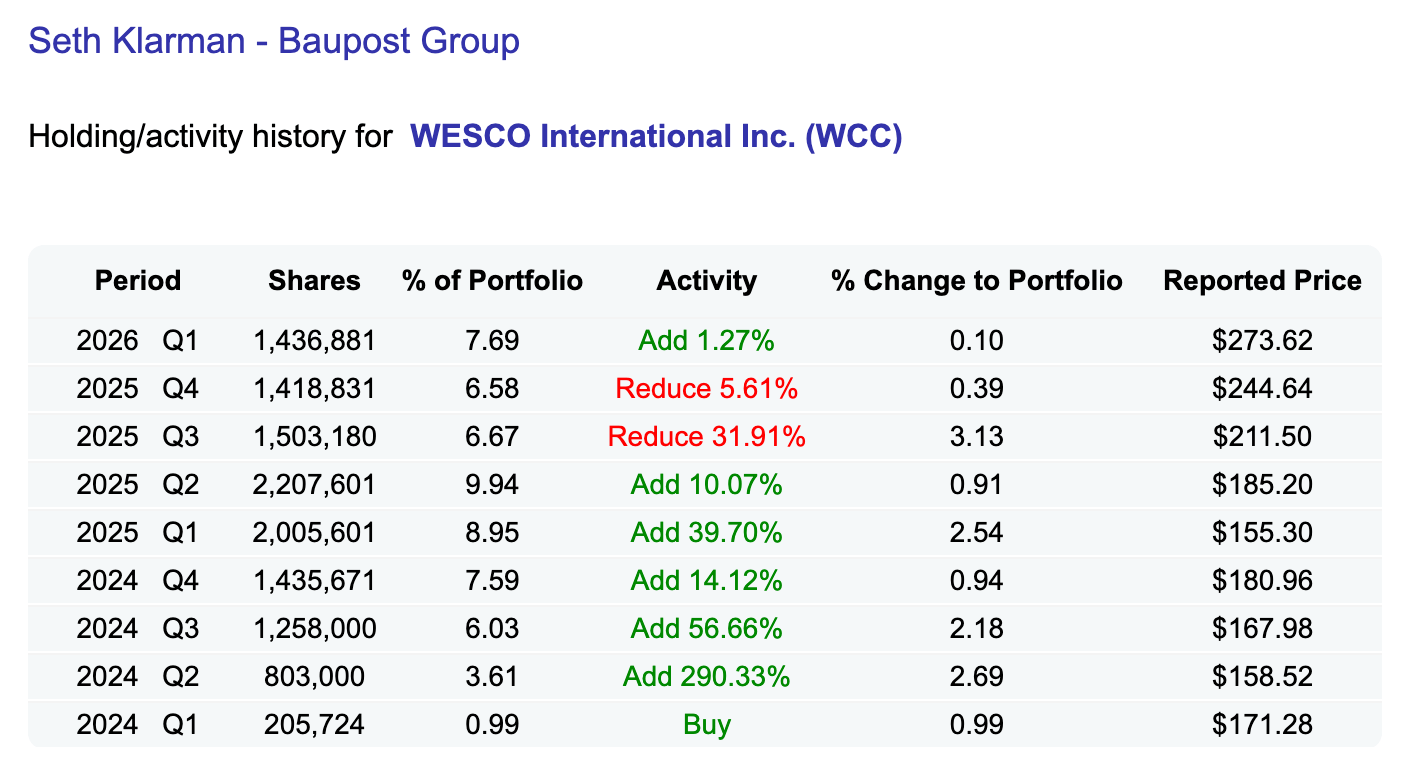
We don’t know his exact entry prices, but his average cost is probably somewhere around $165.
The stock closed last week at $364, so that’s well over a double.
Klarman has already started selling. In Q3 2025, with the stock around $211, he cut the position by almost a third. He trimmed a bit more in Q4 at $245. This is exactly what he says he does:
“[We protect] on the downside as best we can, by doing deep fundamental analysis, by knowing our names unbelievably well, by not being afraid to sell them when the price is up. And the same way, same as we buy more when the price is down.”
Morningstar raised its fair value estimate for Wesco in July, but only to $275, roughly 25% below where the stock trades today. It rates the moat narrow and says that "the market seems to be extrapolating Wesco's supercharged organic sales growth too far into the future."
It will be interesting to see from the Q2 filings (reflecting holdings on 30 June) how much Klarman will have trimmed this position. Or does he see something in the data centre buildout that others are not seeing yet…
Q2 Update: I ended the section on WESCO wondering how much Klarman would trim. The answer is more than half: he cut the position by 54%, from 7.7% down to 4.2%. If we add up the Q3 2025 cut, the Q4 trim and this one, he has now sold roughly 70% of the position. It seems Klarman might agree with Morningstar's $275 fair value estimate.
💎 The Gem: Genuine Parts Company (GPC) [Q2 update]
Klarman’s biggest buy of Q2 was Genuine Parts Company (GPC), the company behind NAPA Auto Parts. He added 1.3 million shares, an increase of 89%.
Background
On 17 February, GPC announced it was splitting itself into two separate companies. On the same day it also reported a weak quarter (adjusted EPS of $1.55 against $1.79 expected, North America Automotive EBITDA down 14%), and guided 2026 lower.
The market did not take it well and the stock fell 19% in a week. It kept sliding through the next months, and bottomed around $91. In February it was trading at $146.
“[We protect] on the downside as best we can… by not being afraid to sell them when the price is up. And the same way, same as we buy more when the price is down.”
I used the above quote for the selling in WESCO, and Genuine Parts is clearly the second half of the quote.
Genuine Parts Company — To buy or not to buy
As always, I’ll evaluate this Guru Gems candidate using my Terry Smith-inspired framework:
1/ Buy good companies
GPC consists of two separate businesses:
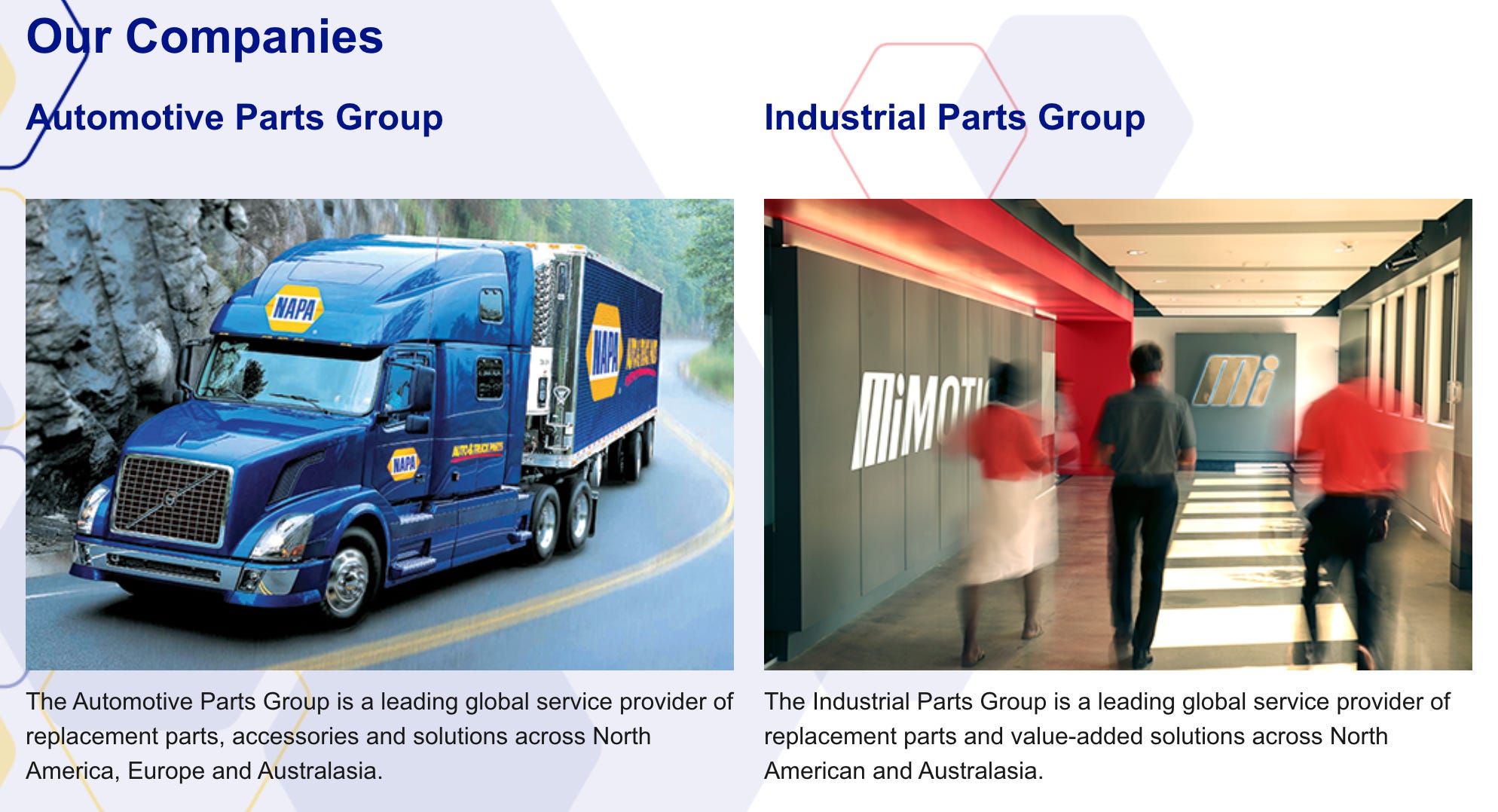
Global Automotive (‘NAPA’, ~60-65% of revenues): distribution of automotive replacement parts through 10,000+ locations in North America, Europe and Australasia, two thirds of them independently owned. Around 80% of sales go to professional mechanics who need the right part ASAP, which is where the distribution network earns its keep.
Global Industrial (‘Motion’, ~35-40% of revenues): second-largest industrial distributor in North America, with leading share in bearings and power transmission. Roughly $9 billion of revenue and more than 200,000 maintenance and repair customers.
Why GPC made it into the Baupost portfolio
Let’s look at GPC through Klarman’s eyes and see why this became his sixth-largest position.
A special situation. The separation is a ‘tax-free spin-off’ targeted for Q1 2027.
The company’s aim is to “unlock shareholder value by allowing each entity to pursue tailored strategies, optimize capital allocation, and enhance investor clarity”.
The market sold the stock for a different reason. The spin and the bad quarter were announced on the same morning. Investors reacted to the earnings miss and the lower guidance, and the separation was buried underneath it.
At $91, the downside was already in the price. At that price the stock was on around 8x EV/EBITDA, under 12x this year's adjusted earnings, and a dividend yielding 4.7% backed by 70 consecutive years of increases. That was the equity version of Klarman’s line: "I can buy this bond at 70 that I think is covered at par."
Industrial was practically thrown in for free. We only learned this in July, but if the automotive half is worth what O’Reilly later offered, then at $91 Motion was valued at roughly 7x pro forma EBITDA. Applied Industrial Technologies trades near 20x.
Nobody wanted it, which is the point. Remember Klarman’s third bucket: companies AI will not affect much, and which nobody finds exciting. Selling bearings to factories and brake pads to mechanics definitely fits that category.
So Klarman wasn’t probably paying up much for the separation. He was buying at a price the market had set on a bad quarter, and getting the catalyst for almost nothing.
Then, two days after the quarter closed, he got his confirmation. On 2 July Bloomberg reported a roughly $10 billion cash bid from O’Reilly for the automotive business, and the stock jumped 13% in a day. Klarman had already built the position by then. Three weeks later, CEO Will Stengel said GPC is “not currently in discussions with any competitor.”
This is not a high-quality compounder
I think it’s important to highlight that Klarman isn't buying a compounder here, he's buying a special situation, and that's how it should be judged.
Group EBITDA margin is 8.3%. Return on invested capital is somewhere around 10–12%. Organic growth is around 1–3%, with most of the top line bought through acquisitions (over 50 in 2025 alone).
Finally, Morningstar rates the moat ‘narrow’.
2/ Don’t overpay
At around $135, GPC trades at:
~17x this year’s adjusted EPS guidance of $7.50–8.00
~11x EV/EBITDA
a 3.2% dividend yield
That’s a fair price, not particularly cheap. Since the separation is the whole thesis, it’s also worth doing the sum-of-the-parts.
Management shared the following in July: after allocating corporate costs and dis-synergies, each business lands at roughly $1.0 billion of pro forma EBITDA, which adds up to about the same $2.0 billion GPC earns today. The split creates no new EBITDA, so whatever value it unlocks has to come from the multiple.
Assume we hold the automotive half at O’Reilly’s $10 billion and the market is now paying about $13 billion for Motion, or roughly 13x. Then Motion has gone from about 7x at the lows to about 13x today. If we put it at 16x the stock is worth about $157; and at 11x, about $120. At $134 we are sitting in the middle.
3/ Final decision
The usual question with a Guru buy is what they see that the market doesn’t. Here I think we already know, and it isn’t really about the business. Klarman was handed a special situation at a price set on a bad quarter, and he took it.
Which leaves the question: what is left for the rest of us? Not much. Motion has re-rated from roughly 7x to 13x, the O’Reilly bid is public, and the price now assumes a deal management says it isn’t negotiating. The catalyst is still coming, but I would be paying full price for it rather than getting it for free.
📌 I’m passing on Genuine Parts. It will be interesting to watch what happens during and after the investor days, and what further moves Klarman will be making.
That’s it for this edition!
Let's close with another great quote from this brilliant Guru. I've really enjoyed studying Seth Klarman.
“People think they’re hiring a manager to make them money. But probably, they’re hiring a manager to keep them out of trouble and maybe fight their own instincts sometimes.”
As always, thank you for reading and following along on my journey. You can find me on X @guru_gems and Substack @gurugems for more Guru Gems insights.
Until next week!