
Welcome back!
This week’s Hidden Master comes in two parts. Today, the investor and his playbook; next Sunday (1 November) his biggest investment: Nintendo.
I’m on a family holiday in Japan this week, so writing about a Guru who has owned Nintendo shares since 2018 is quite fitting.
As a kid I spent hours playing Super Mario Land on Game Boy and Street Fighter II on the Super Nintendo. Visiting the Nintendo Store and Nintendo Museum with my kids this week made me realize how iconic some of its characters are, and how popular they still are with my kids’ generation.
More on Nintendo next week. First, let’s introduce today’s Hidden Master.
In today’s edition:
🕴️ The Guru: Ryan O’Connor, founder of Crossroads Capital, a small Kansas City fund with a ten-year record
🏛 The Playbook: The Crossroads Way in five principles
📺 The Playbook in action: Why they bought Constellation Software after a 55% fall
📊 The Crossroads portfolio: My estimate from their letters
Here is a 2-minute AI audio version of today’s feature:
🕴️ The Guru: Ryan O'Connor
Ryan O’Connor is the founder and portfolio manager of Crossroads Capital.
Before Crossroads he was an analyst at several value-focused investment partnerships, a financial advisor at AG Edwards & Sons and an options trader on the Chicago Mercantile Exchange. He is a member of Value Investors Club and MOI Global.
The options background still shows: his letters regularly describe writing calls and selling puts around his core positions.
Crossroads Capital Investment Partners, LP, is a concentrated long/short partnership with a long bias.
“We own businesses with identifiable value-unlocking transformations and hard catalysts, in positions sized so we can hold them through whatever fog rolls in. This strategy necessitates earned conviction in our names, combined with prudent sizing and portfolio construction that’s defensive against catastrophe, but still poised to reap the rewards that patience can provide.”
— Crossroads Q2 2026 Investor Letter
The track record
From its inception in June 2016 to the end of September 2026, the fund compounded at 16.2% a year net of fees, against 15.2% for the S&P 500 (total return) and 9.8% for the Russell 2000 Value.
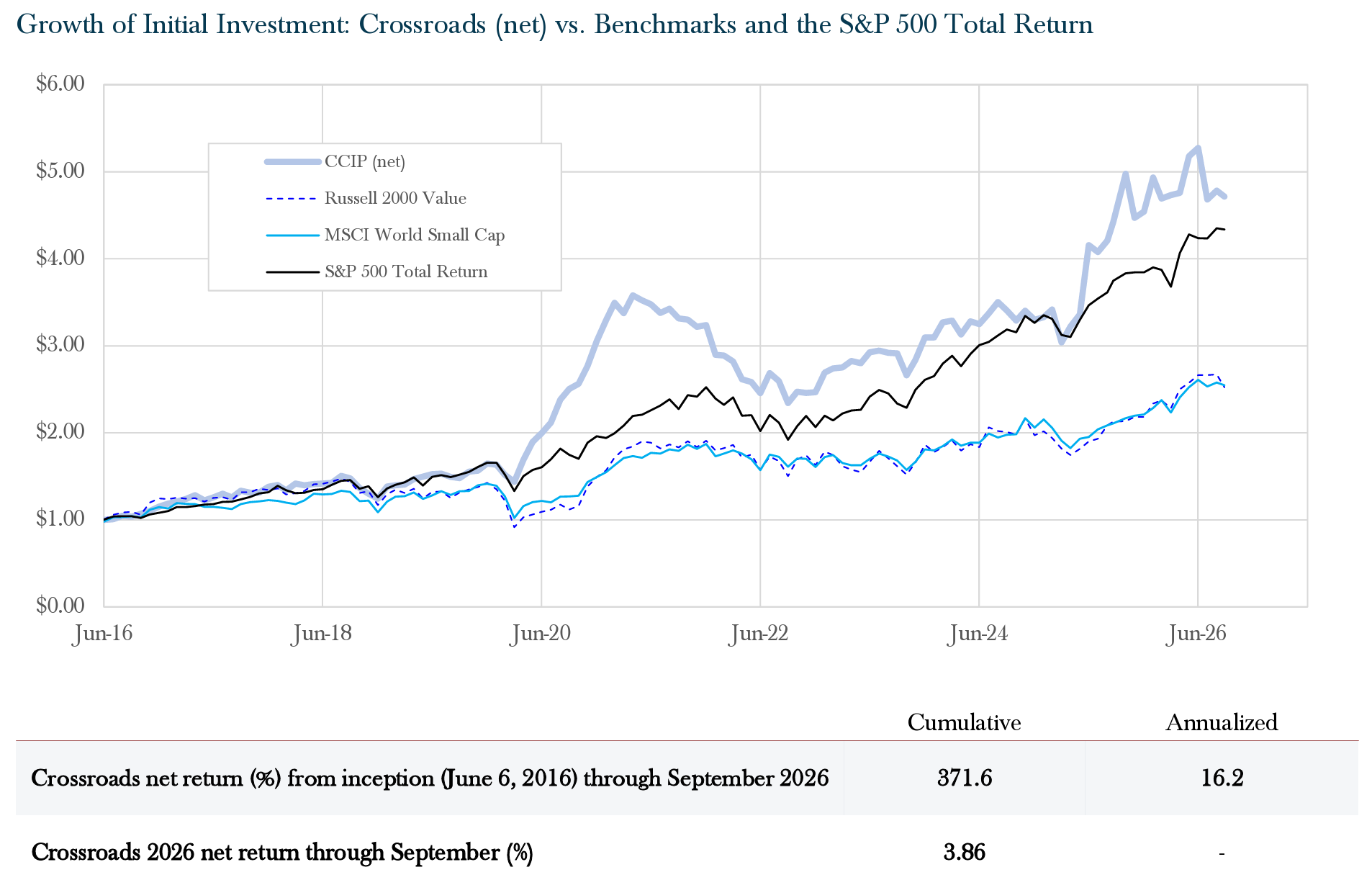
The ride has been bumpy. The fund made 85.5% in 2020 and lost 23.8% in 2022, its worst year, then made 25.4% in 2023 and 37.7% in 2025.
Why I believe O’Connor is a hidden master
Four things stood out as I read the letters:
Ten years ahead of the S&P 500 while making, in the firm’s words, “no material investments in any of the main components of that index”. Most of his investments are smaller, under-followed companies.
He writes about his mistakes. On 2022: “Had I acted while I had the chance, our full year results would have been considerably improved – and that’s on me”. Or on Nebius in 2026: “we sized it too small”.
His own money is in the fund. The team “have not just put our net worth in the Fund, but also our personal and professional reputations”.
Few people know him. And that’s a pity, because his letters are excellent. The fund is a small private partnership: it started in 2016 with about $1 million and managed over $17.5 million in November 2020. He also keeps his ideas quiet: “we prefer to build positions quietly before talking about them publicly”.
🏛 The Playbook: The Crossroads Way
Crossroads’ investment approach is built on a small number of clear principles.
1️⃣ Two buckets, Buffett-style
Crossroads is modelled on Warren Buffett’s partnerships of 1956 to 1969, which they call ‘Buffett 1.0’, and uses the same two buckets:
Compounders. Buffett called these “generals”: undervalued stocks such as Disney and American Express. Crossroads looks for under-followed ‘emerging compounders’.
Special situations. Buffett called these “workouts”: stocks he expected to rise once the company “worked out some issue, problem, or deal”. At Crossroads, an event such as a spin-off, a merger or a restructuring unlocks the value.
Long-time readers will recognise this split from Guru Gems #58 on Marc Werres, whose Hinde Group uses almost the same two categories.

O’Connor has a nice personal connection to Buffett and his early LPs, which he writes about in his 2019 letter.
His grandfather, Bill O’Connor, was an IBM salesman and “an old poker buddy of Buffett’s”. He sold his IBM shares to invest in Buffett’s early partnerships.
Years later, O’Connor asked him why he had never diversified. “Ryan,” he said, “if you knew Warren, you wouldn’t ask that question.”
If you enjoy this newsletter, please help others discover it by clicking 🤍
And if you would like to support my work, consider buying me a virtual coffee ☕
2️⃣ Know why it's mispriced
A low price isn’t enough for Crossroads.