

Welcome back!
Today I’m sharing 2 interesting insights I came across this week.
If you’re new to Guru Gems: I study the world’s best long-term investors and share what I learn.
My latest deep-dive was on Tom Gayner, a highly respected long-term capital allocator who transformed Markel from a small insurance company into a global conglomerate.

I am also building two real-money portfolios based on the Gurus’ wisdom:
Guru Gems portfolio - Quality companies held for years
Magic Formula portfolio - ‘Good’ companies at ‘bargain’ prices held for one year
1️⃣ Rich Pzena: “You don’t get to buy what everybody wants at a low price”
Rich Pzena is the founder and co-CIO of Pzena Investment Management, a deep value investment firm he established in 1995.
I wrote about Pzena and his deep-value playbook a few months ago:

Rich Pzena was recently on the Compound Insights podcast. There are a few really interesting pieces in the interview and I will highlight two that stood out to me.
What Pzena learned from the dot-com bubble
The interview starts with Pzena recounting the early days of starting his own firm in 1995 and the role of luck.
They had good returns during the first 2 years, but then came a period of 2.5 years where the only thing that mattered was the internet and where “stocks went up and up and up and we did nothing and nothing and nothing”.
Pzena significantly underperformed the S&P 500 during that period and investors started to redeem their money.
He tells a story which captures really well the thinking at that time:
A woman came into the office, sat down and said to me: “My grandmother is a better investor than you are…all you have to do is buy Cisco…everybody in the world has figured this out except you and you’re just stubborn.”
And so I tried to do arithmetic with her. At the time Cisco was the first company to hit half a trillion dollar valuation, so I said: “If you’re going to buy the whole company and write a check for $500 billion and you want to make 20% per year return, they have to earn $100 billion a year and they currently earn $1 billion a year. Don’t you think there is something wrong with that?”
And she said: “You don’t get it, do you?”
To which I agreed…
Cisco’s stock price peaked in March 2000, then started declining and 2 years later had fallen to 80% of its peak price, making it one of the prime examples of the dot-com bubble.
Despite the painful redemptions, Pzena had managed to keep his cool and he stayed disciplined throughout the bubble.
This made him well positioned to earn stellar returns for 5 years in a row when the bubble burst.
Moral of the story
I like this anecdote as it serves as a good reminder that companies with good fundamentals (Cisco was profitable and its revenues were strongly increasing) can also get caught up in heavy speculation and unrealistic expectations. (fun fact: Cisco closed at a new all-time high for the first time since the dot-com peak just this week)
Is Nvidia the modern-age Cisco?
Michael Burry certainly thinks so.
It’s difficult to say whether Nvidia will meet the same fate as Cisco, but I could easily imagine a modern version of Pzena’s story where the woman says: “My grandmother is a better investor than you are…all you have to do is buy Nvidia…”
How non-professional investors can pick value stocks
At the end of the interview, Pzena is asked about the initial due diligence or checklist a non-professional investor should look at if they want to pursue a value approach to investing and picking stocks:
“The reality is: the quantitative stuff works. You can buy low Price to Book (P/B) stocks, you can screen on low Price to Book and you have a universe that you could start with. And if you screen on low Price to Book and eliminate the ones that have excessively leveraged balance sheets, it’s a good starting point.
The checklist that I would say, beyond the screen, is where the interesting part comes in, and it depends on how much work you want to do, but you could dig into what’s going wrong with the business and read what the company says they’re going to do to fix it and say: does that make sense or not make sense.
You can look and say: is the history of this company a 20% Return on Capital Employed (ROCE) over the last 25 years or a 5% Return on Capital Employed. And so if I could find a 25% that’s selling at a low price, where it sounds sensible what they’re doing, it’s a very good start if you don’t have a giant team of research people, but it’s not work-free.”
Pzena suggests that DIY investors can look for ‘cheap’ (low P/B) and ‘good’ (high ROCE) as a first filter before doing further research on a stock.
This sounds very much like Joel Greenblatt’s Magic Formula and it is indeed the basis for my Magic Formula portfolio. The main difference is that Greenblatt suggests EV/EBIT instead of P/B.
Buying a group of these companies is a way to mitigate having to do much analysis on the individual names as the formula is supposed to work ‘on average’.
Next week’s Guru Gems post will incidentally be Round 5 of the Magic Portfolio, so make sure to subscribe if you don’t want to miss it!
If you enjoy this newsletter, please help others discover it by clicking 🤍
2️⃣ GMO: “It’s probably a bubble” (But that’s OK)
My second learning of the week comes from GMO’s Quarterly Letter. GMO is the investment firm co-founded by Jeremy Grantham.
Grantham is a British billionaire investor who famously identified the tech bubble of 2000 as well as the global financial crisis of 2008. (Although some would argue that he is often warning for bubbles and therefore bound to be correct occasionally…)
Usually, when people call for a bubble, they imply you should sell everything and hide in cash or gold, but GMO’s Quarterly Letter actually offers some guidance as to what investors could do if they are ‘agnostic’ about whether or not there is a bubble.
Party like it’s 1999
At the end of the nineties and early 2000, the S&P 500 (driven by tech) became incredibly expensive and had negative expected returns.
But almost every other asset class (Small Caps, REITs, Emerging Markets,…) was cheap and priced to deliver strong returns.
“With U.S. large cap stocks trading at their highest valuations ever, their expected return was significantly negative in real terms. But for an investor prepared to look elsewhere, there was plenty to do. Several other risk assets were trading cheaply relative to history and offered better-than-normal expected returns”
The lesson here is that you didn’t need to predict the crash to make money in 2000, but you needed to own what wasn’t in the bubble.
So what about today?
GMO argues that the current market looks very much like the Internet Bubble at the end of the nineties (many others, including Burry, are making the same analogy by the way).
The AI Bubble has inflated US Large Caps to dangerous levels, but just like in 2000, other assets look much more attractive from a Risk/Reward point of view.
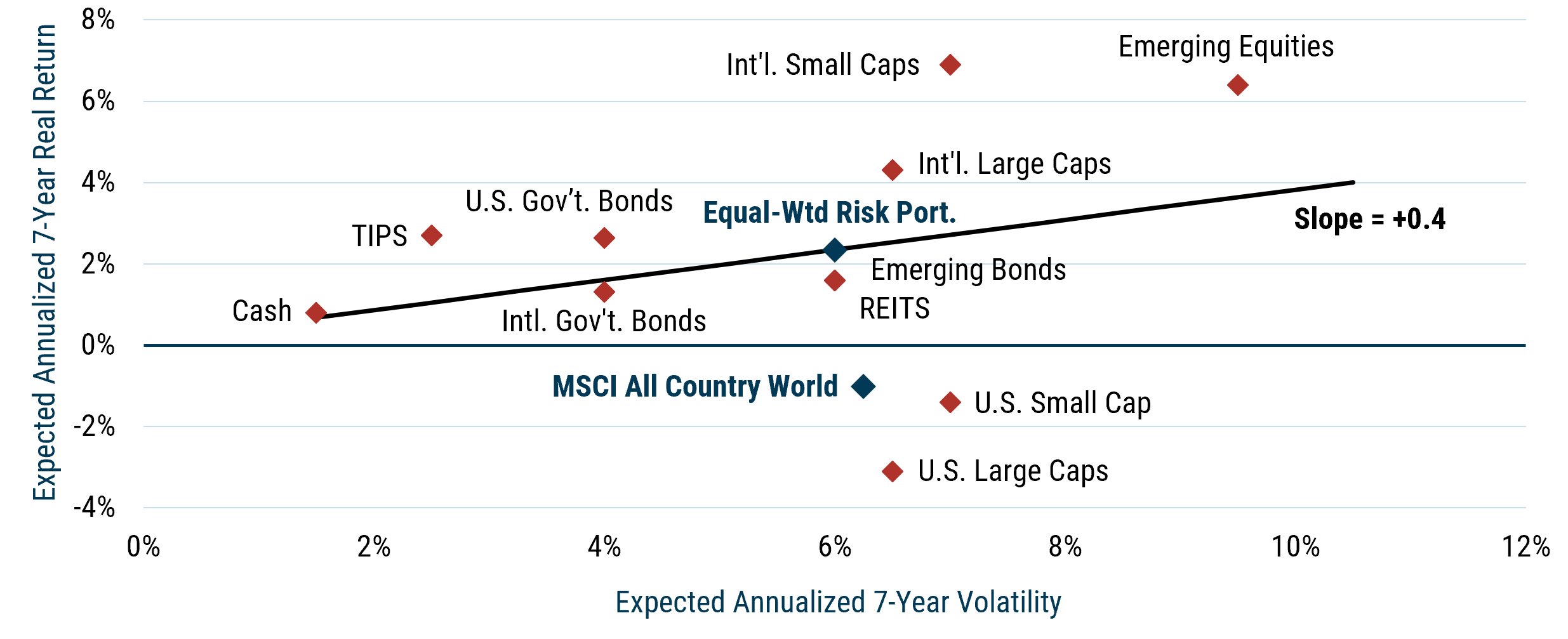
According to GMO’s data, an ‘agnostic investor’ can build a portfolio that can win “if the bubble is a bubble and should also do just fine if all is normal”.
The key is to own very little U.S. equities, which is not an easy thing to do for many investors, given U.S. equities have significantly beaten the rest of the world over the last 15 years.
☝️ My Takeaway
For me, the learning from Pzena’s interview as well as GMO’s Letter can be summarized in one sentence:
You need to look where others aren’t looking.
🅱️ Bonus material
While I was writing this week’s update, Howard Marks released his latest ‘Memo’, on the topic of … you guessed it: bubbles!

It’s yet again a brilliant memo with lots of food for thought.
Since no one can say definitively whether this is a bubble, I’d advise that no one should go all-in without acknowledging that they face the risk of ruin if things go badly. But by the same token, no one should stay all-out and risk missing out on one of the great technological steps forward. A moderate position, applied with selectivity and prudence, seems like the best approach. — Howard Marks in ‘Is It A Bubble’
If you want to learn more about Howard Marks, I wrote about key lessons from Marks’ book ‘The Most Important Thing’, which many consider to be one of the best investing books of the past two decades:

EDIT: Just as I was about to hit the ‘Publish’ button for this post, I saw that William Green released a new episode of my favorite podcast Richer, Wiser, Happier with none other than Howard Marks!
🕺Super Bonus
I thought it would be nice to end this week’s newsletter on a lighter note…and since we talked about partying like it’s 1999, here’s an iconic song for you :)
That’s it for this week! Please like or share if you find these insights valuable.
You can follow me on X @guru_gems and Substack @gurugems for more insights.
Until next week!

Fascinating. Your analysis on Pzena’s insight about not buying popular assets cheaply resonates though the concept of ‘value’ becomes even more intricate in rapidly evolving tech sectors where future potential often drives perception more than current metrics.