

Welcome back and thank you to all new subscribers for joining Guru Gems!
Today I’m sharing my thoughts on 2 things that caught my attention this week: a long interview on one of my favorite podcasts, and an earnings update of one of my Guru Gems.
2 minute AI audio version:
New to Guru Gems? Start here.
1️⃣ Chris Begg: “Alphabet remains one of the most extraordinary businesses ever built”
As you may know, I’m a big fan of the Richer Wiser Happier podcast series. This week I listened to a recent episode with Chris Begg, who runs East Coast Asset Management and teaches the Security Analysis course at Columbia Business School (the same course that Ben Graham taught to Warren Buffett in 1951).
Long-time Guru Gems readers may recognise this name. Back in April 2025, in the second edition of this newsletter, I quoted Begg from an earlier episode of the same podcast (RWH #56):
“Volatility is our friend, always. The price we pay will determine the rate of return.”
In that issue I listed the Gurus who owned Alphabet, and East Coast had 15% of the portfolio in it. Today it is 17% and still Begg’s largest position. Alphabet is also the largest holding in the Guru Gems portfolio, so I listened very carefully to this episode.
East Coast Asset Management portfolio
Before we get into the interview, let’s have a look at Begg’s latest portfolio. Looking at the Q2 13F filings, it shows 65 positions in total.
What’s a bit strange is that in the interview Begg says “we own less than ten companies in our portfolio.” There is a long tail of companies and ETFs which are less than 0.2% of the portfolio, so it could be that many of these are either legacy positions or companies they recently started looking into.
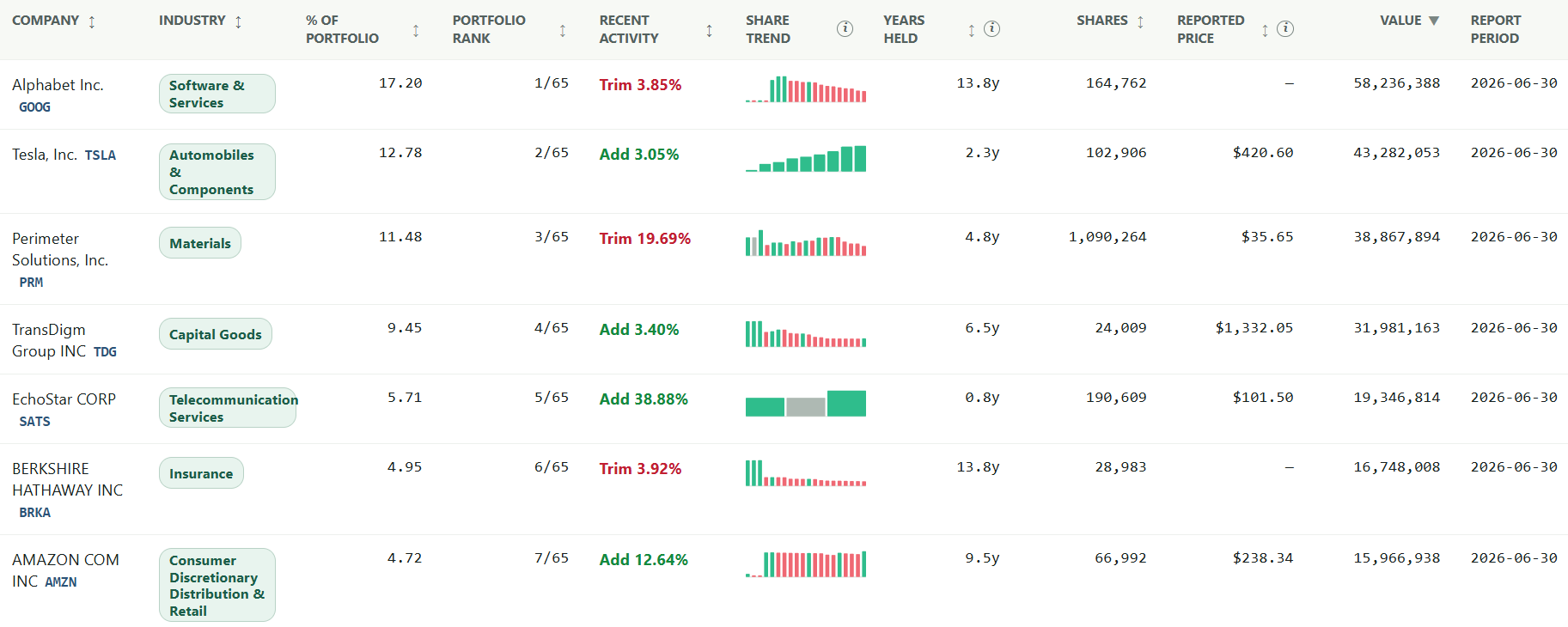
The seven names listed above are about two thirds of the reported portfolio, and he mentions nearly all of them in the interview. Begg calls them his “Grove of Titans”.
Constellation Software, a recent position and also one of my Guru Gems, trades in Toronto so it doesn’t show up in the 13F filings.
Pillars, clouds, and graphs
Begg wants three pillars in every Grove of Titans business: 1) a moat that is widening, 2) secular tailwinds driving the top line, and 3) a human element, meaning operators with a history of intelligent capital allocation.
The best time to buy these titans, according to Begg, is when there are ‘clouds’ around the business.
“When you get the quality at a reasonable price, there’s usually clouds.”
A cloud, as he puts it, is “a perception that something might change versus evidence that it is” and his research is organised around one question:
“Much of our research effort is devoted to a simple question. Are the clouds temporary or permanent?”
Alphabet, the ultimate ‘graph’
Begg describes Alphabet as a graph. A graph is a mathematical structure used to model pairwise relations between objects (read more here).
“At its core, it is a graph designed to organize the world's information and make it universally accessible and useful.
[…] Nodes and edges populating across a domain, [producing] increasing returns to scale […] instead of the diminishing returns most businesses run into as they get bigger.”
He argues that this is what a lot of people misread about the last decade of technology: the big platforms did not slow down as they scaled, their growth accelerated.
The two clouds for Alphabet were the threat to search and blue links as well as the antitrust case, and East Coast owned the business at fifteen times earnings while both were still hanging there. Note that this is also when Guru Gems bought Alphabet… ;)
Search volumes went up with AI rather than down, the ruling went their way, and the stock rerated. In his words: "it was almost like we woke up one day and the cloud was gone."
Begg still owns Alphabet as his largest position, and he believes Alphabet remains one of the most extraordinary businesses ever built.
He sees Alphabet as a collection of fantastic businesses (Google Cloud, YouTube, Waymo, …) with at the core a leading AI effort under Demis Hassabis at DeepMind that runs well past building LLMs, into work like AlphaFold.
"There’s a large AI effort that Demis has led, which is leading to all kinds of different applications we saw with AlphaFold, health care breakthroughs, AGI, ASI.
So we think there’s a lot of things that are misunderstood about their AI advantages and how broad it is.”
Constellation Software: ten years of homework
Begg has been studying Constellation Software for over ten years. He knows Mark Leonard and has had him in the Columbia classroom three times. He knew the business very well, but in all those years he never owned any shares, because it was always fully valued.
Then came the software apocalypse, what Begg calls “the biggest cloud of 2026”, and the stock fell 50% from its highs.
That is when East Coast went to work, studying the business even deeper and taking the whole team to Constellation’s investor day in Toronto to meet Mark Miller and the division heads. Then they bought.
“The cloud that is still resident around software is a perception that these assets could be disrupted versus any evidence that they are.”
Norbert Lou’s playbook
Listening to Begg talk about his Constellation purchase made me think of a similar story from a different Guru.
Last October I wrote about Norbert Lou of Punch Card Capital, who watched TGS-Nopec for seven years without buying a single share. Then Deepwater Horizon blew out in April 2010, Washington shut down drilling in the Gulf, and a company that earned roughly half its money there fell to six times after-tax earnings.
TGS-Nopec, in Lou’s words, “was priced as if the Gulf of Mexico would never re-open.” He started buying in June, and the stock rose 90% over the back half of that year.

“When you can be really patient and selective, you have the luxury of waiting for that confluence of multiple forces.” — Norbert Lou
Constellation’s risk to watch
Begg says that what he is watching now is churn at Constellation’s individual businesses. If that starts accelerating, the cloud is real and he is wrong.
But so far he is finding the opposite, with AI something that can be layered on top of these businesses rather than the thing that kills them.
Tesla and SpaceX: the Value 3.0 lens
Tesla is a stock most value investors cannot picture in their portfolio.
In my 10 May issue I wrote about Christopher Tsai and his Value Investing 4.0 essay. Tsai has Tesla as his largest position (22%) and believes it is deeply misunderstood. Begg is now in the same camp, at nearly 13% of his portfolio after adding again in Q2.

I think the interesting part to understand is not whether he is right about Tesla and SpaceX, but how someone who teaches Ben Graham’s course ends up here at all.
The framing he uses is ‘Value 3.0’, a label he shares with James Anderson. Graham was 1.0, a dollar of assets for fifty cents, margin of safety in the balance sheet. Buffett and Munger were 2.0, a wonderful business at a fair price, margin of safety in the discounted cash flows.
In 3.0 the margin of safety comes from the end state. Begg suggests Nick Sleep was already doing this with Amazon, which looked expensive on every 1.0 and 2.0 measure and turned out, in hindsight, to be one of the cheapest companies in the world.
He says that the one thing that does not change across the three is asymmetry:
“Everything that a value investor does and thinks about has to be asymmetric,”
So rather than modelling next year he asks what a business is worth in ten and works backwards, which is close to what Bill Miller once told William Green: he was not buying at a discount to what things are worth, but at a discount to what he believed they would be worth.
It also explains why he has no regrets about passing on Tesla in the early years. Back then you were still underwriting whether the thing could be built at all. He waited until the platform existed and only then started counting what could be built on top of it. He sees five businesses inside Tesla, five inside SpaceX, and he expects a merger of the two within twelve months.
I don’t think I will be adding either name to my watch list any time soon, but I do want to keep an open mind about the frameworks used by these investors.
→ If you enjoy this newsletter, please subscribe and help others discover it by clicking 🤍
→ If you find value here, consider buying me a virtual coffee ☕
My most recent Guru deep-dive is on Seth Klarman, one of the great quality investors. I recently updated the post with Q2 portfolio data and it is quickly becoming one of my most read posts, so check it out if you haven’t yet!

2️⃣ Copart buys ACV Auctions
Copart reported Q4 fiscal 2026 earnings on Thursday. It is one of my Guru Gems, and I first looked at it in August 2025 when I profiled Peter Keefe of Rockbridge Capital.
Last week I flagged three things I would watch in Copart's Q4 earnings.
The quarter itself
Fiscal Q4 was not exactly spectacular, with EPS of $0.35 against $0.41 a year ago and full year EPS of $1.55 versus $1.59. Full year revenue came in at $4.7 billion, a 0.4% increase over prior fiscal year.
The biggest news was the ACV Auctions acquisition, which I will cover in some more detail below.
First, a short update on the three points I was watching before the call:
1. Reallocating capital. Copart announced an all-cash deal to acquire ACV Auctions, a digital dealer-to-dealer marketplace selling over 800,000 vehicles a year, and plans to use its 275+ physical locations as staging and marshaling hubs for ACV’s land-light model.
2. Volume recovery. Global unit sales fell 2.9% in the quarter, with the US down 5.7% and international up 10%. Excluding a single lost customer account, Adair said US insurance assignments would have been up 2.3%. Total loss frequency reached 23.3%, a record for a second calendar quarter.
3. The balance sheet. Copart closed FY2026 with $4.5 billion in cash and held-to-maturity securities. Even after funding the ACV deal, CFO Leah Stearns said it retains more than $2 billion in cash plus a $1.25 billion undrawn credit line and no debt outstanding.
What Copart actually bought
ACV is a digital marketplace for wholesale vehicles, mostly dealer to dealer: $10 billion of annual gross merchandise value, 22,000 unique buyers, 70,000 transactions a month, plus a transportation arm, a floorplan lender (ACV Capital) and an inspection stack including VIPER.
Copart is paying $10.50 a share, valuing ACV at $1.9 billion, a 45% premium to where ACV traded on 10 August, the last day before media reports of a possible deal.
“ACV sells more than 800,000 vehicles each year and, importantly, operates with virtually no land of its own” — Jay Adair
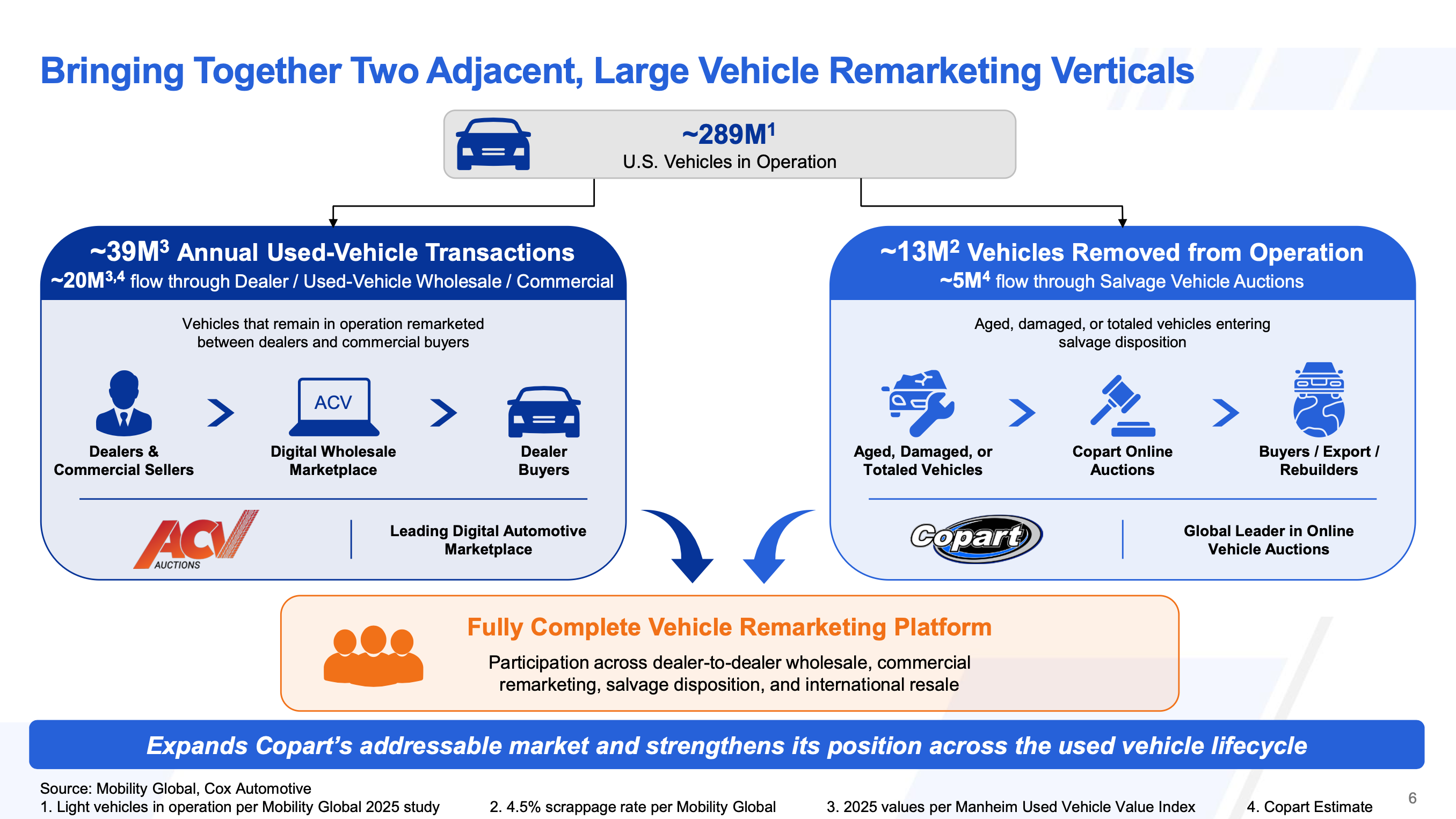
Why they bought it
1. Totalled but not wrecked
In the earnings call, Adair talks about how complicated cars have become, with an interesting comparison: a military drone runs on about 3.5 million lines of code, an Airbus on 30 million, Windows 10 on 50 million, and a new Tesla on roughly 100 million.
“When we think about cars, they really are becoming computers on wheels. We believe total loss frequency will continue to go up.”
And it is indeed already going up. Total loss frequency hit 23.3%, a record for a second quarter, and average collision severity passed $6,300 a claim, up 8.8%.
The consequence, in Adair’s words, is that:
“More often than not now, you’re seeing cars that don’t look like they should have been totaled, but they’re economic totals. While they’re still drivable, while they’re repairable, they’re economically totaled.”
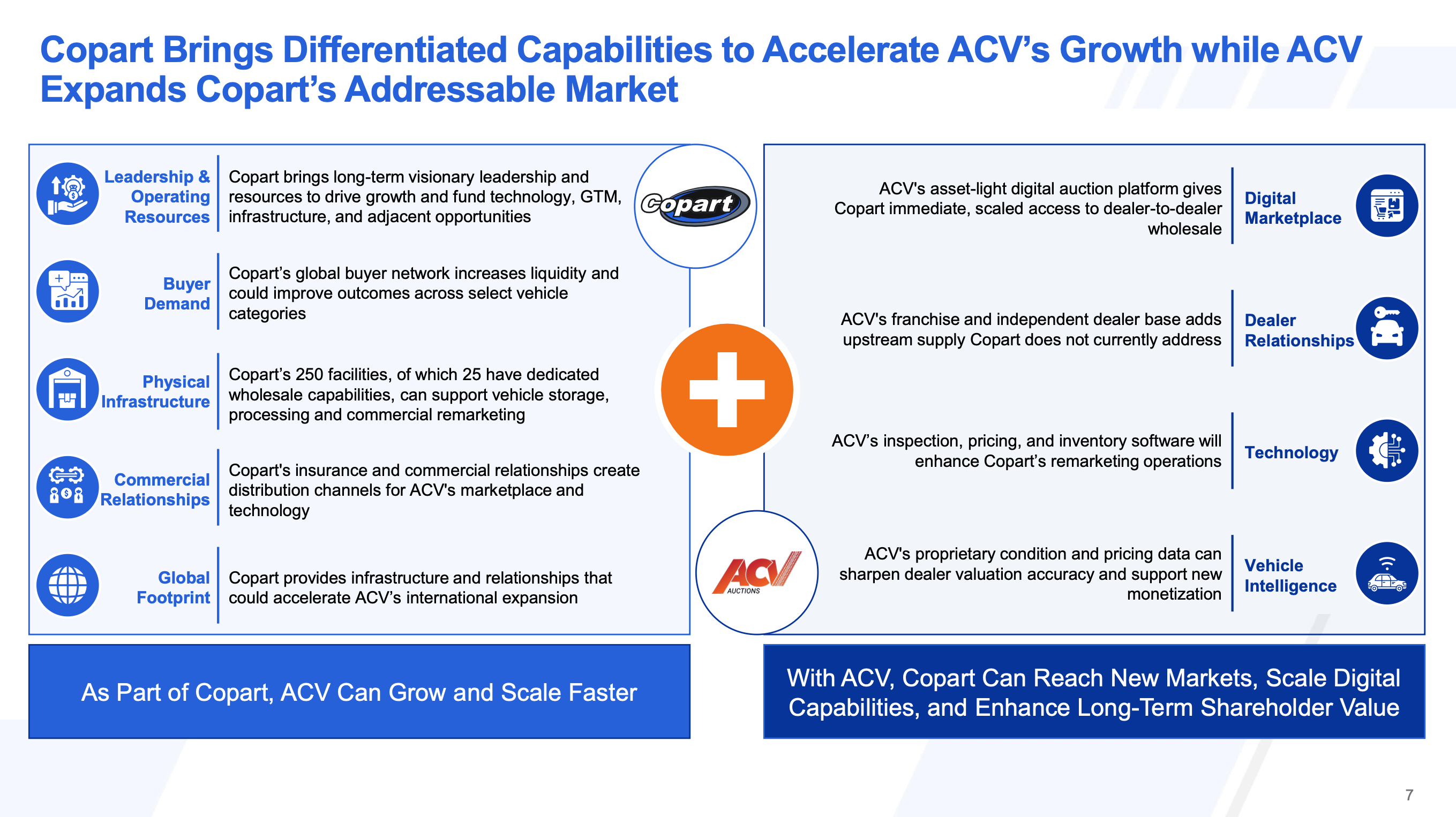
Copart’s buyer base was built for wrecks: dismantlers, rebuilders and exporters. The natural buyer for a drivable, lightly damaged car is a franchise dealer, and those are exactly the buyers ACV will bring them.
Adair again:
“Think about every car that is not damaged or lightly damaged is going to be put in front of thousands of dealers.”
2. Growth without land
Copart has always grown by buying and building yards, spending $569 million on property and equipment in FY2025 and $337 million in FY2026. ACV adds more than 800,000 units a year without an acre.
Adair wants to run ACV's cars through Copart's existing yards, and it works the other way too.
When asked how a physical network helps a digital business, he described a dealer with 50 cars that nobody can efficiently collect:
"With Copart, we can move those vehicles over to Copart, and then a nine-car coming through can pick those up on their time and bring them down to Mexico or bring them to a port."
ACV's lower-end trade-ins are vehicles "our international buyers, especially Mexico, just love."
3. Buying what they could not build
This is not Copart's first go at whole car, meaning undamaged vehicles rather than salvage.
It launched Dealer Services back in 2007, and sellers other than insurers now make up about a quarter of its volume. But its own Copart Direct programme saw volume fall 34.5% this year, and the franchise dealers never really came.
Asked why the earlier attempts had not made a bigger splash, Adair replied:
"To get into those franchise dealers and get into the higher-end trades, I think does take a different product. ACV is a different product than Copart."
The deck says the same thing more politely: “ACV's […] dealer base adds upstream supply Copart does not currently address".
What it costs
So what does $1.9 billion buy them? ACV guided its own 2026 to roughly $850 million of revenue, $73 to $77 million of adjusted EBITDA and a GAAP net loss of $44 to $49 million. Copart has paid a 45% premium for a business that does not yet earn a GAAP profit, in a year when its own EPS went backwards.
On the earnings impact, Copart expects the deal to be neutral on EPS in the first full year and accretive from fiscal 2028. There are no numbers yet on near-term cost and synergies, but Adair is relying on their track record to create value:
“Copart has a very strong track record of driving strong return on invested capital across the businesses it has acquired.”
What’s next
Both boards have approved the acquisition and management expects to close by calendar year end.
When asked whether this rules out further M&A, Adair said:
“I don’t think this prohibits us from doing any future acquisitions. We’re looking at other businesses that we may want to acquire in the auction space.”
That’s it for this week! Please like or share if you find these insights valuable.
You can follow me on Substack @gurugems and X @guru_gems for more insights.
Until next week!