

Welcome to a very special edition of Guru Gems.
This is newsletter #52. One full year of studying the world’s long-term investing masters every single week.
When I started Guru Gems in April 2025, I had a simple idea: study the best investors, share what I learn, and build a real-money portfolio based on their wisdom.
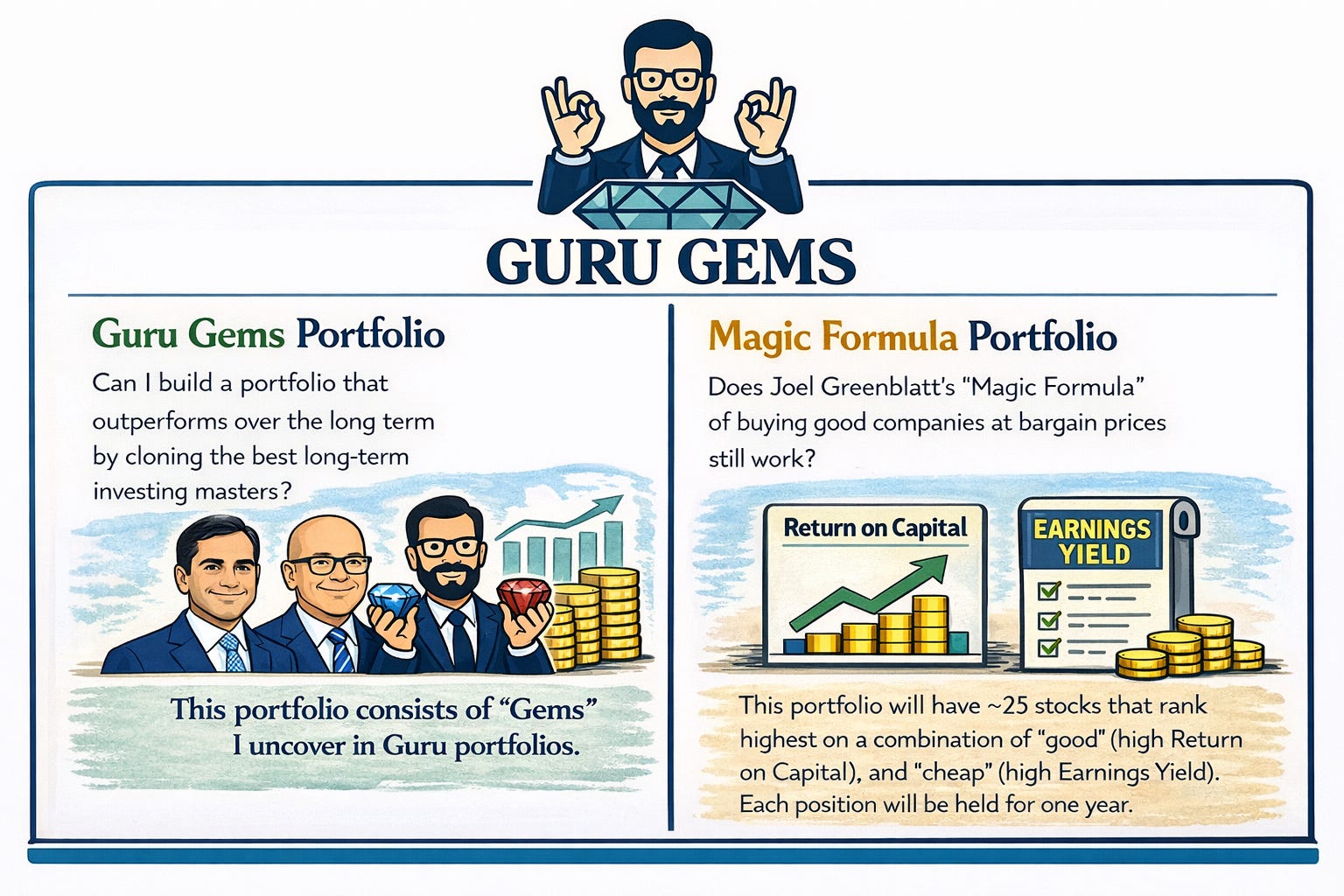
Along the way, I also started running a Magic Formula portfolio inspired by Joel Greenblatt, giving me two very different lenses on investing: concentrated quality on one hand (Guru Gems portfolio), systematic value on the other (Magic Formula portfolio).
52 newsletters later I can tell you this has been a very rewarding learning journey.
In today’s anniversary edition:
📊 Guru Gems Year 1 by the Numbers
💎 How the Portfolios Are Doing
📚 3 Lessons I’ve Learned After Studying Gurus for a Year
☑️ The Intelligent Investor Checklist 2.0 (refreshed with new Guru wisdom)
🏆 The Guru Gems Hall of Fame
📋 2026 Watchlist
📊 Guru Gems Year 1 by the Numbers
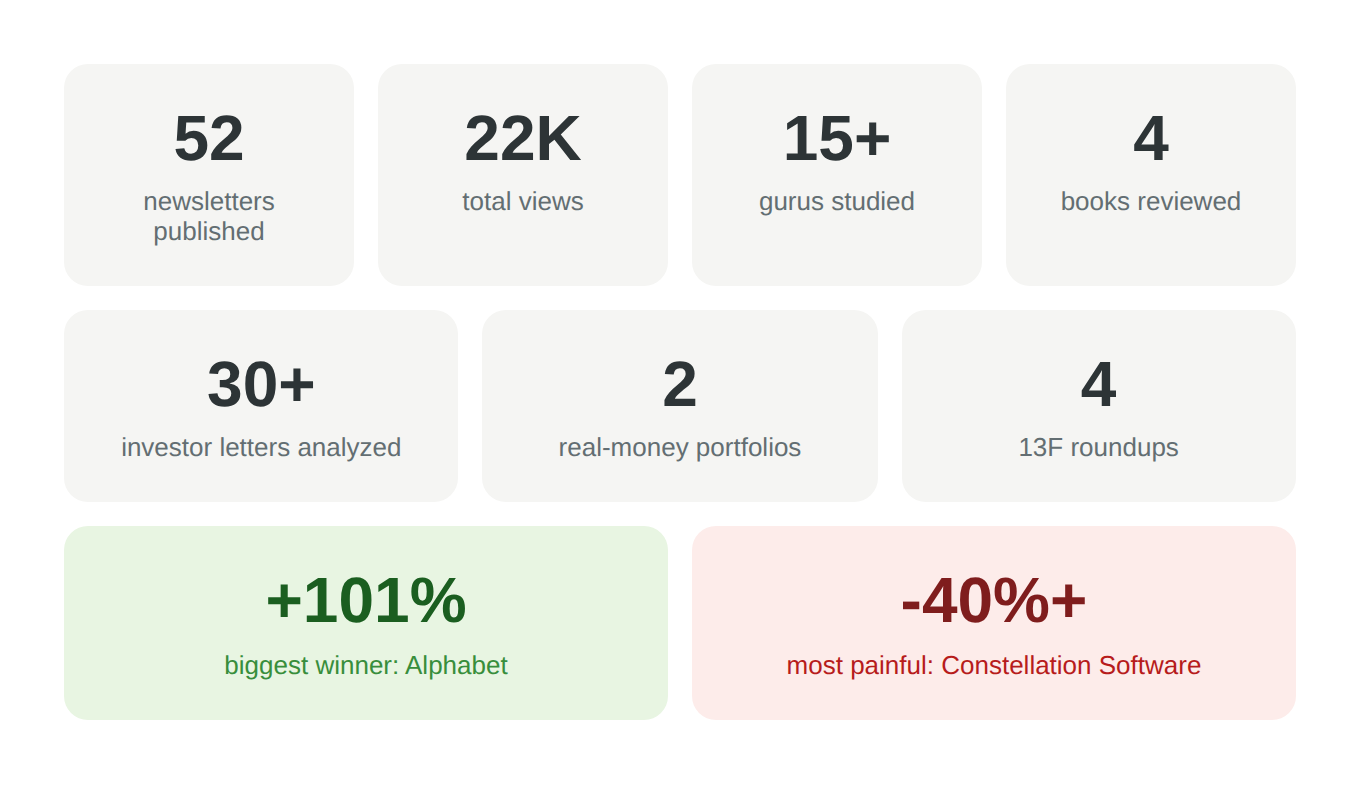
One year ago, I wrote one of my first posts asking: “Is Alphabet the ultimate Guru Gem?”. At the time, it was the most-held stock among long-term Superinvestors, yet the market was done with Alphabet (“ChatGPT will kill Google!”). Buying it at $157 turned out to be my best decision of the year.
The most popular post of the year? My deep-dive on Norbert Lou and the Punch Card Mindset. Something about a quiet, ultra-concentrated investor who only needs a handful of great ideas in a lifetime clearly resonated with this community, and was viewed 1300 times.

You can browse the full archive of all 52 newsletters here, categorized by theme.
💎 How the Portfolios Are Doing
One of my goals with Guru Gems is that I want to be fully transparent about the performance, both the good and the not-so-good.
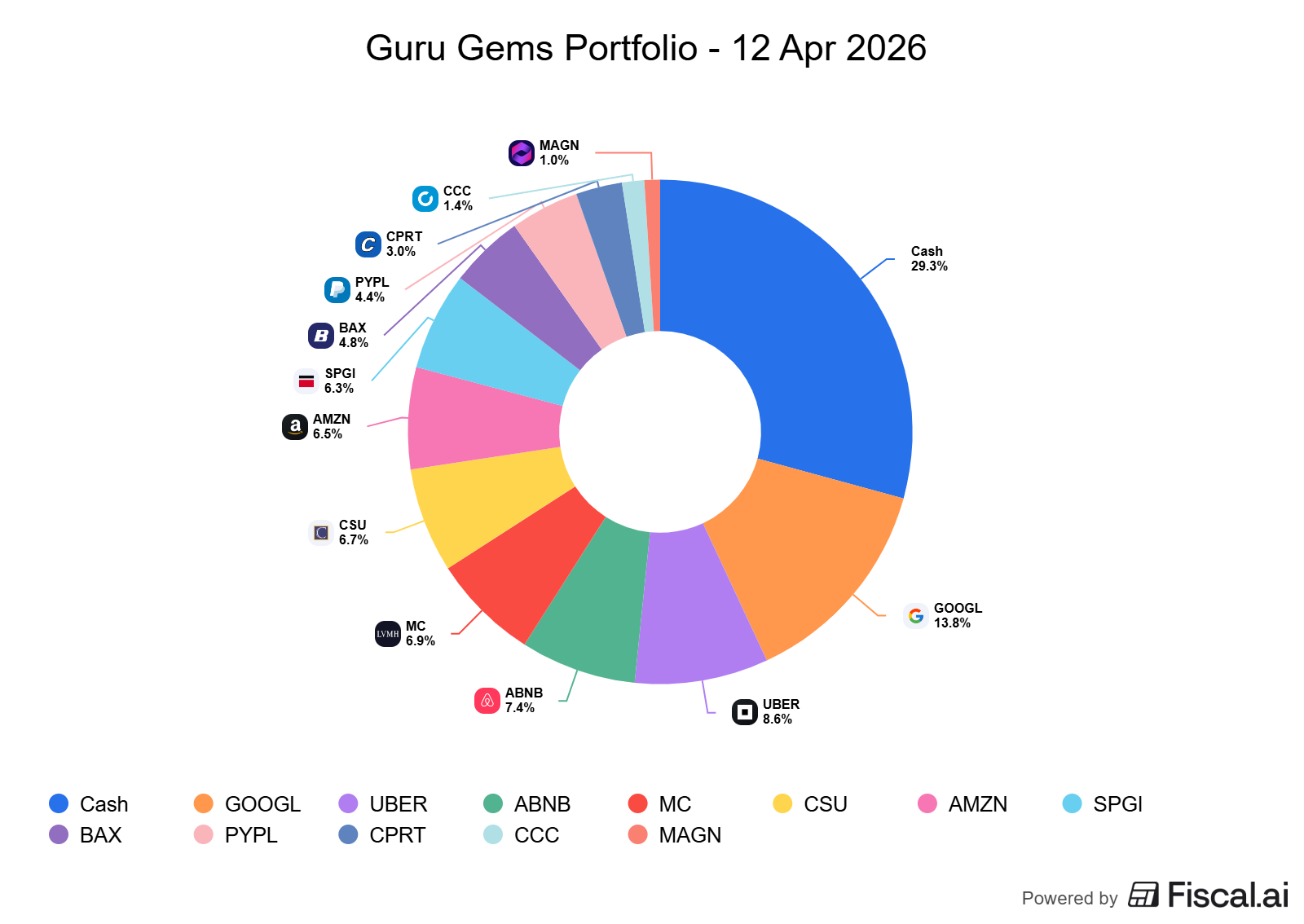
Guru Gems Portfolio
The portfolio finished 2025 up +17% on invested capital, driven primarily by Alphabet’s phenomenal run (+99% by end of December).
But 2026 has been a different story. The SaaSpocalypse hammered Constellation Software (CSU) and CCC Intelligent Solutions (CCC), LVMH had its worst-ever start to a year, and PayPal fell 20% in February following weak earnings and a CEO change.
As I shared in last week’s “Podium of Errors,” I made mistakes, particularly on position sizing with CSU.
I still strongly believe in the companies I am invested in as well as my process. As Rochon wrote about one of his long-term winners: after the first four years of owning it, they still hadn’t made a profit.
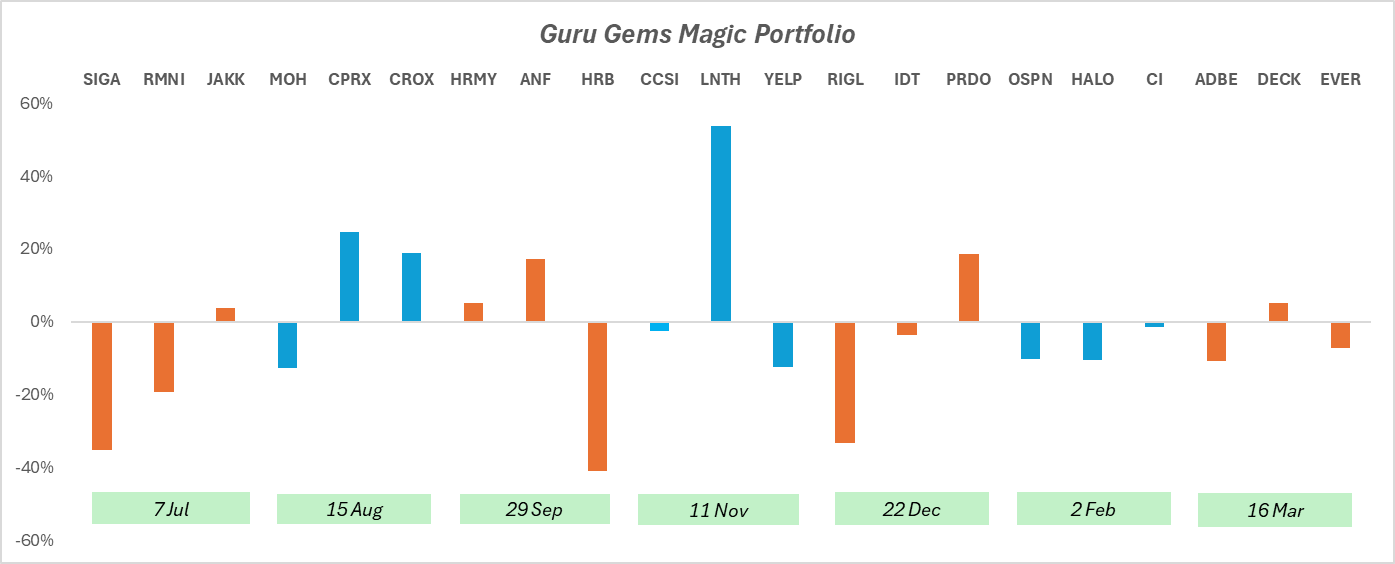
Magic Formula Portfolio
My Greenblatt-inspired portfolio, which I started in the summer of 2025, naturally tilts towards small-cap value names, particularly in healthcare. Small caps have been significantly underperforming the S&P 500 (I wrote about this cycle in November).
The Magic Formula portfolio has had a bumpy ride, and is currently at -2%.

I continue to add new names every few months as Greenblatt instructs. The whole point of this strategy is mechanical discipline over a multi-year period, so it’s too early to judge.
→ If you enjoy Guru Gems, please subscribe and like this post 🤍
→ If you find value here, consider buying me a virtual coffee ☕
📚 3 Key Lessons After Studying Gurus for a Year
After spending hundreds of hours reading investor letters, studying portfolios, reviewing books, and listening to podcasts, here are the 3 key lessons that have stuck with me the most.
1️⃣ Patience is the ultimate edge
I know this sounds like a cliché. But after studying 15+ Gurus for a year, patience really is the ultimate edge.
Chris Hohn, who has compounded at 18%+ per year, put it best: “They say there is no free lunch in finance, but I do think long-termism in a great company is a free lunch.”

François Rochon owned O’Reilly Automotive for four years before making a profit, and it went on to become one of his biggest multi-baggers. Chuck Akre thinks in 5 to 10 year horizons. Bryan Lawrence may go a full year without a single new idea. Peter Keefe described Copart as a “multi-decade compounding opportunity.” Chris Davis has held Capital One for over a decade.
All of them essentially apply the same principle which Terry Smith nicely summarized as:
Buy Good Companies
Don’t Overpay
Do Nothing (as long as the thesis remains unchanged)
2️⃣ How you behave after you invest matters more than what you pick
This is the most powerful insight I took away from the book Stock Master Maestros. Lee Freeman-Shor’s data showed that what separated great investors from the rest was not stock selection but execution: how much they let winners run, how fast they cut losses, and whether they doubled down on losers.

Greg Padilla's 216% payoff ratio comes from a simple rule: invest a standard 2-2.5%, let the position float, and almost never add to losers.
The first part of this rule, a smaller position size, is something I had to learn the hard way. I bought CSU right before the SaaSpocalypse, and as it kept falling, I added more. If I had followed Padilla's approach, the damage would have been much smaller.
This is why in my recent “Podium of Errors,” I gave the 🥇 gold medal mistake to position sizing on Constellation Software.

3️⃣ A checklist saves you from yourself
Finally, the third big lesson for me is the importance of imposing (and following) a set of pre-defined rules for yourself.
I wrote about this in November when reviewing ‘The Intelligent Investor’, but it’s clear that this is something all of the successful investors apply.
“By imposing a rule on yourself - I will never buy a stock without first completing a checklist - you can avoid the heartache that comes from selling in a panic after buying on an impulse.”
—Jason Zweig

When I published the original Guru Gems Intelligent Investor Checklist back in November, it was inspired by the wisdom of Benjamin Graham and Jason Zweig, with Guru-specific checks layered on top.
After studying more Gurus, I think it’s time for an upgrade, and I am happy to share with you the Guru Gems Intelligent Investor Checklist 2.0

The WAWI exercise from Greg Padilla (“Why Are We Idiots?”) is my favorite addition. I really like this idea of writing down the top 3 reasons why an investment could fail. If you can’t identify clear risks, you probably don’t understand the company well enough.
🏆 The Guru Gems Hall of Fame
Looking back at Year 1, I want to highlight the Gurus that left the biggest impression on me.
🥇 François Rochon — 15% annualized returns over 30+ years. His annual letters are masterclasses in rational, long-term thinking and his humility and consistency are very inspiring. Re-reading his letters from 2010 onward was one of my favorite research projects this year.

🥈 Chris Hohn — 18%+ annualized returns over 2 decades, using a ‘Fortress Business model’ playbook. Hohn is very selective in the industries and companies he invests in, and once he finds a fortress business, he uses time horizon arbitrage as a competitive advantage (he calls it ‘Extreme long-termism’).
“If you find something good — and it’s going to be good long term — stick with it. Don’t assume newer is always better.”
🥉 Bryan Lawrence — Running a portfolio of just 10 stocks with extraordinary discipline. Lawrence has proven that focused, patient investing can generate exceptional returns. His ‘concentrated quality’ approach and his willingness to go a full year without a single new idea really challenge you how to think about portfolio construction.

📋 Guru Gems Watchlist
The market turbulence in Q1 has made several high-quality companies significantly cheaper.
In my recent post on Stock Master Maestros, I included an update on 5 companies on the watchlist that I believe are becoming attractive: MOH, FICO, MELI, CPNG, MA.
I’m watching these very closely and may add them to the portfolio at some point.
Here is a screenshot of the top companies on my watchlist.
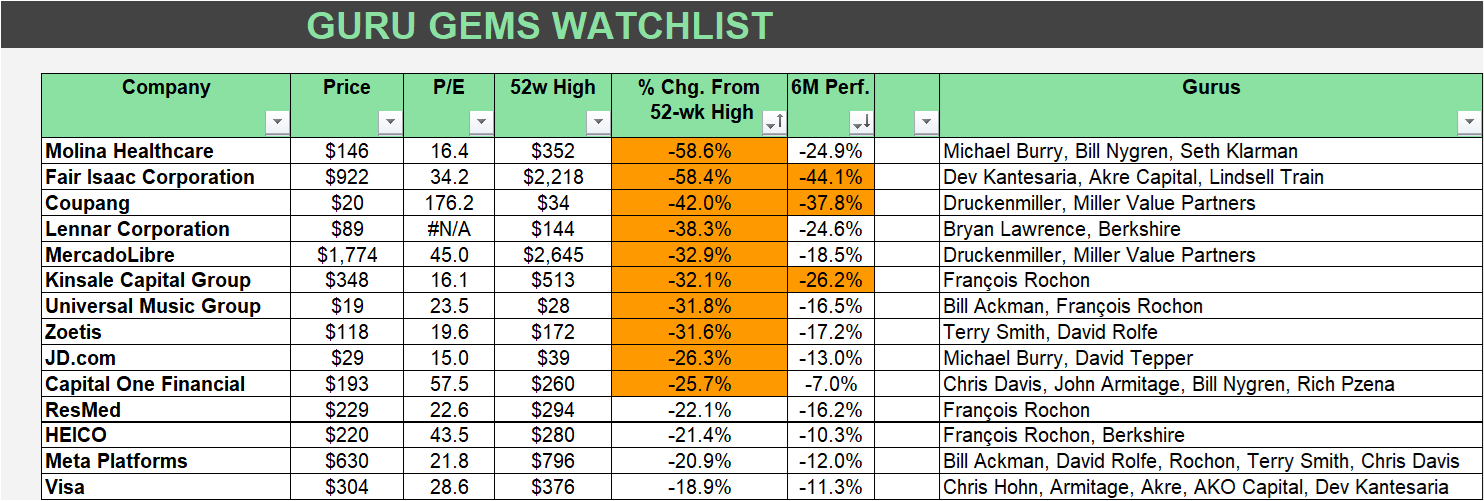
You can access the full watchlist in the Guru Gems Master Google Doc.
🔮 What’s Next for Year 2?
A few things I’m excited about for the year ahead:
More Guru deep-dives — There are so many incredible investors left to study. In this first year I have covered mostly well-known names, so going forward I will try to cover also some lesser-known Gurus.
More international Gurus — Most of my coverage has been US-focused. I want to explore great investors in Europe and Asia.
Continuing the Magic Formula — Ever since I read Greenblatt’s book for the first time many years ago, I was fascinated by this idea that if you consistently buy companies that are ‘cheap’ and ‘good’, you can beat the market. So far, this hasn’t proven to be true, but I definitely want to give this 2 full years before rethinking it.
Continuing to share openly — I believe my recent ‘Podium of Errors’ post was well received. I plan to keep sharing both the wins and the losses. That’s what makes this real.
Please share any suggestions you may have on investors, companies, books, podcasts, … you would like me to cover with Guru Gems.
Thank You 🙏
To every single person who has subscribed, read, liked, shared, or commented on Guru Gems this year: Thank You!
Writing Guru Gems every week has been intellectually very rewarding. I started this as a way to document my own research and to keep myself accountable as an investor, and didn’t know if anyone would care about a newsletter where someone studies the world’s best investors.
Now with hundreds of followers and subscribers, I am even more motivated to keep going, so I hope you’ll stay for the journey and please make sure to spread the word ;)
Here is to finding more Gems in Year 2!
“I try to be more knowledgeable each year as an investor”
— John Templeton
Thank you for reading, I will be back next week with a new Guru and a new Gem!
Congratulations Guru Gems! Have enjoyed reading every single newsletter.
Congrats!