
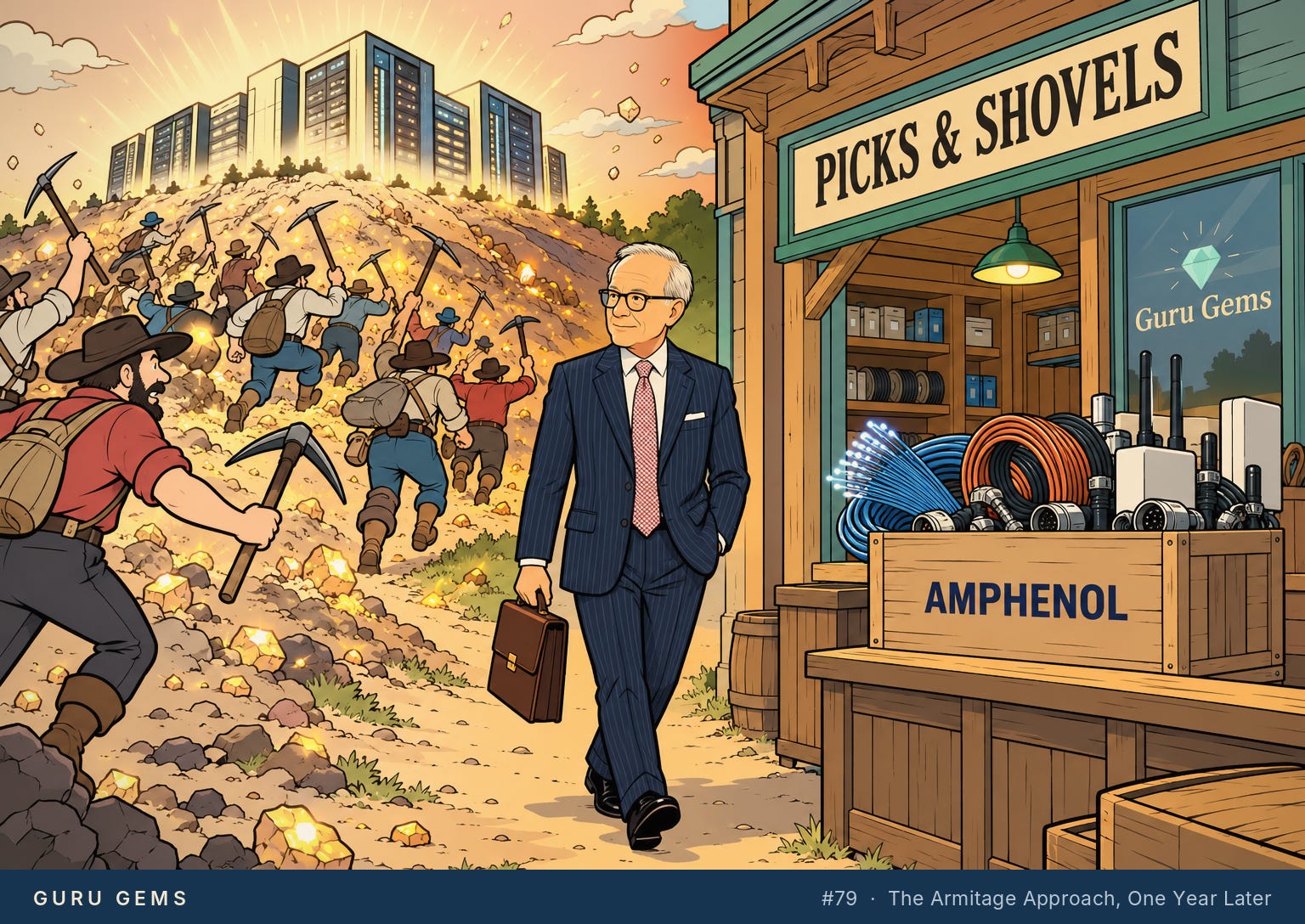
“There’s a difference between a good company and a good investment.” —John Armitage
Welcome back!
One year ago, in Guru Gems #26, I wrote about John Armitage and Egerton Capital, the London fund he co-founded in 1994.
Last week Nicolai Tangen, the CEO of Norway’s sovereign wealth fund, released a conversation with him on his podcast In Good Company (7 October 2026). Tangen worked for Armitage at Egerton for five years before setting up AKO Capital.
This week, I revisit John Armitage one year later: what changed in his portfolio, what I learned from the podcast, and which other investors he talks to.
I’m also taking a closer look at his #3 position, which he increased by nearly 70% in Q2: Amphenol (APH).
Here is a 2-minute AI audio version of today’s post:
What changed at Egerton in a year
Well, quite a bit it seems. Here is an overview showing the main changes in Egerton Capital’s portfolio over the past four quarters:
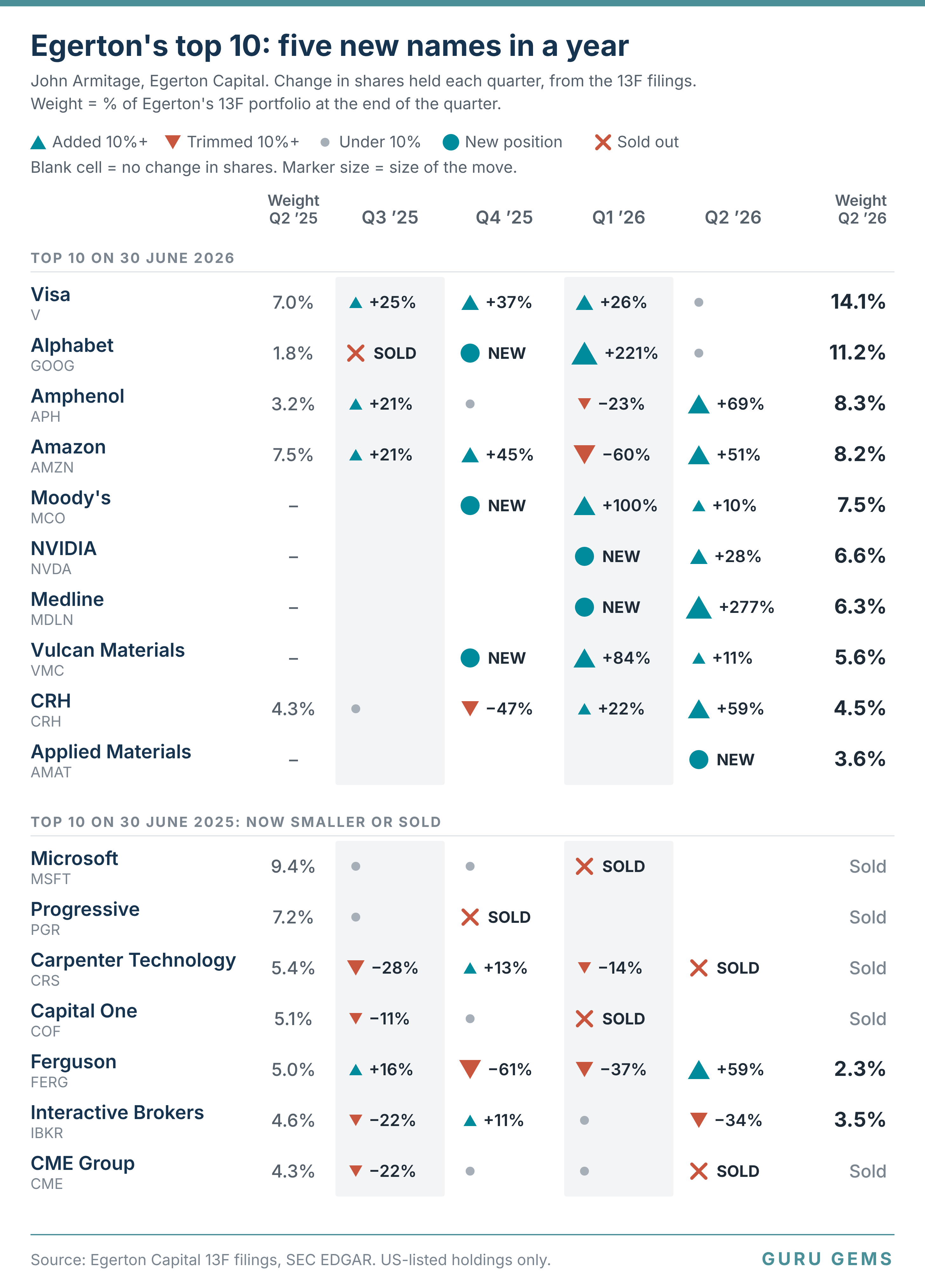
The 13F only shows US-listed shares, so part of the portfolio is missing. In the podcast Armitage says Egerton has ‘a big holding’ in Airbus and also mentions that he owns ASML.
A few things stand out from the portfolio:
Most of the portfolio is new. Only 8 of the 25 positions from a year ago are still there. Microsoft (his largest position a year ago, 9.4%) is out, as well as Progressive, Carpenter Technology, Capital One, Meta and GE Aerospace, among others. The largest of the 15 new positions are Moody’s (7.5%), NVIDIA (6.6%), Medline (6.3%) and Vulcan Materials (5.6%).
It is more concentrated. The top 10 went from 60% to 76% of the 13F.
Three names got much bigger. Compared to last a year ago, he more than doubled his Visa shares (+123%) and added 54% to Amphenol. Alphabet went from 1.8% to 11.2%, after he sold all of it in Q3 2025 and bought it back in Q4 2025.
Visa is his largest position (14.1%), and he cut Uber by half in Q2. I wrote about Visa in last week’s post and Uber was this month’s ‘Gem Spotlight’, a new monthly post on one of my Guru Gems.


🎙️ What I learned from the podcast
1/ 🏰 What is a good company?
“What is a good company” is Tangen’s first question. Armitage starts by saying there’s a difference between a good company and a good investment. He says a ‘moat’ is necessary but not sufficient:
“Moats are critically important but at the same time if you have a moat without the right management you get destroyed”
His examples are Boeing under its previous CEO and Rolls-Royce, which “had a moat” but was “a burning platform” before its current chief executive.
The third element is capital allocation, because a company’s value is “the value of the future cash flows. Therefore, how those future cash flows are invested is important.”
“So I think culture, capital allocation and [moats] are all very important.”
2/ 🧮 How important is valuation?
“Valuation is really important to me and it’s probably been too important in my career because I’ve probably missed lots of great growth stocks.”
He says he likes owning things where there is some valuation support on a conventional basis (P/E, P/FCF, EV/EBIT).
So how much will he pay?
“I feel like if you can buy a good company with decent double digit growth near 30 times next year, that’s attractive in today’s environment.”
He says he has less comfort than some people for high earnings multiples.
Someone he admires “thinks GE is a [...] cheap valuation”, while to Armitage 35 times earnings is a bit rich.
He doesn’t name the admirer, but it’s clear that he is talking about Chris Hohn, who runs TCI. A few minutes later in the interview Armitage describes Hohn as having ‘an amazingly powerful intellect’.
GE Aerospace is TCI’s largest holding. Egerton owned it a year ago (3.3%) but had sold it by the end of Q3 2025.
Read more on Chris Hohn:

If you enjoy this newsletter, please help others discover it by clicking 🤍
And if you would like to support my work, consider buying me a virtual coffee ☕
3/ 🌱 How he builds a position
“We start small and then we try and do a lot of work.”
He likes having “small positions which can grow”, and at Egerton a position only becomes big with two votes:
“That means that two people must love a position for it to be large. and that if I don’t love it, it won’t be large.”
One of the biggest challenges on building new positions, Armitage says, is that the new investment has to displace an old one which is psychologically very difficult:
“You own this company, it’s done well for you. It’s psychologically just very different. It’s harder than it should be to substitute something else for it.”
4/ 🚩 On red flags, and Fiserv
Asked about red flags:
“Consistently missing expectations. And that feeling that someone is always presenting a picture which is slightly biased to be positive.”
And on disappointments:
“I don’t like disappointments and if there’s a disappointment I always tend to cut the position back a bit”
His example is Fiserv, a company in which they had a long-term holding and which was a very good investment for them, until “They had some results which weren’t quite what we thought they were. We didn’t understand it and we sold the position”.
🤝 Who Armitage talks to
It’s always interesting to hear which other investors the Gurus are connecting with or exchanging ideas with.
His ideas, he says, “come from all the people around me”, and “I think you have to be eclectic about where you get those ideas from”.
He calls himself “not a sort of particular networker”, but when Tangen asks which investors he talks to, there are a few people he deeply admires and likes to catch up with a few times a year.
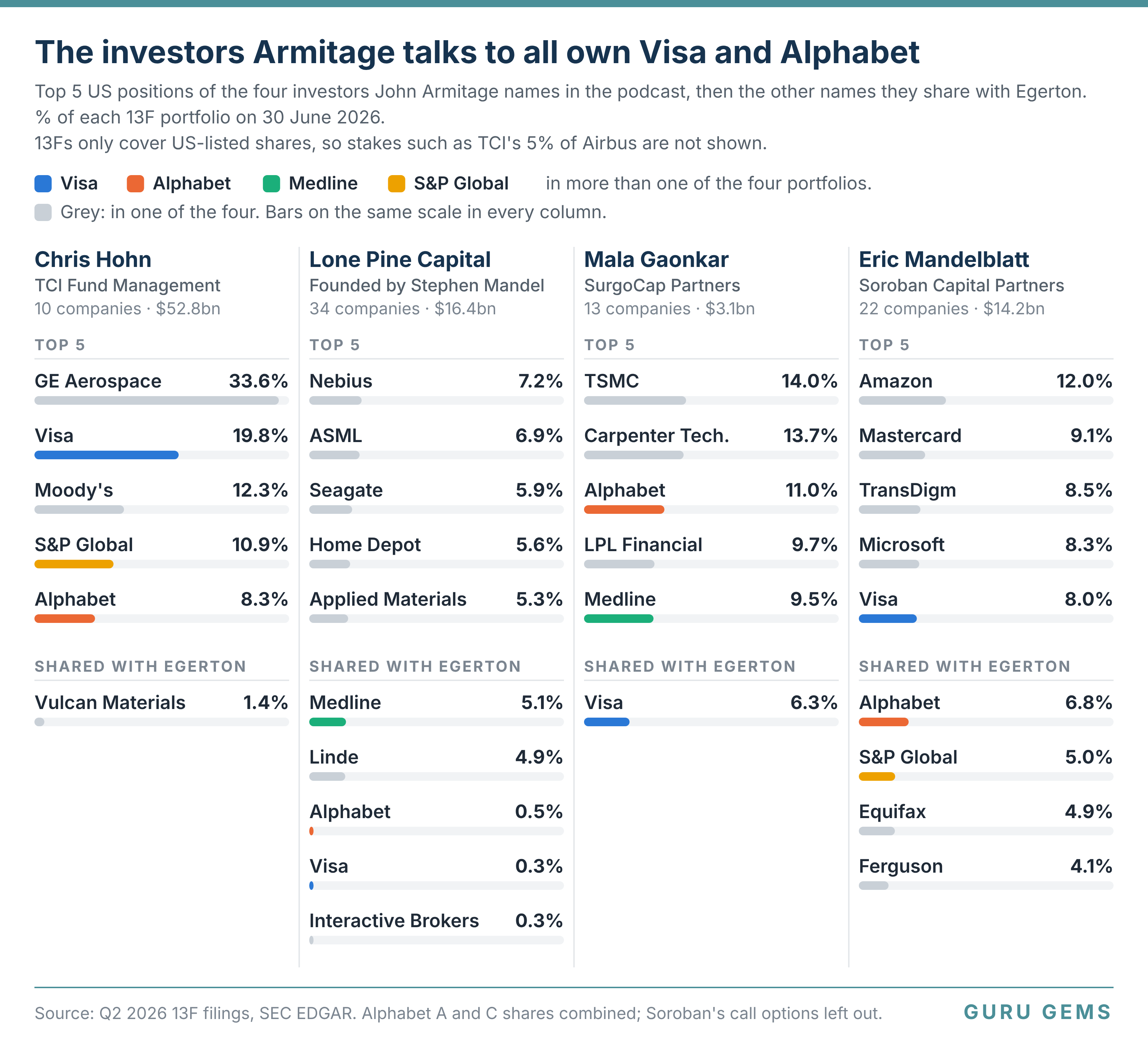
Chris Hohn, TCI Fund Management, whom I covered in Guru Gems #47. 10 companies, $52.8bn.
Lone Pine Capital, founded in 1997 by Stephen Mandel, who stepped back from managing money in 2019. 34 companies, $16.4bn.
Mala Gaonkar, SurgoCap Partners. She spent more than 20 years at Lone Pine before launching SurgoCap in January 2023. 13 companies, $3.1bn.
Eric Mandelblatt, Soroban Capital Partners, which he co-founded in 2010 after Goldman Sachs and TPG-Axon. 22 companies, $14.2bn, plus call options on Microsoft and Meta (not in the weights).
Two stocks are in all five 13Fs: Visa and Alphabet. Both are in the Guru Gems portfolio.
💎 The Gem: Amphenol (APH)
Amphenol is Egerton’s #3 position at 8.3%, after Armitage added 69.5% in Q2 2026.
When Tangen asks whether Egerton is participating in AI, he names Nvidia and “a brilliant company which supplies into it, Amphenol”. Amphenol is indeed what could be called a ‘picks and shovels’ play on AI.
As always, I’ll evaluate this Guru Gems candidate using my Terry Smith-inspired framework.
1/ Is it ‘Good’?
I'll use Armitage's own tests from lesson 1: the moat, the management and culture, and capital allocation.
First, what it does
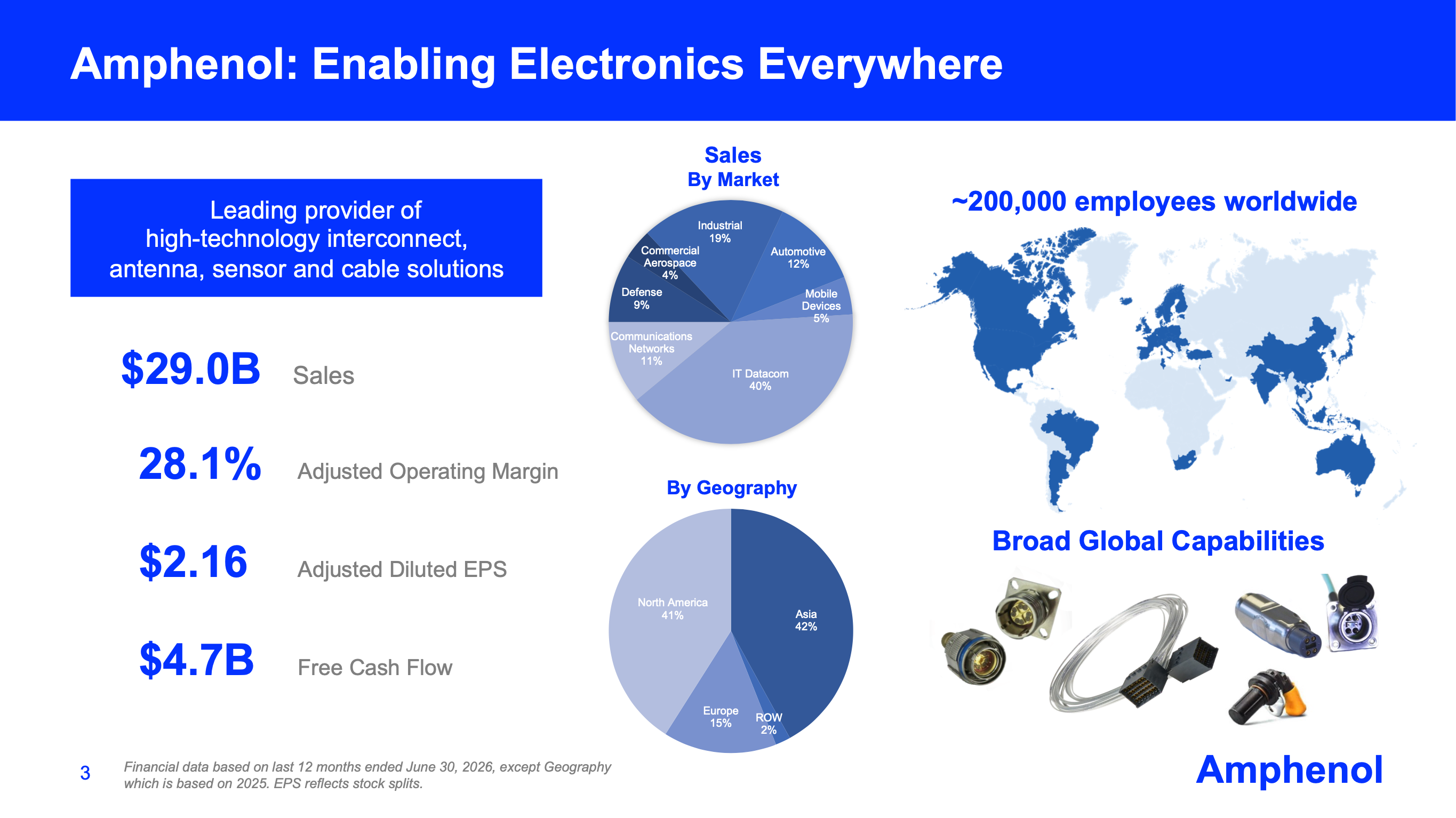
Amphenol makes the components that allow electronic systems to connect, communicate and function: connectors, antennas, sensors, and copper and fibre-optic cables and interconnect systems.
Its products are used everywhere from AI data centres and communications networks to cars, factories, medical equipment, aircraft and defence systems.
In essence, Amphenol supplies the electronic world's wiring and nervous system, increasingly important as devices become more sophisticated and require more connections.
The moat
Amphenol's moat is built on engineering expertise, reliability and high switching costs rather than a single breakthrough product. Its components are often customised and designed into customers' systems, sometimes in mission-critical applications where failure is not an option.
Switching suppliers can mean redesigning, testing and qualifying components all over again, giving Amphenol a valuable incumbent advantage.
Morningstar identifies these switching costs and the company's design capabilities as the foundations of its wide economic moat.
Management and culture
Amphenol has a strong entrepreneurial culture. Rather than directing every decision from headquarters, the company empowers local general managers to run their businesses, respond quickly to customers and take responsibility for results.
On its Q2 2026 earnings call on 29 July 2026, CEO Adam Norwitt described approximately 150 operations run by general managers, with no central procurement organisation.
This decentralised model helps Amphenol stay agile while integrating acquisitions and responding to rapidly changing customer needs.
Capital allocation
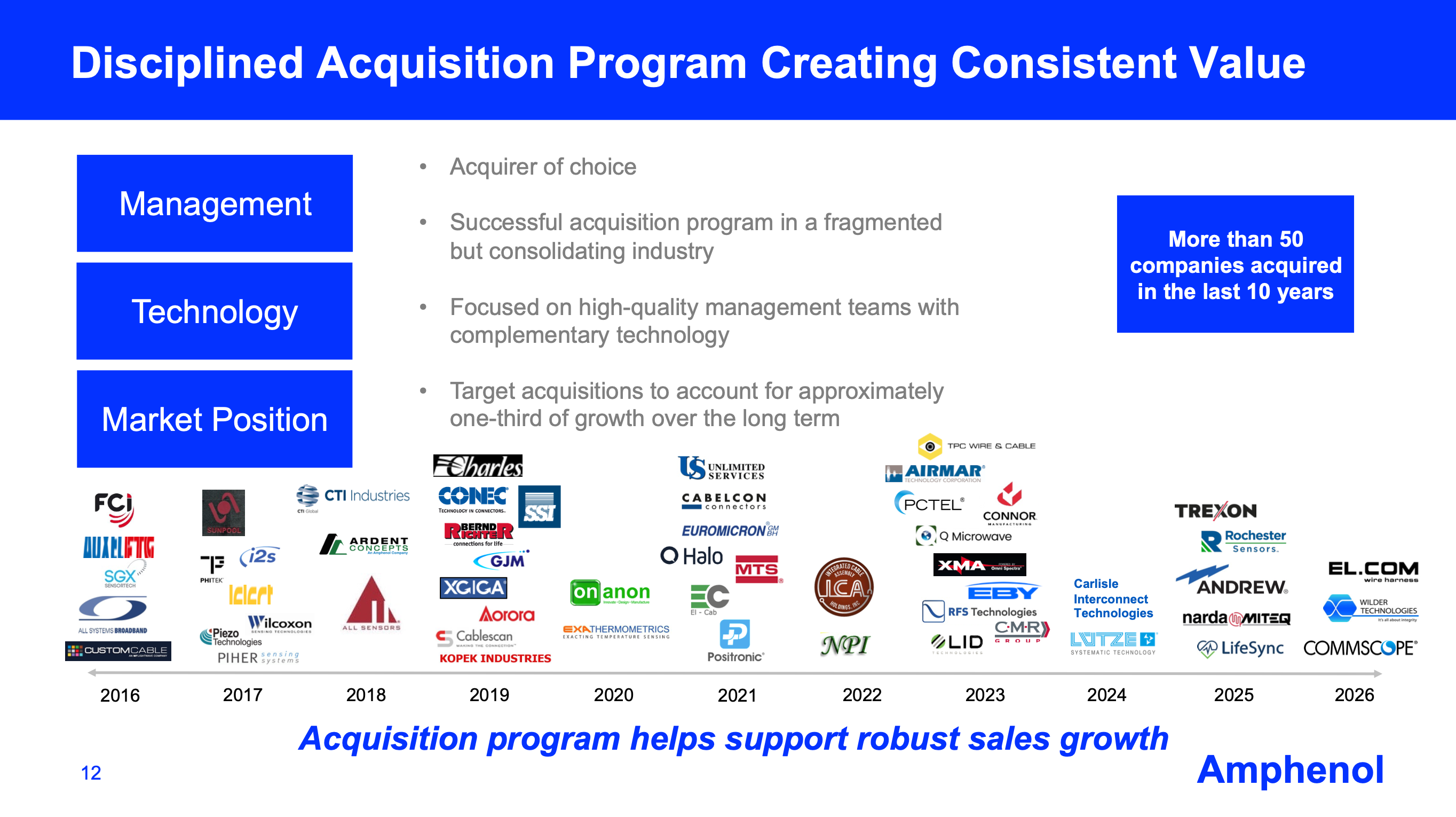
Acquisitions are a central part of Amphenol's growth strategy: its 2025 Form 10-K reports approximately $3.8 billion spent on five acquisitions during 2025.
In 2026, the company added CommScope, followed by El.Com and Wilder Technologies in Q2, expanding its capabilities in fibre optics, high-speed interconnects and other specialised markets.
It also returned approximately $515 million to shareholders in Q2 2026 through share repurchases and dividends.
The challenge is to keep making acquisitions that create value while maintaining a strong balance sheet; net debt stood at $13.4 billion on 30 June 2026, following the acquisition spending.
The numbers
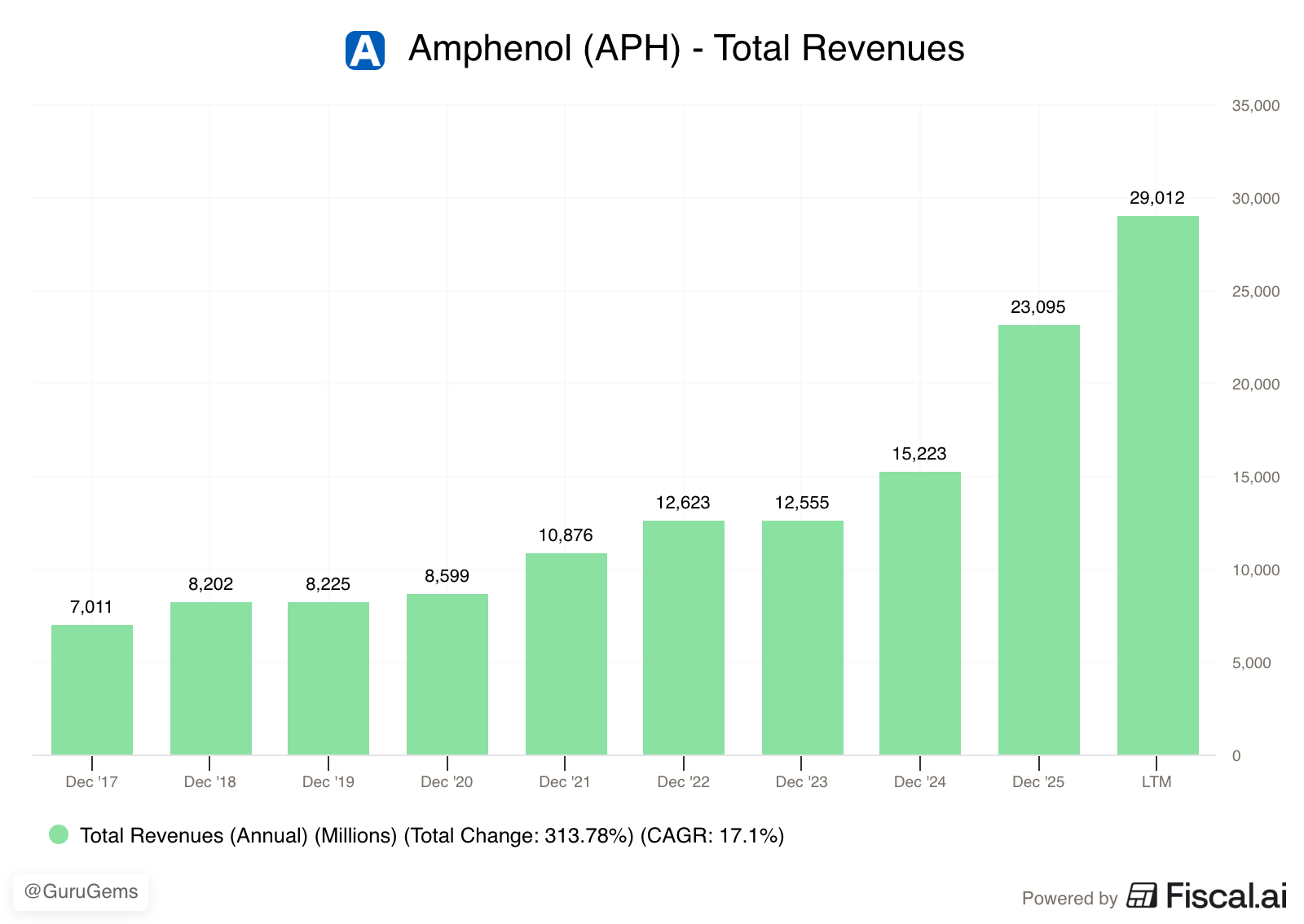
Amphenol delivered a record $8.76 billion in sales in Q2 2026, up 55% year on year, including 30% organic growth.
Adjusted operating margin reached 29.8% in Q2 2026, a record according to management, although the result included an $80 million benefit from tariff recoveries.
The company also generated $1.2 billion in free cash flow during Q2 2026, demonstrating its ability to turn strong demand into cash.
These are exceptional results, but separating organic growth from acquisitions is essential when assessing how sustainable the performance will be.
Risks
The biggest question is whether today's exceptional AI and data-centre demand can last.
IT Datacom accounted for 40% of sales over the twelve months ended 30 June 2026, according to the September 2026 investor presentation, leaving Amphenol exposed to any slowdown in infrastructure spending or changes in interconnect architecture.
There is also geopolitical risk: China represented 16% of net sales in 2025, while 37% of long-lived assets were located in China as of 31 December 2025.
Trade restrictions, tariffs, technological changes and the challenge of integrating large acquisitions could all impact future growth.
2/ Is it ‘Cheap’?
Amphenol is an exceptional business and that is reflected in the valuation.
The shares closed at $79.35 on 16 October 2026, up 30% since Guru Gems #26 went out ($60.85 on 10 October 2025, split-adjusted), but down 9% this week alone.
That’s ~40 times the last four quarters’ GAAP earnings per share ($2.00, Q3 2025 to Q2 2026, split-adjusted), or ~37 times adjusted earnings ($2.16).
Against its own history: Amphenol’s trailing P/E has averaged about 32x since 2018, ranging from 18x in March 2020 to 50x in September 2025. At 40x today, it’s well above its average, though below last year’s peak.
📌 Adding Amphenol (APH) to the watchlist
Amphenol passes Armitage’s three tests for a good company. It has a wide moat built on switching costs, an entrepreneurial culture that looks hard to copy, and a long record of buying and integrating companies well. Q2 also brought record sales and margins.
But I need to study it a bit better before I make a decision. Most of today’s growth comes from AI data centres, and it’s unclear how much of that demand will last, or how exposed Amphenol is if spending slows. And at around 40 times trailing earnings, a lot of that growth is already in the price.
That’s it for this week’s edition!
Thank you for reading and following along.
Until next week!
I'm surprised how active he's been this year, especially selling Google one quarter only to buy it back and then increase it thereafter. Tax loss harvesting perhaps?