
Welcome back!
Last week I started a small position in Visa (read here in case you missed it).
An obvious follow-up question is: why Visa and not Mastercard?
The Gurus don’t seem to agree on that one either. In today’s post I’ll take a closer look at the Gurus’ activities across these two names and what they are saying.
A quick note before we start.
This will not be a deep-dive. Visa and Mastercard are probably two of the most covered stocks in the world (after the hyperscalers, maybe), and I don’t think I can add much on that front.
If you want a longer deep-dive, I would recommend Jimmy Investor’s Mastercard ($MA) Deep Dive, The Cash Flow Compounder’s Mastercard (The Compounder Score) or Macro investing - Gertjan’s Visa Deep Dive.
This post takes a different angle: what the Gurus who own them have been doing and saying, and a side-by-side check using the frameworks of two of them.
It is also a check for myself that these are still wonderful businesses that belong in a long-term portfolio like Guru Gems.
On the menu for today:
💳 The business model: what Visa and Mastercard do, and where the growth comes from
🧭 Guru ownership: two years of moves by 10 Gurus, and what they say in their letters
⚖️ Visa vs Mastercard, side by side: four pillars taken from two Gurus who own both, Tom Gayner and Bill Ackman
📌 Closing thoughts: why I started with Visa, and when I would buy more of either
➕ Bonus: a bit of fun with The Simpsons ;)
Here is a 2-minute AI-audio version if you’re short on time:
Let’s jump in!
💳 Business model
“In our view, Visa and Mastercard are among the highest-quality businesses in the world.”
Bill Ackman, Pershing Square Q2 2026 letter
Visa and Mastercard run the networks that connect your bank (the issuer) to the merchant’s bank (the acquirer). When you tap your card, the network authorizes the payment, then clears and settles it between the two banks.
What they don’t do is equally important. Neither company issues cards, lends money or sets the interest rate on your credit card. That is the banks’ business, and so is the credit risk.
Visa and Mastercard collect a small fee on the volume and the number of transactions, a bigger one when the payment crosses a border, and increasingly a fee for extra services. Bill Ackman estimates their take at roughly 20 basis points of a typical transaction.
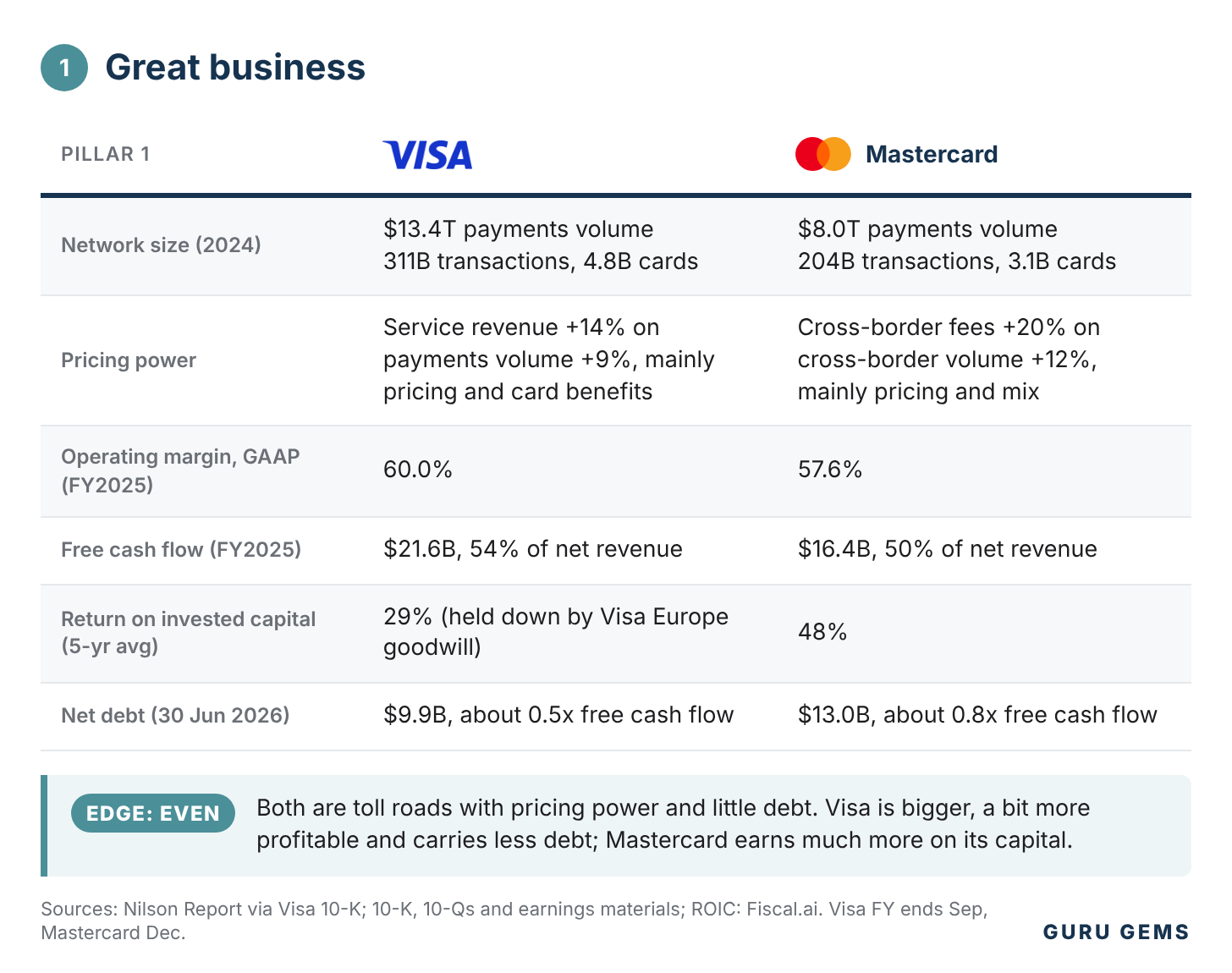
Visa is the bigger of the two. In 2024 it handled about $13 trillion of payments volume on 4.8 billion cards, against $8 trillion on 3.1 billion cards for Mastercard.
Where the growth comes from
Cash and cheques moving to cards. Visa estimates more than $40 trillion of consumer spending a year it could address (excluding Russia and China), of which over $20 trillion still goes through cash, cheques and bank transfers. Bill Ackman puts card volumes at about half of addressable consumer spending worldwide.
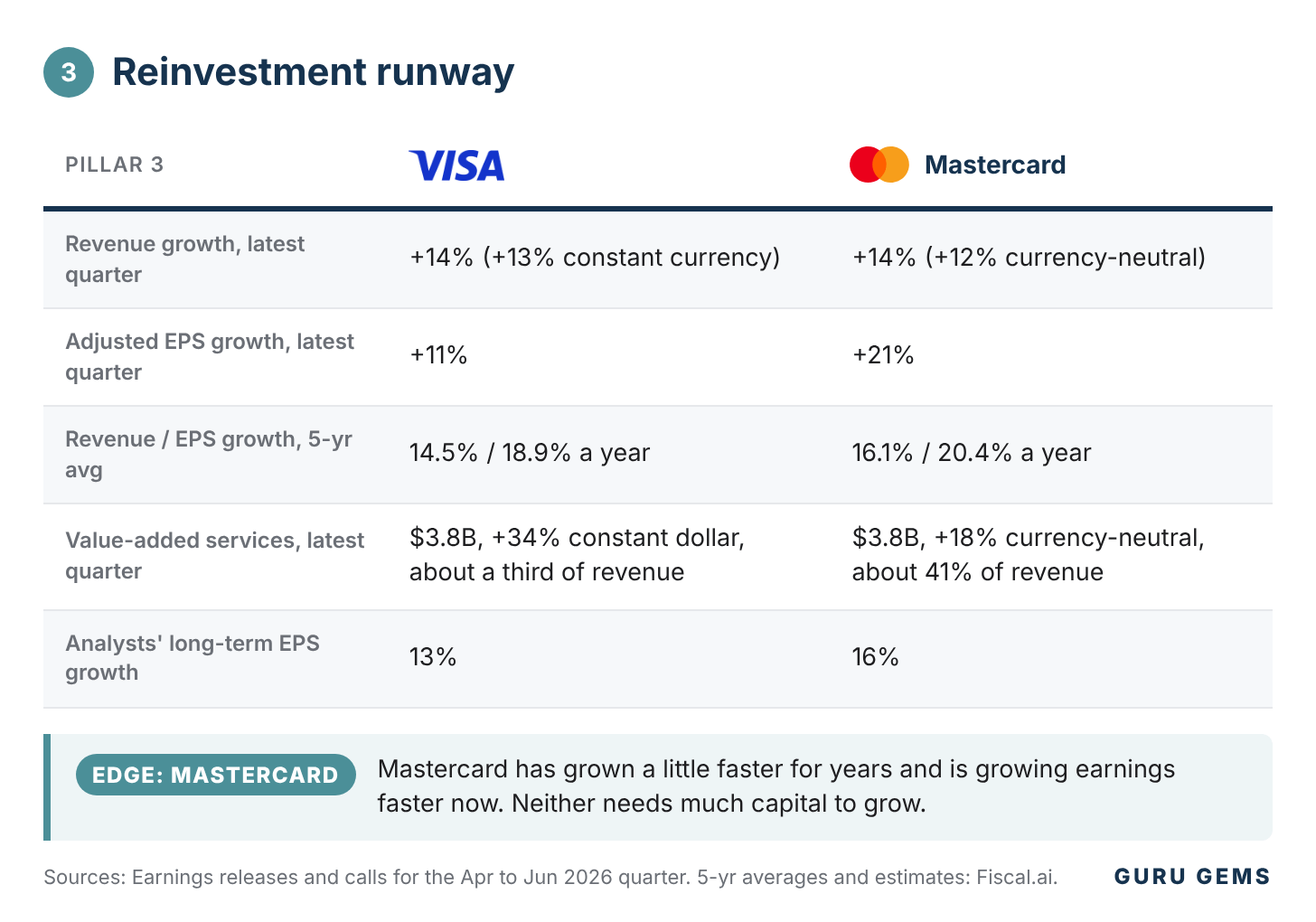
E-commerce and cross-border payments. Cross-border is the most profitable volume. It grew 12% at both companies in the latest quarter.
Value-added services. Fraud and cyber tools, data, consulting, marketing and processing. Both companies booked about $3.8 billion of these services last quarter: roughly a third of revenue at Visa and about 40% at Mastercard.
Business payments and money movement. Business-to-business payments are 85% of the value of all global payments, according to Terry Smith’s latest letter. Both networks go after this with commercial and virtual cards, while Visa Direct and Mastercard Move handle payouts, remittances and transfers.
New rails: AI agents and stablecoins. Both are building tools so that AI agents can pay with a card (Visa Intelligent Commerce, Mastercard Agent Pay). Mastercard closed its $1.5 billion purchase of stablecoin platform BVNK in August. These are also the two worries that knocked the shares down this spring (more on that below).
🧭 Guru ownership
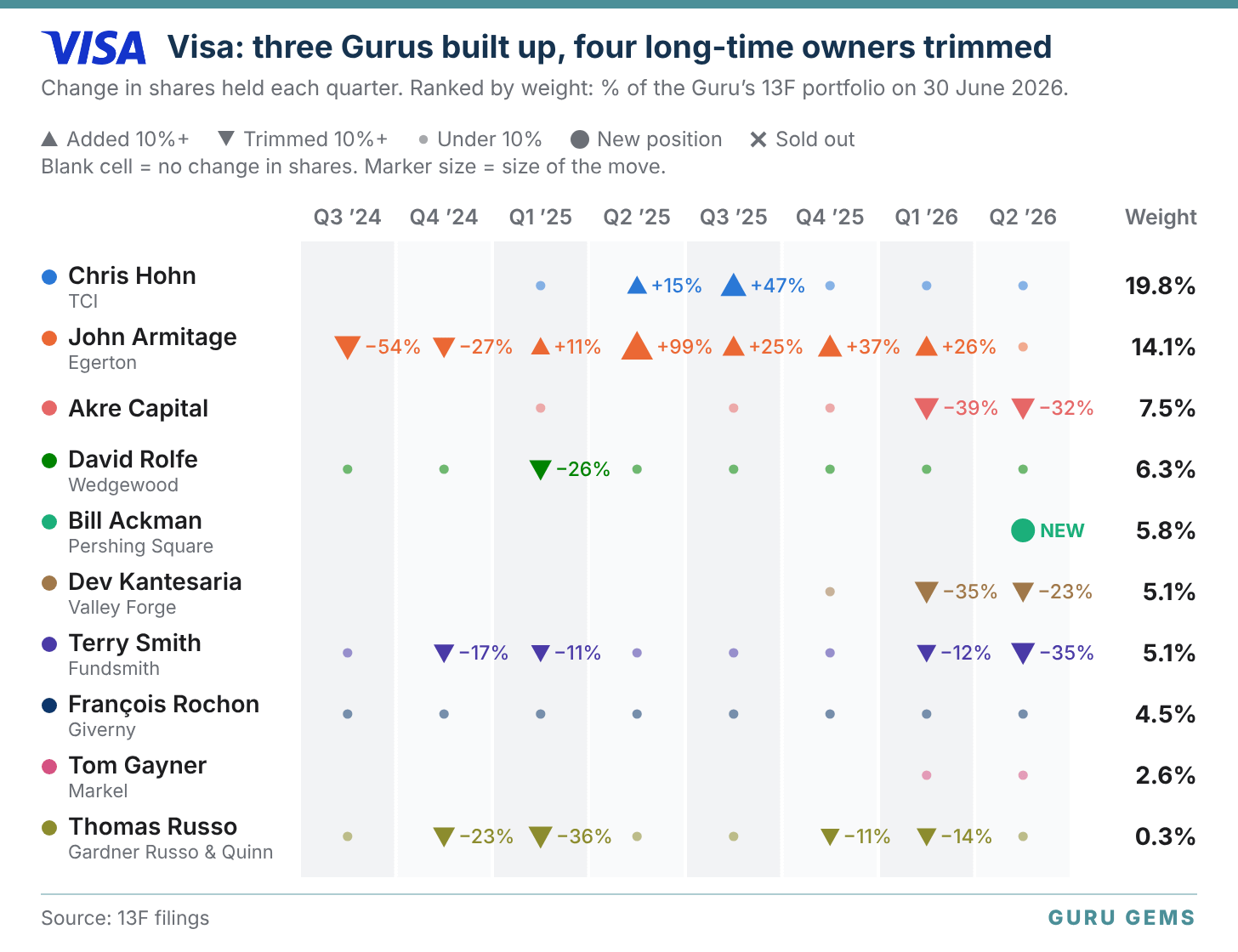
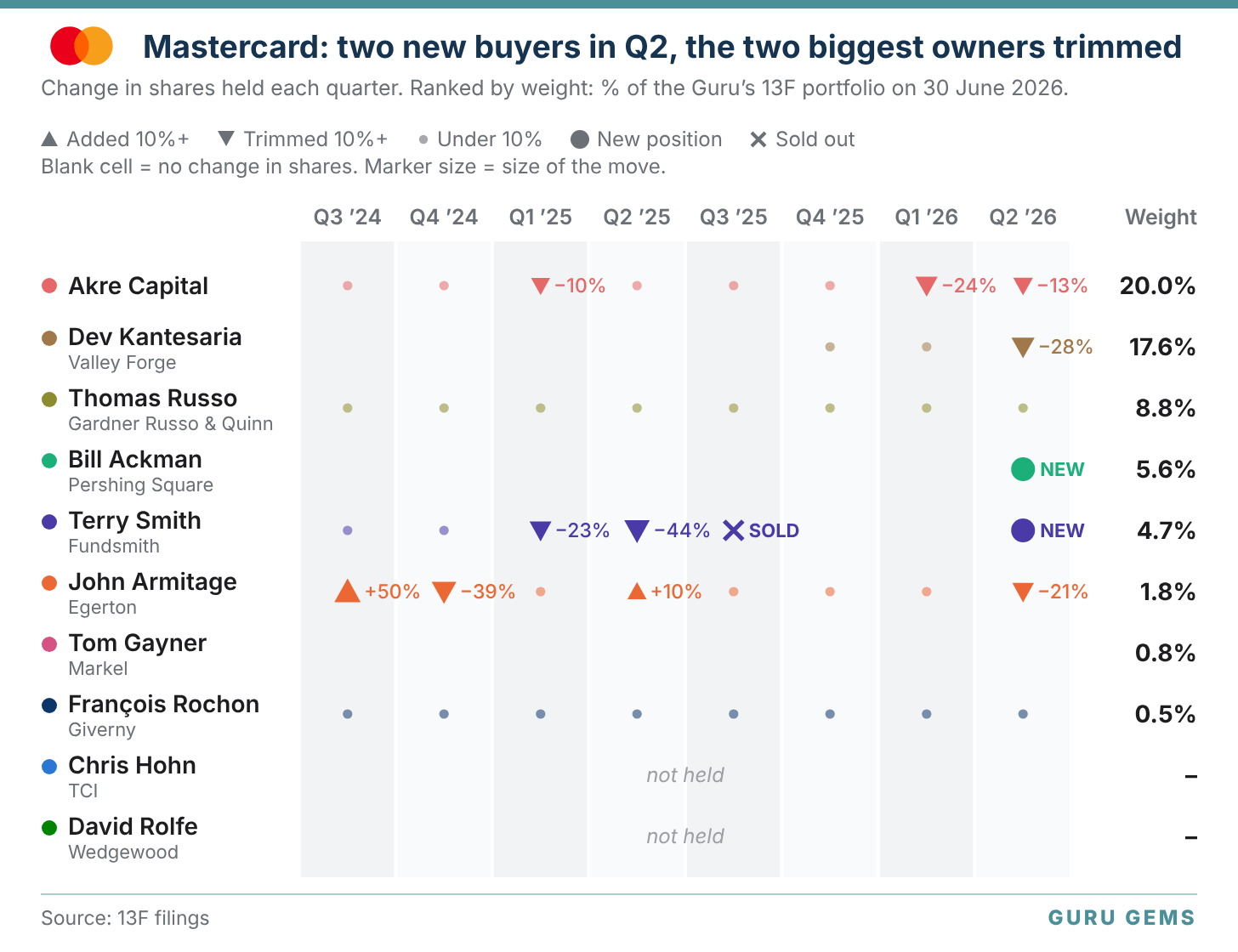
All 10 Gurus I picked for this post own Visa, and 8 of them own Mastercard (Chris Hohn and David Rolfe only own Visa).
Here is every move they made in the two stocks over the last two years:
What the Gurus are saying
Bill Ackman opened both positions earlier this year and gives them a full page in his Q2 letter.
Why he likes them:
“Earlier this year, we initiated positions in Visa and Mastercard, two businesses we have long admired, which provide the dominant global networks for consumer and commercial payments, with an increasing share of revenue growth coming from value-added services.
In our view, Visa and Mastercard are among the highest-quality businesses in the world. Both are capital-light “toll-takers” that earn a nominal fee on each transaction without taking any material risk and are natural beneficiaries of higher inflation. Their networks, built over decades, connect billions of consumers with hundreds of millions of merchants and thousands of financial institutions. Each new member and transaction further strengthens the networks and deepens their data advantage.
Value-added services now represent approximately 30% and 40% of revenues at Visa and Mastercard, respectively, and are growing at two to three times the rate of the payments business, a mix shift that will accelerate overall revenue growth. These characteristics produce a highly attractive financial profile of double-digit revenue growth with high operating margins, minimal incremental cost per transaction, and 100%+ cash flow conversion.”
Why the shares got cheap this spring:
“Despite these attributes, Visa and Mastercard recently de-rated to 22 times next twelve months’ earnings. We attribute this to investor concerns around stablecoin disruption, agentic commerce, and proposed U.S. regulation, each of which we believe is misplaced.”
On stablecoins:
“We believe stablecoins represent an opportunity for the card networks rather than a threat. They are most relevant where cards are not the incumbent: cross-border business-to-business payments, high-cost remittance corridors, and dollar savings in countries with volatile currencies. Adoption in these areas should grow in parallel with, not at the expense of, card volumes. In consumer payments, cards offer near-universal merchant acceptance, fraud protection, access to credit, and rewards, advantages that stablecoins, whose transactions are typically final and harder to reverse, cannot replicate.”
On AI agents:
“Similarly, we believe agentic commerce is more likely to expand the payments ecosystem than to erode the networks' moats, as agents reduce friction, enable more frequent purchases, and accelerate the digitization of commerce.”
On the price:
“The card networks have a long history of consistent growth despite periodic fears of disruption, the most recent of which created the opportunity for our purchase of shares in the companies. While Visa and Mastercard shares have appreciated from our cost as the S&P 500 has remained flat, they remain attractively valued at 23 and 24 times forward earnings.”
His own estimate of EPS growth over the next three to five years is 16% a year for Visa and 18% for Mastercard, including the dividend.
Terry Smith explained in his half-year letter why he now owns both:
“Future growth depends on bringing this unbanked population into the financial system, shifting remaining cash transactions to digital payments, and expanding into business-to-business payments, a far bigger market than C2C or C2B payments. We now own both Visa and Mastercard in the portfolio as payments is one of the few sectors that we expect to grow no matter what happens with AI, and Mastercard and Visa are equally good businesses.
This gives us a way to achieve >6% exposure to payments without excessive stock-specific risk or breaching UCITS concentration rules.
Also, with 46% of all global transactions still done in cash and B2B payments 85% of the value of total global payments, there is plenty of room for two companies to grow and compound.
ROIC: >75%, FCF yield: 4.5%.”
From reading this, it looks like the big Visa trim was a way to pay for Mastercard. He went from owning 6% of the fund in Visa alone to close to 10% across both names.
This reshuffle came in a very busy half-year in which he turned over more than half of the fund, which is a lot for someone whose motto ends with “do nothing”.
David Rolfe added to Visa in the quarter, and it was one of his five biggest contributors. Here is what he wrote in his Q2 2026 letter:
“Visa contributed to quarterly performance, reporting accelerating revenue growth of 17%, driven by 11% growth in payment volumes and 21% growth in cross-border volume. Value-added services also grew 25% and now represent almost one-third of the Company's total revenue.
Agentic commerce remains nascent but could represent a new addressable market for Visa as the Company tracks and helps autonomous AI agents perform micro-transactions. This contrasts with just a few quarters ago, when the market was fretting about the risks agentic commerce could pose.
We think Visa's global scale, including acceptance at over 130 million merchants, and deep integration with almost 15,000 financial institutions make it a valuable partner for agentic commerce startups.”
François Rochon was asked in a WealthTrack interview last November which company in his portfolio best represents “the best of the best”.
His answer: “I would choose Visa.” He bought it in 2010 after a 25% drop on fears of new fee regulation, paying 16 to 18 times earnings (I wrote more about this last week).
→ If you enjoy this newsletter, please subscribe and help others discover it by clicking 🤍
→ If you find value here, consider buying me a virtual coffee ☕
New to Guru Gems? Start here.
⚖️ Visa vs Mastercard, side by side
Tom Gayner and Bill Ackman both own Visa and Mastercard, and their frameworks for identifying quality stocks overlap a lot (Gayner’s four pillars, Ackman’s principles).
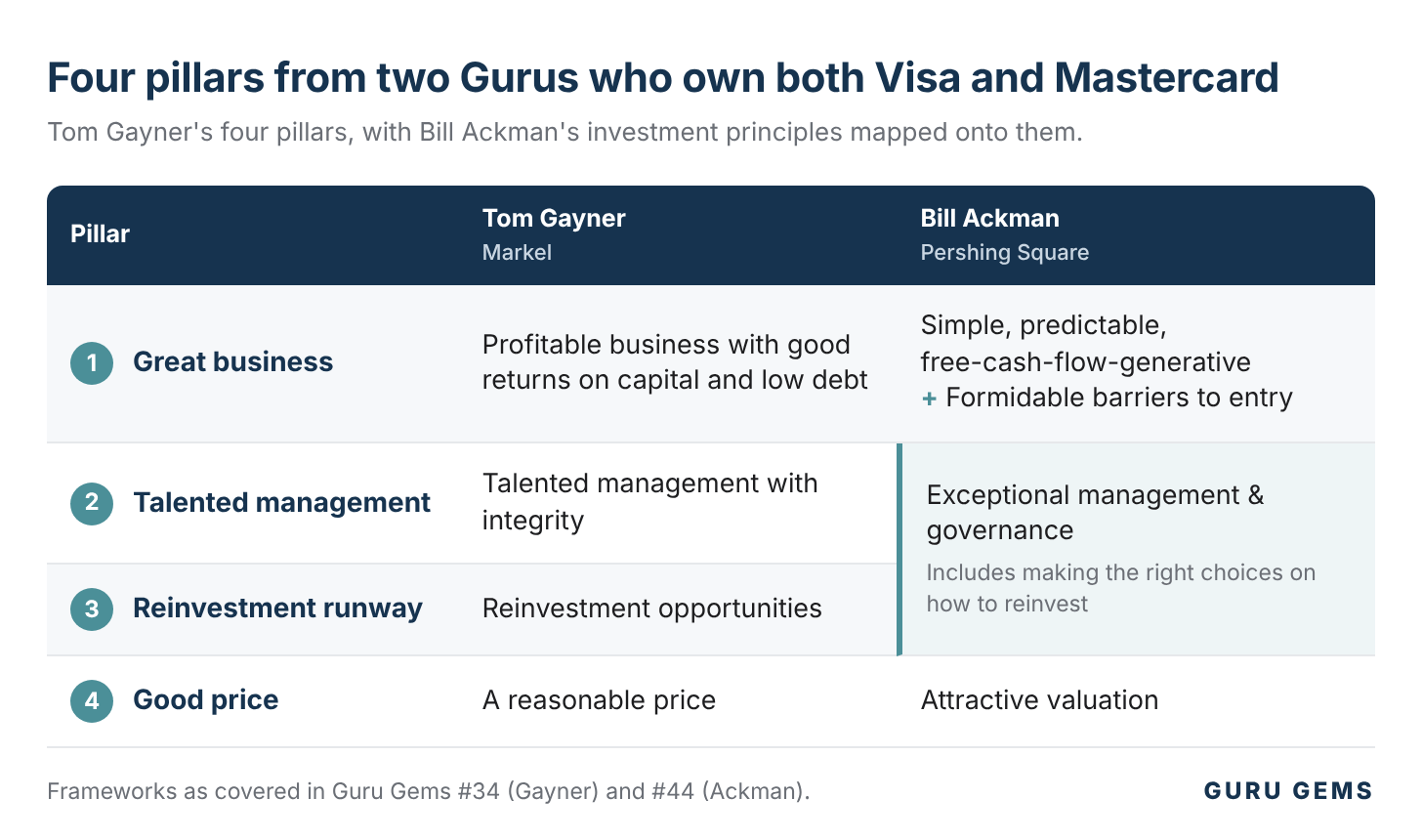
Now let’s analyze both Gems across each of these four pillars:
What the pillars leave out
As I mentioned in the beginning, this is not a comprehensive deep-dive and therefore it doesn’t cover all aspects you might see in a typical stock write-up. A big one that is missing for example is risks.
For Visa and Mastercard the main risks are the following:
Regulation and lawsuits. Visa booked a $2.5 billion litigation provision in fiscal 2025 and still faces the US Department of Justice’s debit case. The US proposals to cap card interest rates and force routing competition have stalled, according to Ackman, but they could come back.
New payment rails. Stablecoins and AI agents could route some payments around the card networks. Ackman thinks the opposite is more likely, but it is the main reason the shares de-rated this spring.
Local schemes. Governments in Europe and elsewhere want their own payment systems, such as Wero in Europe.
I went through Visa’s risks briefly last week, and the deep-dives linked at the top of this post cover them in more detail.
📌 Closing thoughts
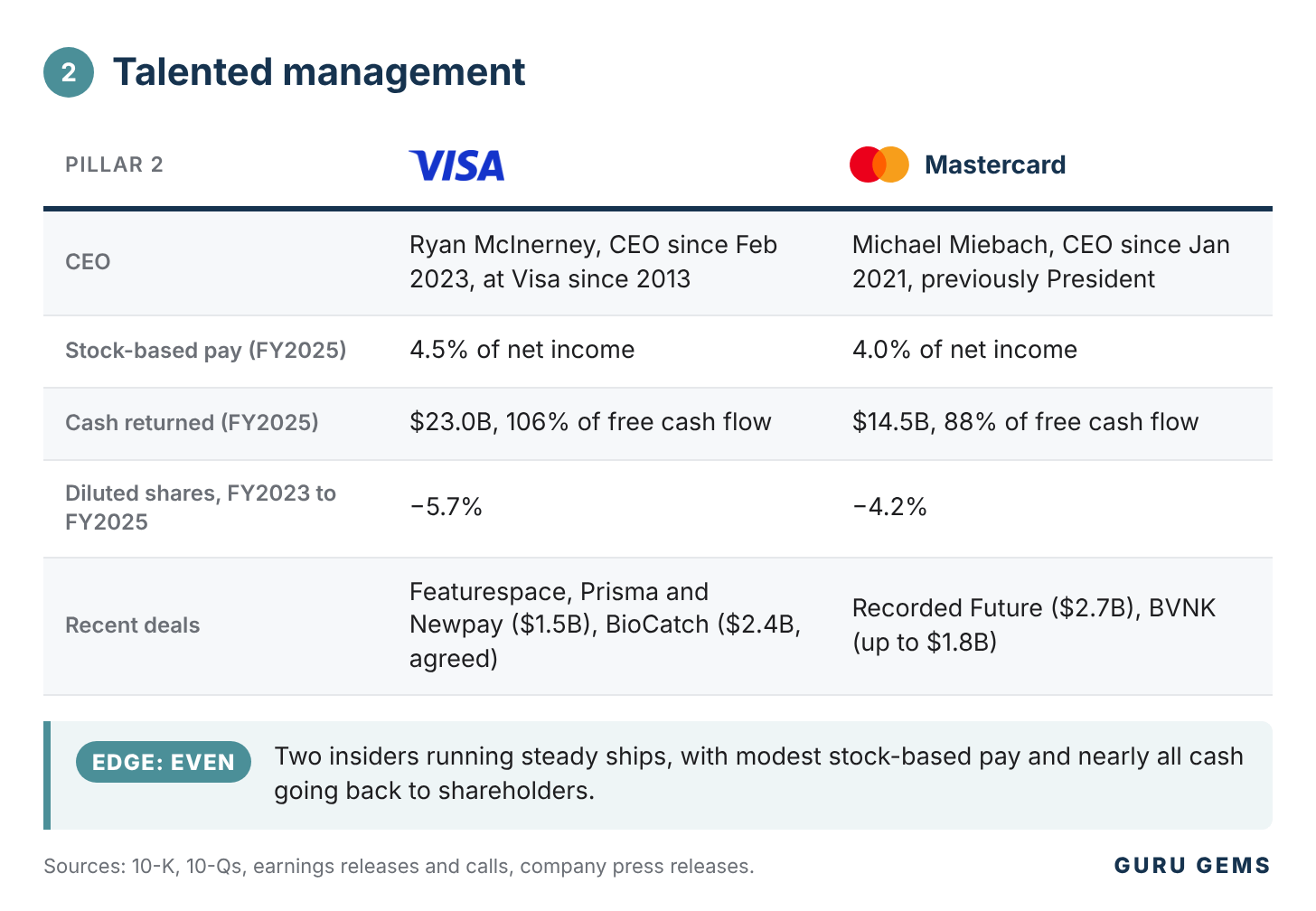
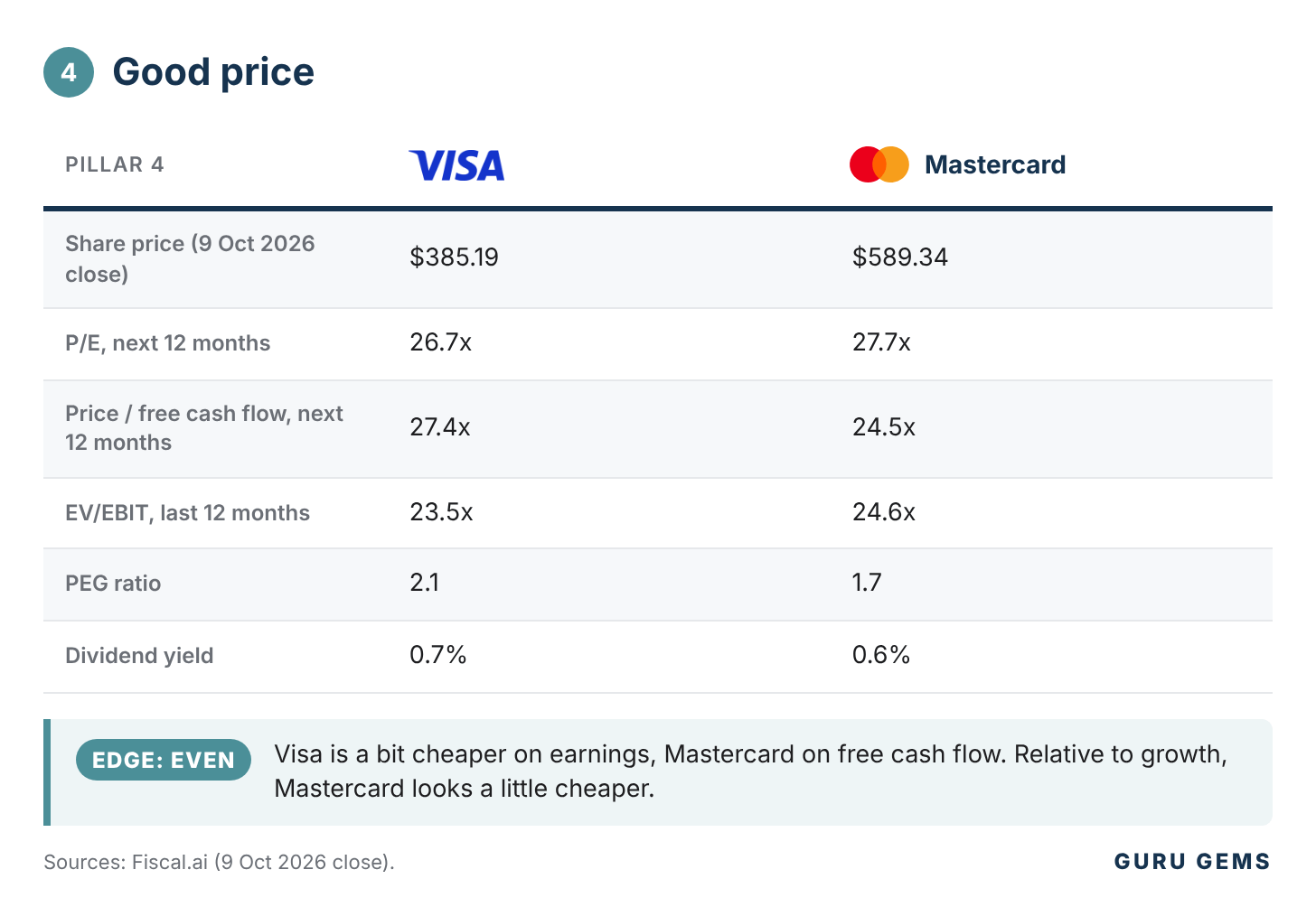
After going through the filings and the letters, I end up close to Terry Smith and Bill Ackman: Visa and Mastercard are equally attractive. Mastercard has grown a bit faster and earns more on its capital. Visa is bigger, has higher margins and carries less debt. And on price there is little difference between them.
Last week I started a small position in Visa, at around 2% of the Guru Gems portfolio. I started with Visa because of its bigger network, because it is a very large position in the portfolio of two Gurus I highly respect (Hohn and Armitage), and because it was slightly cheaper on next year’s earnings.
From here, I will look to add to Visa, or to start a position in Mastercard, whenever either one becomes attractive on valuation. For reference, both traded at about 22 times forward earnings this spring when Ackman bought, against ~26x for Visa and ~27x for Mastercard today. Like Ackman and Smith, I may well end up owning both.
"I feel like if you can buy a good company with decent double digit growth near 30 times next year's earnings, that's attractive in today's environment."
—John Armitage
Here is a fun one to close today’s post… Santos L. Halper :)
That’s it for this week’s edition. As always, thank you for following along my learning journey!
You can follow me on Substack @gurugems and X @guru_gems for more insights.
Until next week!