
Welcome back!
Last week I introduced Ryan O’Connor and The Crossroads Way.
Today, I take a look at his biggest investment: Nintendo.
A quick recap of Part 1 if you missed it: Ryan O’Connor runs Crossroads Capital, a small Kansas City fund modelled on Buffett’s early partnerships. Crossroads is a “concentrated, long-term-oriented investment manager that employs a research-intensive and often event-driven investment approach.”
While we don’t have exact portfolio position sizes, it’s clear from the letters that one name in the portfolio has been one of the largest positions for a while now: the Japanese gaming company that brought us Mario and Zelda.
The value of studying a long-term investor is that you can follow one thesis through the years and see how they apply their thinking and frameworks.
O’Connor bought Nintendo in late 2018 and has written about it in almost every letter since, so we can follow eight years of his thinking on what he calls “an iconic 130+ year-old software- and IP-rich franchise”.
In today’s edition:
💎 The Gem: what Nintendo does, and how O’Connor’s thesis has evolved from 2018 to today
⚖️ The bull case and the bear case today
💴 The valuation, and ‘To buy or not to buy’ for my Guru Gems portfolio
Here is a 2-minute AI audio version of today’s feature:
💎 The Gem: Nintendo
What Nintendo does, and how it makes money
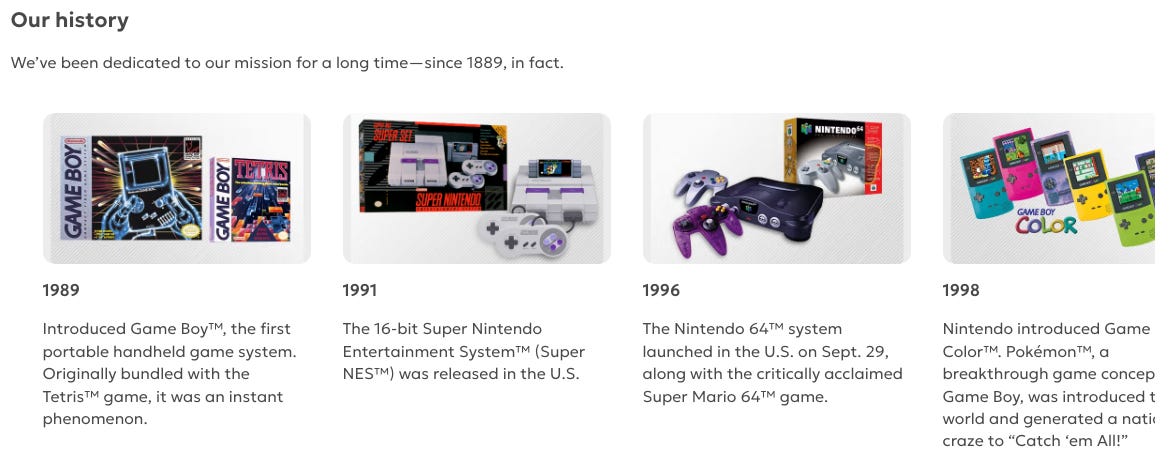
Last week’s cover showed a card shop with “1889” above the door. That is the year it all began for Nintendo, when Fusajiro Yamauchi started making and selling hanafuda, Japanese playing cards, in Kyoto. (Fun fact: 1889 is the year in which Vincent Van Gogh painted The Starry Night)
Today Nintendo makes game consoles and the games that run on them:
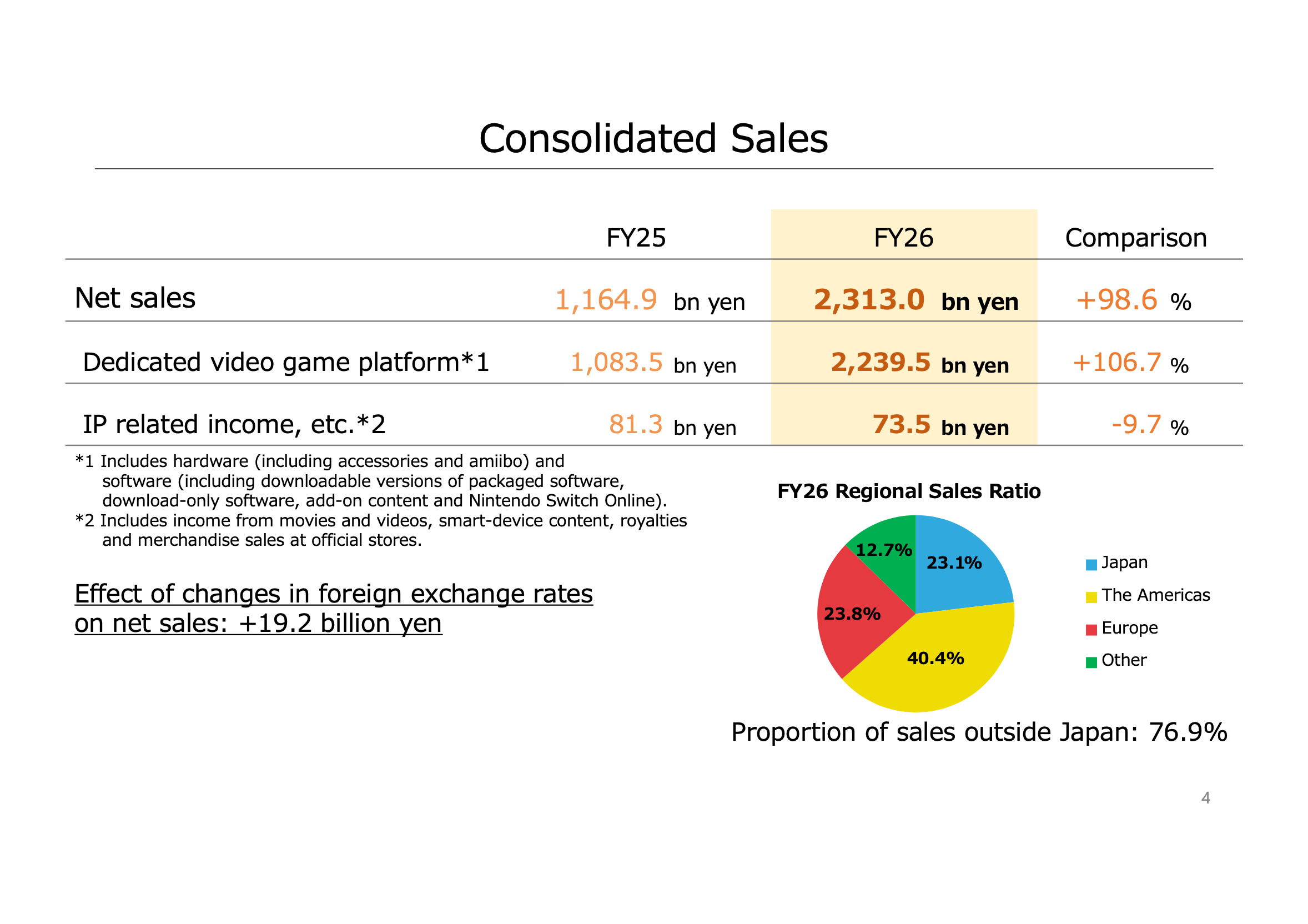
In Fiscal Year 2026 (FY26) 97% of its ¥2,313 billion sales came from hardware and software video games.
The remaining 3% was IP-related income from mobile games, films and licensing.
Roughly 77% of sales is made outside of Japan.
Consoles bring in a lot of revenue; the games bring in most of the profit (especially Nintendo’s own, which were 75% of software sales last year).
You can see this in the gross margin: 61% in FY25, when consoles were 44% of game sales, and only 39% the next year, when the Switch 2 launch made consoles sales 67% of total games sales.
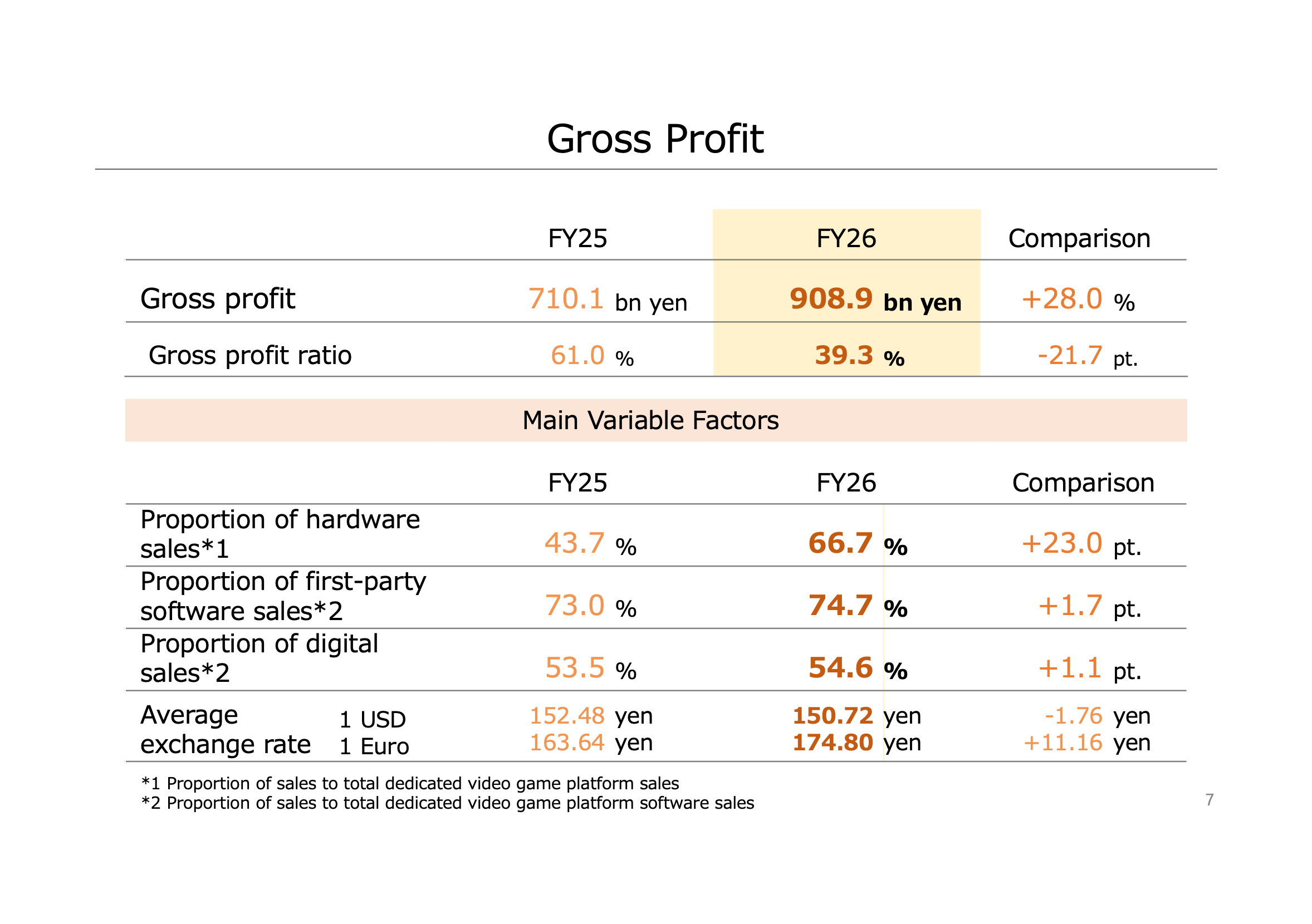
Digital sales were 55% of software sales last year, up from 25% when O’Connor bought.
Crossroads’ thesis in short
When Crossroads initially made Nintendo its largest fund position in late 2018, the consensus view treated Nintendo as a cyclical hardware company whose user base reset to zero every 5–6 years with each new console launch.
O’Connor on the other hand saw a company turning into something like Apple, with users and games carrying over from one device to the next, and a library of characters it could use far beyond games, the way Disney does. (His 2018 letter opens with Buffett on buying 5% of Disney in 1966.)
“The heart of our thesis is that Nintendo has changed from a cyclical boom-bust business model to one marked by steadily expanding margins and predictable, secular growth.”
—Crossroads 2021 Investor Letter
In Part 1 I wrote that a framework mispricing was at the centre of Crossroads’ Nintendo story: “genuinely new business architectures get evaluated against templates that don’t fit them”. (Mispricing: A Primer, 25 Jun 2026)
Here is how Crossroads’ thesis has developed in four stages.
1. 2018–2019: “De-cyclifying” the business
Around the turn of 2019, worries about Switch sales took the ADR* share price from about $58 to around $33, “largely due to fears that a cyclical collapse in Switch demand is right around the corner”.
*ADR stands for American Depositary Receipt
It allows investors to buy shares of non-US companies in the US without dealing with foreign currencies or exchanges. Nintendo’s ADR (NTDOY) trades over the counter.
Crossroads’ 2018 letter argued that Nintendo was changing its business in four ways the market hadn’t priced in: “de-cyclifying the console business, moving to digital distribution, making smartphone games, and effectively monetizing its IP”.
Smartphone games never took off; by 2021 he called mobile “perhaps Nintendo’s biggest miss in recent years”. The other three, together with the balance sheet, became the pillars of his thesis:
An Apple-like hardware model. The Switch is a home console and a handheld in one, so Nintendo could retire the 3DS and put all its developers on one machine. He expected cheaper and more powerful models every two to three years, “followed by iPhone-style price drops on the older models”, all playing the same games. If that worked, Nintendo’s users would “never again reset to zero, as it has every five to six years in the past”.
Digital sales and a subscription. He compared Nintendo’s online store to the way Apple surrounds “its iPhone and iPad with its App Store”, and expected “the ongoing structural shift to higher-margin digital distribution of software” to lift margins. And he saw Nintendo Switch Online, the paid subscription launched in 2018, as a “recurring revenue money machine”.
Disney-style use of the characters. With its dozens of much-loved characters, Nintendo was “essentially the Disney of videogames”. “Television shows, theme parks, movies, stand-alone retail locations, toys, and various licensed products are all in the works.” That included Super Nintendo World at Universal’s parks and a Mario film with Illumination, the studio behind Despicable Me.
A big margin of safety. Nintendo traded at “less than 12 times next year’s consensus earnings – and just 8 times after backing out its roughly $9 billion in cash”. Take out the cash, Pokémon and its other stakes, and he reckoned he had paid a bit under $9 billion for the rest: the games business plus its library of characters, which on its own was “easily worth $9 billion”. He put the chance of a permanent loss at “close to nil” and said Nintendo could reach “as much as 25 to 30% of the Fund”, against his usual 5–10%.
2. 2021–2022: Validation of the “Apple model”
In Crossroads’ 2021 letter, published in March 2022, O’Connor felt the thesis had been proven:
“[…] we could make sense of its dramatic undervaluation when our thesis was based on informed conjecture, but now it’s based on objective fact”
One family of devices. The cheaper Switch Lite (2019) “expanded the Switch’s TAM”, and the OLED model followed in 2021, all playing the same games. In late 2020 Nintendo stopped developing for the 3DS, so it “no longer needs to maintain parallel development processes for portable and home-based hardware and games”. He bet the next console would also “be compatible with the latest iterations of Switch devices”. That proved right, though the high-end Switch “Pro” he expected “in the first quarter of 2023” never came; the Switch 2 arrived in June 2025.
Looking past “peak Switch”. Wall Street worried that Switch sales had peaked. He pointed to software and users instead, including the measure Nintendo’s president Shuntaro Furukawa had called “the most important KPI for Nintendo”: cumulative sales per console sold. His example: Mario Kart 8 “sold only 8m copies” on the Wii U, and its Switch version “over 43m units”.
Nintendo starts using its cash. Nintendo announced “a roughly $4bn investment in network infrastructure and other online (software-based) service initiatives”, built around Nintendo Accounts. Management also said that “dividend increases and further buybacks remain on the table for the foreseeable future, something we can’t recall it ever explicitly stating before”.
By mid-March 2022 Nintendo was about a quarter of the Crossroads fund, and in the 2021 letter he explained why:
“Despite our general preference for small- and micro-cap growth businesses, the unique combination of Nintendo’s massive opportunities and minimal risks makes it a company we simply must own.”
If you enjoy this newsletter, please help others discover it by clicking 🤍
And if you would like to support my work, consider buying me a virtual coffee ☕
3. 2023–2024: The IP flywheel and the “Nintendo Cinematic Universe”
In Crossroads’ 2023 letter (April 2024) he wrote that “Nintendo’s IP content flywheel is finally in full effect”.